
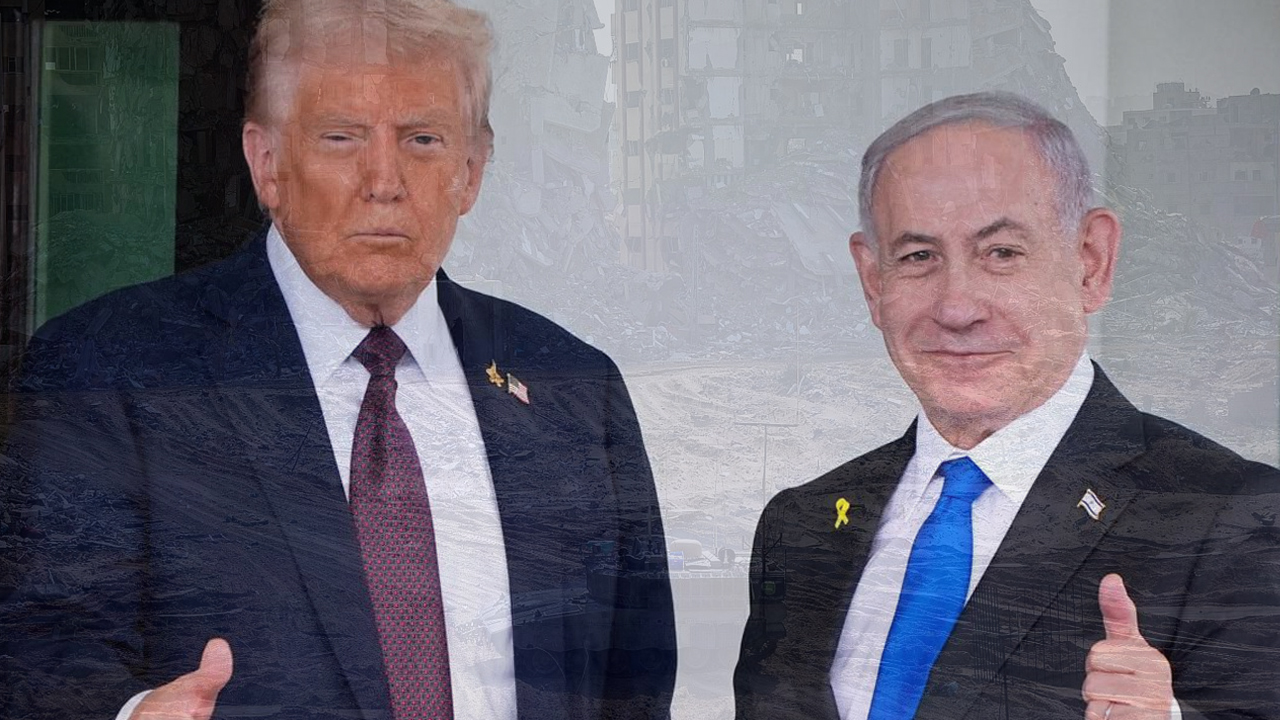
What Trump and Netanyahu have engineered is not just a cynical maneuver, but the continuation of a deeper structure of thought: the colonial idea that the empire knows best, that natives cannot govern themselves, that “peace” can only be conferred by those who hold power.
Arkadeep Goswami
Introduction: The Spectacle of Peace
Every age of empire has had its spectacles — grand performances designed to convince the world that domination is in fact benevolence. For the British in India, it was the durbar, with its parade of local princes affirming loyalty to the Crown. For the French in Algeria, it was the endless talk of “assimilation,” as if colonial violence could be softened by a thin coating of republican rhetoric. For the United States today, it is the language of “peace deals” — agreements brokered not to liberate, but to manage, and to render permanent a structure of domination.
The so-called Gaza “peace deal,” announced by Donald Trump in partnership with Benjamin Netanyahu, belongs firmly to this tradition. Far from offering peace, it offers an elaborate rebranding of war. Its central function is not to end violence, but to reframe it: to present Israel’s devastation of Gaza not as a crime, but as a regrettable prelude to magnanimous reconstruction; to position Trump not as a patron of genocide, but as a messianic figure, a self-styled peacemaker in a conflict he barely understands; and to cleanse Netanyahu of culpability for war crimes by presenting him as a reluctant but responsible statesman.
To see this deal as anything other than colonial theater is to misread both its purpose and its context. For over a century, Zionism has functioned as a settler-colonial movement — one that seeks not merely to dominate Palestinians but to displace and erase them. Every “peace plan” that has emerged under U.S. sponsorship has operated within this framework, asking Palestinians to renounce sovereignty in exchange for temporary relief. Trump’s Gaza deal, with its 20 carefully crafted points, is simply the most brazen expression of this logic.
The deal is accompanied by a new institutional invention: the Gaza International “Board of Peace,” which Trump himself has declared he will head. That such a body could be proposed — and that Trump, a businessman turned demagogue, could announce himself as its leader — exposes the depth of colonial arrogance at work. Palestine is not treated as a people with political agency, but as a venture, a market, a project to be overseen by the benevolent hand of the empire. The very language of “board” evokes not liberation but management: Gaza as a corporation in receivership, its population as assets to be administered, its future as a portfolio to be invested in.
In this spectacle, Palestinians are absent except as recipients of American benevolence. Their suffering — mass killings, forced starvation, the destruction of hospitals and universities, the expulsion of hundreds of thousands — is not acknowledged as the consequence of Israeli policy. Instead, it is framed as a regrettable tragedy that now provides the opportunity for U.S. leadership to shine. Like all colonial spectacles, the deal requires erasure: erasure of the past, erasure of culpability, erasure of Palestinian agency.
Yet to analyze it as mere cynicism would be insufficient. What Trump and Netanyahu have engineered is not just a cynical maneuver, but the continuation of a deeper structure of thought: the colonial idea that the empire knows best, that natives cannot govern themselves, that “peace” can only be conferred by those who hold power. It is this structure — more than the particulars of the 20 points — that we must confront. For unless we dismantle the colonial assumptions that undergird every “peace plan,” the cycle of dispossession will continue under the guise of diplomacy.
Trump’s Megalomania as Peacemaker
Donald Trump’s entry into the Palestinian question was never the result of studied knowledge, moral conviction, or historical awareness. It was, as with much else in his political career, an act of branding. Trump does not so much “solve” problems as rename them, plastering over histories with slogans and re-presenting old structures as if they were novel creations of his will. His approach to Gaza is no different.
In announcing the Gaza “peace deal,” Trump cast himself as a solitary statesman, a man of destiny who could accomplish what generations of politicians, diplomats, and negotiators could not. This is, of course, the familiar Trumpian refrain: “I alone can fix it.” Yet the hubris here is not merely personal. It reflects the imperial arrogance of the United States itself, an arrogance rooted in the conviction that history only begins when Washington decrees it so.
Previous American presidents, for all their own complicity, at least cloaked their interventions in the language of diplomacy. Carter presented Camp David as the fruit of painstaking mediation; Clinton presented Oslo as the dawn of mutual recognition; even George W. Bush framed his “road map” in technocratic terms. Trump dispensed with such subtleties. For him, the Gaza deal is not about negotiation at all. It is about performance — about appearing on the world stage as a dealmaker, about reducing the centuries-long Palestinian struggle for liberation to another episode in the Trumpian theater of self-aggrandizement.
It is telling that the institutional apparatus he proposes for Gaza is not a government, not an interim Palestinian authority, but a “Board of Peace” — language borrowed less from politics than from corporate management. Trump imagines himself not as a statesman among equals, but as a CEO overseeing a troubled subsidiary. Palestinians are not citizens with rights, but employees in need of discipline and restructuring. Gaza is not a homeland but a venture in need of profitability. Such is the logic of neoliberal colonialism: land is capital, people are human resources, and sovereignty is reduced to a management problem.
What makes Trump’s megalomania particularly insidious is that it erases the very history it claims to resolve. In his narrative, violence begins with Hamas, destruction with Palestinian resistance, instability with the refusal to accept Israeli dominance. The decades of dispossession, the systematic colonization of the West Bank, the ongoing blockade of Gaza, the deliberate destruction of its economy — all this is written out of the story. The Palestinians appear only as recalcitrant subjects, in need of discipline by the imperial father. And Trump, with his characteristic bravado, casts himself as that father, stepping in where others have failed, bestowing peace upon the ungrateful.
The megalomania is not simply rhetorical. It has concrete effects. By presenting the Gaza deal as a triumph of his personal will, Trump reframes Palestinian suffering as the stage upon which his greatness can be displayed. The tens of thousands killed in Gaza are transformed into the backdrop of his performance. The cities reduced to rubble, the children orphaned, the families starved — all become props in the theater of Trump’s self-mythology. The violence is not denied, but appropriated, re-narrated as the precondition for his magnanimous intervention.
This, too, is a colonial gesture with a long pedigree. Empires have always cast themselves as peacemakers, swooping in to resolve conflicts they themselves created. The British presented themselves as arbiters between Hindus and Muslims, even as they had exacerbated communal divisions for decades. The French claimed to pacify Algeria, even as they massacred its population. Trump’s Gaza deal belongs to this lineage. The colonizer destroys, then poses as the healer; creates instability, then insists on being the stabilizer; commits crimes, then rebrands them as the regrettable prelude to “peace.”
Trump’s megalomania, then, is not merely a matter of personality. It is the distillation of an imperial habit of thought, one that treats history as a canvas upon which the powerful can inscribe their will. What is erased in this process is the agency of the colonized. Palestinians become not historical actors but objects of American magnanimity. Their resistance is criminalized, their voices silenced, their future decided in Washington and Tel Aviv. And Trump, in his arrogance, declares this erasure to be peace.
Netanyahu’s Escape from Accountability
If Trump’s Gaza deal is above all an act of megalomania, for Benjamin Netanyahu it is an act of survival. Rarely in modern history has a statesman presided so brazenly over mass atrocities and yet been able to reposition himself, through the machinery of imperial diplomacy, as a partner for peace. That this transformation has been made possible is not evidence of Israeli statesmanship, but of the extraordinary reach of colonial absolution.
Netanyahu’s record in Gaza is not ambiguous. Entire neighborhoods leveled into rubble. Hospitals and universities targeted. Humanitarian corridors were bombed. Children starved to death by deliberate blockade. The language of international law is clear: these are not “tragic necessities” but war crimes, systematic violations of the Geneva Conventions, acts of collective punishment intended to make civilian life impossible. The International Criminal Court has amassed volumes of evidence; human rights organizations have catalogued atrocities in painstaking detail. And yet, with the stroke of a pen, the Gaza deal transforms this history of violence into the prelude to magnanimous diplomacy.
This is the colonial magic of the so-called peace process: the ability to erase culpability not by disproving it, but by subsuming it into a narrative of “conflict resolution.” Netanyahu is no longer the architect of a live-streamed Genocide; he is the reluctant statesman, the hardened realist willing to negotiate for the sake of stability. The enormity of the crime is buried beneath the solemnity of the handshake. One recalls Edward Said’s warning, written during the Oslo years: that the very language of peace could be turned into a mechanism of domination, that the colonizer could present himself as the arbiter of reconciliation, even as he entrenched his control.
For Netanyahu, the deal offers three layers of absolution
First, it provides legal cover. So long as Israel is engaged in a U.S.-brokered peace initiative, calls for war crimes tribunals are dismissed as “obstructions to peace.” International legal mechanisms are paralyzed by the claim that accountability must wait until diplomacy runs its course — a course designed never to end.
Second, it provides political cover. Within Israel, Netanyahu faces mounting domestic criticism: from families of hostages, from protest movements outraged by authoritarian overreach, from rivals who see opportunity in his vulnerability. The Gaza deal reframes him not as a criminal but as indispensable. However bloody his methods, the narrative goes, only he can deliver security through diplomacy. His violence becomes not a liability but a credential.
Third, it provides historical cover. By embedding Netanyahu within the grand story of American peacemaking, the deal positions him in the lineage of leaders who “made difficult choices for peace.” It transforms a man accused of genocide into a supposed partner in reconciliation. In the eyes of history — or at least in the history written by Washington — Netanyahu is not remembered for starving and maiming children, but for signing ‘peace’ agreements.
None of this is new. Colonial regimes have always sanitized their most ruthless administrators by reframing their violence as statesmanship. French generals who presided over massacres in Algeria became ministers of “reconciliation.” British officials who engineered famines in Bengal were later knighted for their service. Netanyahu belongs to this lineage. His atrocities are reframed not as crimes, but as the unfortunate prelude to magnanimity.
And yet the reality is unaltered. Netanyahu remains the same politician who has built his career on the systematic denial of Palestinian rights, the expansion of settlements, and the rhetoric of eternal war. His genius, if one can call it that, lies not in statecraft but in the ability to turn crimes into bargaining chips. Each atrocity becomes leverage; each round of devastation becomes a stage from which to negotiate. Violence, in this calculus, is not opposed to diplomacy but its very currency.
Trump’s deal, then, is not merely a gift to Netanyahu. It is an exoneration. It ensures that the man most responsible for the devastation of Gaza is remembered not as a war criminal, but as a peacemaker. It allows him to escape accountability by reentering the stage of history cleansed, as though the rubble of Gaza were merely the debris of an unfortunate but necessary past. In this erasure lies the true obscenity of the Gaza deal: it transforms genocide into negotiation, atrocity into diplomacy, crime into statesmanship.
U.S. Complicity and the Colonial Management of Gaza
To understand the Gaza “peace deal,” one cannot separate the actions of Israel from the enabler-in-chief: the United States. The U.S. is not merely a neutral broker; it is the central architect of the structural violence against the Palestinian people. From the moment of Israel’s founding in 1948, successive American administrations have provided diplomatic shielding, military aid, and economic support, ensuring that settler colonial expansion could proceed with impunity.
The Gaza deal exemplifies the continuity of this complicity. By positioning itself as the indispensable mediator, the U.S. masks its role in the very destruction it now promises to mitigate. Consider the scale: billions of dollars in weapons, advanced surveillance technology, and logistical support have flowed into Israel’s military apparatus. Airstrikes that demolish civilian infrastructure, artillery shelling that devastates homes and schools, and systematic enforcement of a blockade that produces famine and disease — all are enabled by U.S. resources and political cover. At the United Nations, American vetoes have repeatedly blocked resolutions condemning Israeli violations of international law. This is not support for “security”; it is support for domination.
Colonial theorists, from Frantz Fanon to Edward Said, have long emphasized that the empire does not merely act through its own violence; it acts through the systems and proxies it cultivates. The United States does not have to occupy Gaza directly; it maintains a colonial order through its ally, Israel. By supplying the instruments of destruction and then offering itself as peacemaker, the U.S. completes a cycle of control that mirrors historical colonial strategies. Consider parallels in other contexts: the British East India Company armed princely states to enforce colonial extraction, then sent officials to “mediate” local disputes; France armed Harkis in Algeria and then positioned itself as guarantor of “order” after massacres. The pattern is unmistakable.
Trump’s declaration that he will head the Gaza International “Board of Peace” extends this pattern into absurdity, making it explicit that American management is to be permanent and self-consciously performative. It is not Gaza’s government, nor the United Nations, nor Palestinian civil society, but Donald Trump, the U.S. president, who will ostensibly oversee the rebuilding and governance of Gaza. One must ask: does he conceive of Palestinians as political actors or as units in a portfolio? Does he see Gaza as a sovereign space or a corporate project? The very language betrays the answer. Palestinians are treated as human capital to be managed, their future delegated to a foreign overseer whose primary skill is self-promotion.
U.S. complicity is not limited to rhetoric or symbolic oversight. The deal’s structure institutionalizes American control over Gaza’s borders, economy, and governance. The plan specifies that international bodies, under U.S. supervision, will manage reconstruction funds, monitor security, and regulate the flow of goods and people. This creates a form of neocolonial governance: Palestinians are no longer citizens in control of their resources; they are clients, dependent on the will of a foreign power to exercise even the most basic functions of daily life. Sovereignty is effectively suspended, and “peace” becomes synonymous with compliance.
Moreover, U.S. complicity is normalized through language. The repeated refrain that the United States is the “honest broker” masks decades of structural violence. Words like “transition,” “stability,” and “security” operate rhetorically to reframe occupation as stewardship, blockade as policy, and apartheid as administration. In Said’s terms, this is Orientalism in practice: the colonizer defines the situation, constructs the narrative, and thereby erases the subjectivity and agency of the colonized. Palestinians are reduced to objects of American care, their political demands subordinated to Washington’s priorities, their liberation conditional upon American approval.
The moral inversion is profound. The U.S., which enabled Israel’s destruction of Gaza, now positions itself as the arbiter of reconstruction. The arsonist becomes the firefighter. The structural violence that produced ruins became the pretext for intervention. In this, we see the enduring logic of empire: domination and care are never mutually exclusive. Rather, care is exercised precisely to entrench domination. Trump’s Gaza deal, therefore, is not a new approach; it is a continuation of a century-long pattern in which the empire, armed and unaccountable, uses diplomacy to consolidate conquest.
Finally, this complicity is compounded by the erasure of accountability. By framing Israel as a partner for peace, the U.S. obscures the very crimes that it enabled. The blockade, the bombardments, the systemic targeting of civilian infrastructure — all are removed from legal or moral scrutiny. The United States becomes both shield and arbiter, a dual role that ensures impunity for the occupier and continued subjugation for the occupied. In short, the Gaza deal is a textbook example of colonial management masquerading as benevolent intervention, where sovereignty is suspended, agency is denied, and empire is consolidated under the guise of peacemaking.
What is the plan?
The 20-point Gaza “peace plan,” once presented as a technical framework for reconstruction and coexistence, has now been subsumed under Donald Trump’s personal claim that he will head the Gaza International “Board of Peace.” This development crystallizes the essential logic of the plan: Gaza is not a sovereign polity, Palestinians are not political actors, and peace is not a goal in itself but a stage for the exercise of colonial power under the guise of benevolence. The plan, once a collection of conditional measures, has become a comprehensive instrument of external control, designed to manage, surveil, and discipline a population rendered subordinate.
At the heart of the plan is a performative reconfiguration of agency. Palestinians, historically dispossessed through decades of military occupation, blockades, and settlement expansion, are now asked to comply with conditions enforced by a foreign overseer — not a neutral international institution, but a former U.S. president whose tenure was defined by self-promotion and transactional politics. The Gaza Board consolidates oversight of governance, security, reconstruction, and international aid under a single personality, transforming civil administration into a spectacle of performance. Gaza becomes a managed territory, its future determined by the whims of a global celebrity-politician rather than the collective will of its inhabitants.
The plan’s purported objectives — ceasefires, reconstruction, economic development, and political normalization — mask a deeper structural violence. Ceasefires are not negotiated settlements but tools of supervision, ensuring that Palestinians remain disarmed and dependent. Reconstruction funds, managed abroad, render the local economy subordinate to external priorities, echoing colonial strategies of economic dependency found in Algeria under French rule, South Africa under apartheid, and India under British finance boards. Political participation is conditional and circumscribed; resistance is criminalized, opposition movements delegitimized, and leadership is filtered through the lens of foreign oversight.
This managerial logic mirrors the classic patterns of settler-colonial control. Historically, empires have maintained domination not simply through overt violence but through structures that normalize dependence, defer sovereignty, and render indigenous populations passive. The Gaza plan reproduces this logic: borders are externally controlled, security is enforced by those who bear no accountability to local populations, and the ultimate authority rests in a distant overseer — in this case, Trump’s Board. The colonial lineage is unmistakable: as with British Residents in princely India, French governors in Algeria, or trustees of League of Nations mandates, the colonizer retains ultimate decision-making power while projecting an image of neutrality, fairness, and benevolence.
The plan also demonstrates the spectacularisation of colonial peace. Trump’s personal branding of the Board turns governance into theater: Palestinian suffering becomes the backdrop for a narrative of magnanimity, violence is reimagined as prelude to reconciliation, and structural oppression is reframed as diplomacy. The lives of those in Gaza — their homes destroyed, their families orphaned, their futures constrained — are subordinated to the optics of an international personality asserting control. The “peace plan” is, in effect, a corporate-style management exercise, with Gaza treated as a project to be optimized rather than a society to be liberated.
Moreover, the plan perpetuates legal and moral impunity. Israel’s actions in Gaza — blockades, airstrikes on civilian infrastructure, and targeting of essential services — remain unaddressed. The United States, already complicit through decades of military aid and political shielding, now centralizes its role in enforcing the plan. The Gaza Board ensures that responsibility for the violence is obscured: the occupier is repositioned as partner in peace, the colonized are rendered compliant subjects, and the legal frameworks of accountability are subordinated to the authority of a self-appointed overseer.
Perhaps most insidious is the treatment of Palestinian political and national aspirations. Issues central to sovereignty — the right of return, the status of Jerusalem, territorial boundaries — are indefinitely deferred, leaving Gaza in a state of permanent provisionality. Normalization with Arab states is framed as progress, yet it is purchased at the expense of Palestinian rights. The plan enforces dependence, manages dissent, and reframes colonization as a benign, technically solvable problem, obscuring the structural reality: that Gaza is occupied, Israel remains unaccountable, and the United States exercises imperial control over the process under the guise of peace.
In short, the Gaza “peace plan” is not a plan for liberation, reconciliation, or justice. It is a comprehensive instrument of colonial management. By centralizing authority under Trump’s Board, it converts political governance into a spectacle, Palestinian agency into compliance, and structural violence into a performance of benevolence. From an anti-colonial perspective, it is a masterclass in the reproduction of settler-colonial logic: dispossession is maintained, resistance is criminalized, and sovereignty is indefinitely suspended, all under the optics of an externally imposed “peace.” The Gaza Board, far from representing progress, cements the hierarchies of power that have defined the region for decades.
Peace Without Justice Is Colonialism
The Gaza “peace plan” under Trump’s self-styled Board of Peace illustrates a fundamental principle of colonial governance: peace imposed without justice is not peace at all, but a continuation of domination under the guise of order. From an anti-colonial perspective, reconciliation cannot exist without the acknowledgment of historical and ongoing crimes, the restoration of rights, and the accountability of perpetrators. Yet the Trump-Gaza framework systematically erases these conditions.
Justice is conspicuously absent from the plan. War crimes — the targeting of civilians, the blockade-induced famine, the destruction of infrastructure — are neither addressed nor condemned. Responsibility for decades of dispossession is deferred, reframed as a technical problem to be managed rather than a moral and legal question demanding accountability. Palestinians are asked to accept provisional governance, economic dependency, and the criminalization of resistance in exchange for a so-called peace that never guarantees sovereignty. This is the logic of colonialism: domination legitimized through the veneer of administration, compliance enforced under the guise of diplomacy.
The very spectacle of Trump heading the Gaza Board crystallizes this dynamic. Palestinians are no longer political actors; they are managed subjects, their agency subordinated to the performance of benevolence. The arsonist becomes the firefighter, the oppressor becomes mediator, and the colonized are expected to participate in their own subjugation. The plan reframes structural violence — occupation, blockade, settlement expansion — as technical problems that can be solved by external oversight, rather than violations requiring redress and restitution. In this, the plan mirrors colonial practices across history, from French Algeria to British India: control is maintained by delegitimizing indigenous leadership, centralizing authority in the colonizer, and presenting domination as governance.
If peace is to have any moral or political meaning, it must be inseparable from justice.
________________
Arkadeep is a political activist and writer based in Kolkata.