
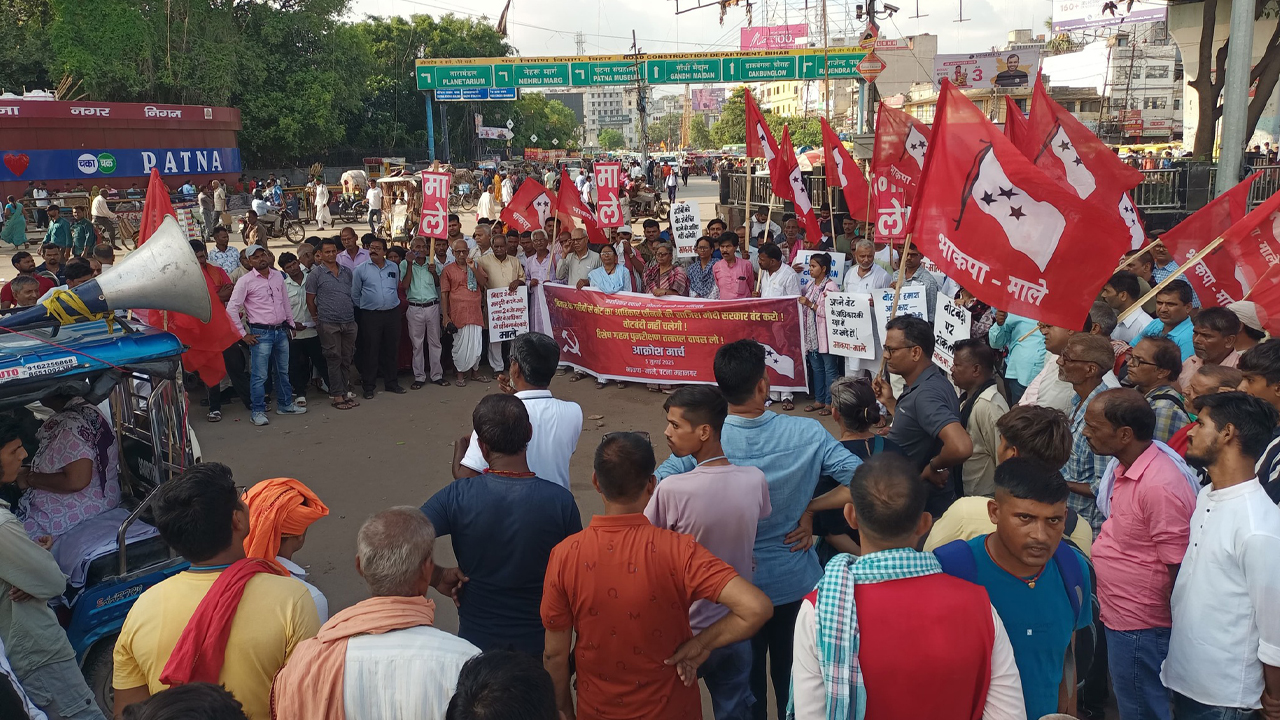
The Special Intensive Revision (SIR) of electoral rolls in Bihar by the Election Commission of India (ECI) will lead to a substantial section of the state’s population, particularly the Muslims and the marginalized poor, lose their right to vote and labelled as ‘doubtful’ citizens.
By Anish Ankur
Assembly Elections in Bihar are expected to be held in the month of Oct-Nov. But a big political storm has erupted in the state since the last two weeks over the Special Intensive Revision (SIR) of electoral rolls launched by the Election Commission of India (ECI) in Bihar. The controversy has engulfed not only the political parties in Bihar but every section of Bihari society is seriously concerned about whether they will be able to vote in the upcoming assembly election or not?
A number of petitions challenging the ECI’s decision has been filed in the Supreme Court by Rashtriya Janata Dal (RJD) MP Manoj Jha, the Association for Democratic Reforms (ADR), activist Yogendra Yadav, Trinamool MP Mahua Moitra, and former Bihar MLA Mujahid Alam for urgent hearing. In its PIL, ADR has said the SIR needs to be set aside, as insisting on people to prove their citizenship and that of their parents within short notice and without relying upon easily available identity documents such as Aadhaar card will potentially disenfranchise nearly 3 crore voters.
RJD MP in his petition said the decision, which has been taken by the ECI without any consultation with the political parties, is “being used to justify aggressive and opaque revisions of electoral rolls that disproportionately target Muslim, Dalit and poor migrant communities, as such, they are not random patterns but are engineered exclusions.”
A Supreme Court bench of Justices Sudhanshu Dhulia and Joymalya Bagchi, on Monday, agreed to list the matter and hear the petitions on July 10 (Thursday).
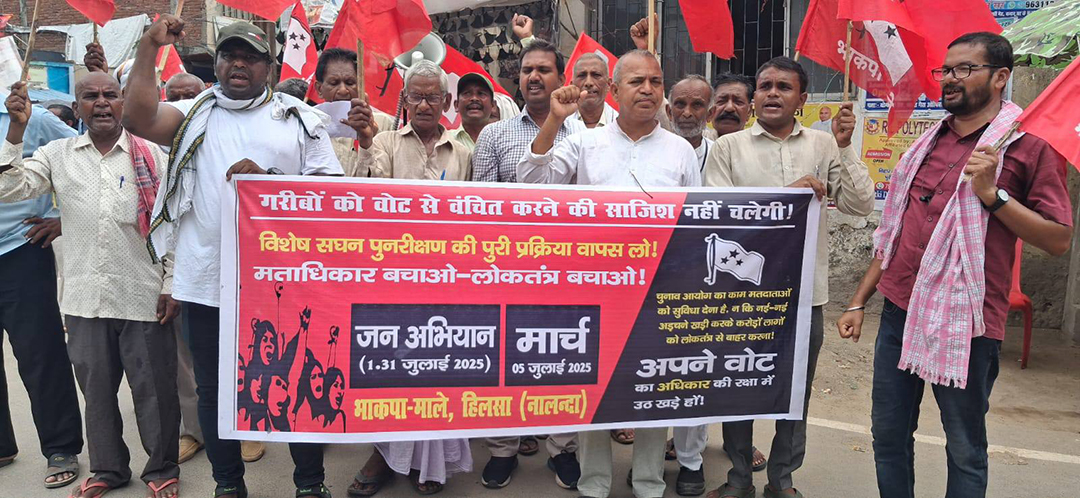
Meanwhile, the Opposition parties, including the Rashtriya Janata Dal (RJD), Congress and the Left constituents, in Bihar have given a state-wide protest call against the ongoing drive on 9th July coinciding with the all India strike called by trade unions. The parties have termed the entire exercise as a ‘Votebandi’ comparing it with the disastrous ‘Notebandi’ by the BJP-led Union government. They allege the stringent documentation requirements and the July 25 deadline risk disenfranchising millions, particularly marginalised communities like Muslims, Dalits and migrant workers.
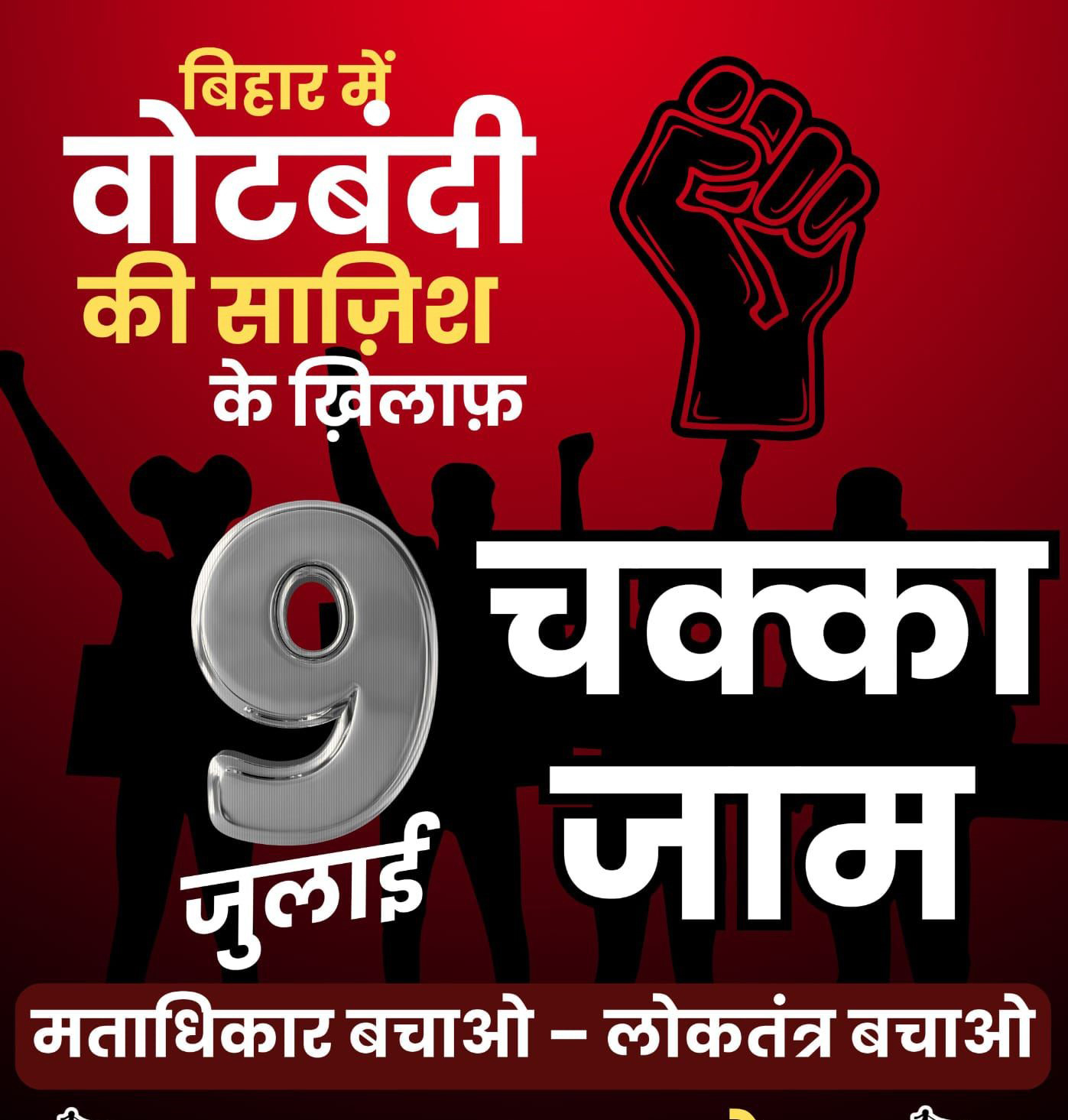
The controversial announcement of Special Intensive Revision (SIR)
There are millions of people in Bihar who may have voted in one or all of the last five general elections and five assembly elections, but now have to present documentary evidence within weeks to validate their right to vote. And, if they are unable to, they could not only be unable to vote but will stand as persons of doubtful citizenship in the eyes of the law. This is the consequence of a sudden and arbitrary decision of the Election Commission of India (ECI) on June 24 to completely revamp the electoral rolls in Bihar, ordering what it defines as a Special Intensive Revision.
Bihar had already completed a special summary revision of the electoral roll by January 2025. It was found by state election officials to be robust, going by the standard metrics they use to review changes over time. They were updating the roll even into June. But most unexpectedly, within days, in a shock to everyone, the ECI scrapped the entire updated 2025 electoral roll, deeming it faulty.
The question naturally arise, what evidence was gathered by the ECI within a few days of June to negate the just completed Special Summary Revision and updation of the electoral roll of Bihar and order the wholesale revision of Bihar’s Electoral Roll, with 7.90 crore voters requiring to prove their identity, citizenship, and place of residence, and that too within only one month?
An investigative report published by Reporters’ Collective found no statewide large anomalies were recorded by the ECI to trigger such a wholesale revision of the electoral roll from scratch. The report found that contrary to ECI’s claims of large scale anomalies, even in the month of June 2025, days before the decision, ECI and its officials in Bihar had accepted the existing electoral roll finalised for the Parliamentary elections in 2024 to be valid. It was using this electoral roll to undertake the regular updation, deletion and addition of voters to it.
The report quoted an ex- Bihar Election Commission office as saying, “For all practical purposes, entire Bihar’s electoral roll is being prepared de novo at such short notice. The ECI has the power to do what is needed to maintain a clean electoral roll. But in this case, I believe, the discretionary power at its disposal has been used to wrongful ends. This exercise could end up taking away the rights of people to vote and unfairly raise doubts over their citizenship.”
Why are opposition parties so apprehensive about the Special Intensive Revision (SIR)?
The sudden U-turn by the ECI and the unexpected development just four months ahead of the assembly election have made most of the political parties, particularly the INDIA block parties, smell a deep conspiracy and an ulterior agenda behind the move. Opposition parties are alleging that at the behest of the BJP government, the ECI is trying to implement NRC from the back door and the sinister design behind this exercise is to disenfranchise a sizeable section of voters particularly those who don’t vote for BJP.
Questions are being asked that while 70 percent of the areas in the state are flooded, how is it possible to complete this gigantic exercise in just one month? When the parliamentary election was held just one year ago with the old voter list, what was the urgency of making a new voter list? Why is citizenship criteria being inducted into the voter list? When, according to ECI’s own estimates, around 21 percent of the voters in Bihar migrate to other states in search of work particularly in the month of June-July-August, then how successful will this exercise be?
The fear of the opposition parties exacerbated when a delegation of political parties first met the Chief Election Commissioner (CEC) Gyanesh Kumar at Delhi. The CEC refused to stay the exercise and said that twenty percent of the electorates in Bihar are likely to be removed from the voters list. Rajesh Ram, Bihar state president of Indian National Congress sarcastically said, “seeing the attitude of Election Commission officials, it seemed as if they had decided to snatch away the voting rights of 20 percent of Bihar’s voters.” CPI (ML-Liberation), general secretary, Dipankar Bhattacharya, lambasting the ECI, alleged that the exercise does seem like an attempt to create a customised electoral roll based on a citizenship test — something unprecedented. In an interview, he said, “the burden has shifted from the state to the citizens to prove their eligibility. This goes beyond the Election Commission’s role under the Representation of the People Act. It stray into the domain of the Citizenship Act. This isn’t just about Bihar; it could set a precedent for the whole country.”
The ECI’s Press Release
The ECI issued the SIR notification on June 24 and on the next day started the drive. The ECI press release says that “In the first phase, from 25th June to 3rd July (2025) Enumeration Forms (EFs) are being printed and distributed to approximately 7.90 crore electors in Bihar. Electoral Registration Officers (EROs) are making available partially pre-filled forms, based on existing records as on 23rd June 2025, through the 77,895 Booth Level Officers (BLOs) pressed into action for the exercise and further 20,603 BLOs are being appointed. These BLOs are delivering the EFs door –to- door to all the 7.90 crore electors whose names are on the Electoral Roll as on 26 June 2025. In addition, the forms are available for download on the ECI portal and the BLAs appointed by political parties may also submit up to 50 certified forms per day.”
The press release further said “In the second phase, the Enumeration Forms will be filled and are to be submitted before 25th July 2025. Electors whose names exist in the Electoral Roll as on 1st January 2003 are only required to submit the Enumeration Form along with an extract of the roll, without the need for submitting any other documents. Those not listed in the 2003 Roll will need to submit a document (from the indicative list of 11 documents) for their date of birth/place of birth as per their birthdate as follows:
- Individuals born before 1st July 1987, to provide a document for themselves
- Those born between 1st July 1987 and 2nd December 2004, to include documents for themselves and one parent
- Individuals born after 2nd December 2004, to submit documents for themselves and both parents. Electors, whose parents’ names were on the Electoral Roll as of 01.01.2003, need not submit any additional documents relating to their parents.
Indicative (not exhaustive) list of documents to be submitted in support of the declaration (separate self-attested documents to be submitted for Self, Father and Mother, if mentioned above, except where extract of the Electoral Roll of Bihar with qualifying date 01.01.2003 is used, which will be considered as a sufficient document in itself):
- Any Identity card/Pension Payment Order issued to regular employee/pensioner of any Central Govt./State Govt./PSU.
- Any Identity Card/Certificate/Document issued in India by Government/local authorities/Banks/Post Office/LIC/PSUs prior to 01.07.1987.
- Birth Certificate issued by the competent authority.
- Passport
- Matriculation/Educational certificate issued by recognized Boards/universities
- Permanent Residence certificate issued by competent State authority
- Forest Right Certificate
- OBC/SC/ST or any caste certificate issued by the competent authority
- National Register of Citizens (wherever it exists)
- Family Register, prepared by State/Local authorities.
- Any land/house allotment certificate by Government
It should be kept in mind that Bihar, being an underdeveloped and poor state, the majority of the populace don’t have the above mentioned 11 documents. Let us take a look at the data that is publicly available for the demographic of 18-40 years in Bihar.
As birth certificates are among eleven key documents listed for inclusion in the electoral roll of Bihar, the Civil Registration System (CRS) reports of the past two decades show that Bihar has been lagging far behind the rest of the country in registering births. As per the National Family Health Survey-3, only 2.8% of Bihar’s population born between 2001 and 2005 possess a birth certificate. Only 2.4% of Bihar’s population possess a passport. According to National Family Health Survey-2 and National Family Health Survey-5, around 45-50% of 18-40-year-olds are matriculate. Only 5% are in government jobs, and 16 % possess caste certificates.
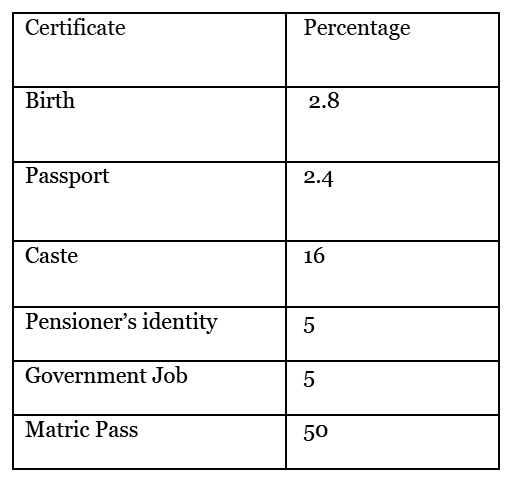
Most people without a matriculation certificate are unlikely to apply for a passport, a government job, or a caste certificate. By the ECI’s new rule, the matriculation certificate has effectively become the main eligibility proof for voters aged between 18 to 40. This shifts us from an universal adult franchise to a system that favours only matriculates. As a result, around 2.4 crore-2.6 crore people who had to leave school, mainly due to poverty, may now be left out of the voters’ list.
It is interesting to note that in the list of these eleven documents ‘Aadhar card’, ‘Job card’, ‘Ration card’ are not applicable for citizenship eligibility.
Further, in its press note of June 28, the ECI stated that the electorate count in Bihar is 7.9 crore. As per the ECI, as “4.96 crore of the 7.9 crore already have their names in the last intensive revision of electoral rolls” in 2003, so just 2.94 crore individuals will need to submit their eligibility documents.
But according to Rahul Shastri of Bharat Jodo Abhiyan “This is clearly an oversight. The electoral roll of 2003 for Bihar did have around 4.96 crore individuals. By our calculations from the reports of the Sample Registration System, around 1.1 crore of them are dead. The ECI has taken their names off the rolls. Hence, of the 4.96 crore electors in the 2003 list, if we remove those who are dead and those who have migrated from Bihar permanently, around 3.16 crore from the 2003 list remain in the present count of Bihar’s electorate. Only these 3.16 crore people do not need to submit any eligibility documents. The rest of the 4.74 crore individuals (7.9 crore minus 3.16 crore) need to submit their documents.”
Why not ‘Aadhaar’ and ‘Ration’ cards?
Around 4.74 crore people in Bihar will have to pass the ECI eligibility test, and as we have seen, many don’t have the required documents. Aadhaar, ration cards, even the Commission’s own voter ID cards aren’t considered valid.
Social activist Jaipraksh, associated with Citizens Forum, Patna said “ if the ECI allows for OBC/SC/ST certificates, why is Aadhaar not allowed if the proof of identity document for a caste certificate is Aadhaar? It should not be that Aadhaar’s major flaw is that it is more available; around 9/10th of the Bihar population possess it. Does the ECI believe that it has issued voter cards to non-citizens? Also, why not allow ration cards?”
The Public Interest Litigation (PIL) filed by ADR also raised this point “ The order dated June 24 issued by ECI has shifted the onus of being on the voter’s list from state to citizens. It has also excluded identification documents such as Adhar or ration cards. Which further makes marginalized communities and the poor more vulnerable to exclusion from voting, thereby undermining the constitutional right to universal adult suffrage and equality.”
Chaos and Confusion on the ground
As the SIR exercise is going on in the state in the full swing a lot of confusion and chaos prevail at ground level. CPI (ML-Liberation) have sent a letter to CEC in this regard by raising important concerns and asking for some clarification about Bihar SIR Exercise. The letter said “The BLA forms that have been issued in Bihar are being provided in English, making it difficult for people to even fill the forms. The ECI claimed this to be a serious and well-planned exercise however the unavailability of forms in Hindi raises questions about the claims of the commission.”
The letter further asked “ There are reports coming from various districts including Bhojpur, Gopalganj and others, Bihar where people are being told to submit enumeration forms without any enabling documents. The lack of uniformity is further causing chaos among the people leading to great anxiety.”
The prevailing mood in Bihar is captured by leader of opposition Tejasvi Yadav as he said “Prime Minister Narendra Modi has directed the commission to cancel the entire voter list of Bihar and prepare a new voter list with documentary evidence of the period before 1987 in just 25 days. In the panic of suffering an electoral defeat, these people are now conspiring to snatch the right to vote from Bihar and Biharis.”
The ECI decision is limiting the right to vote to only those with certain papers — effectively shrinking democracy.
The bogey of Bangladeshi “infiltrators”
There is another political angle, of Bangladeshis, that should be kept in mind. As political analyst and activist of Kisan Sabha Gopal Sharma said “Infiltration of Bangladeshis particularly in the Seemanchal districts of Kishanganj, Purnea, Araria etc. bordering West Bengal, has been the pet agenda of BJP for a long time. The bogey of Muslim infiltrators from Bangladesh is being raised time and again during several elections, and this time the issue is being used to customise the entire voters list to benefit the ruling party. Now it’s an open secret that the Election commission shamelessly acts on the orders of BJP top brass. Bihar is the only Hindi belt state where BJP has not been able to come to power till date on its own, therefore, they are desperate to go to any extent.”
Gaznafar Nawab, associated with Tanzeem-e-Insaf, said the hidden agenda of the BJP is, “They will particularly target the Muslims where they are in majority in the Seemanchal districts. Along with Muslims, backwards and other socially oppressed, who hardly vote for the NDA led BJP, will also be their prime target. We are already witnessing that with every BLO, three to four BJP workers accompany them. What are they doing? To help the BLOs identify who are known anti-BJP voters. Unless something is done urgently to stop this, the Bihar election is going to be a model where only those who support the ruling party will be allowed to vote.”
In the next one year, elections will be held in several states, including the most sensitive and politically important state of West Bengal. The ECI is facing a severe credibility crisis, particularly after the Maharashtra assembly election where a lot of glaring inconsistencies in electoral rolls are becoming public. How it tackles this controversy will be important in the coming days to restore people’s faith in its neutrality?
Will the Supreme Court step in and halt or at least substantially modify the ill-planned and arbitrary SIR? Or will it too hide behind the excuse of the ECI being an autonomous constitutional body and refrain from interfering in its functioning? A substantial section of Bihar’s population, particularly the Muslims and the marginalized poor stand to lose their right to vote. And if the current rulers are successful in Bihar, West Bengal will be next in line and subsequently other states too.
________________
Anis Ankur is a freelance journalist based in Patna.