
Gargi’s book is a historiographical recovery of the junctures when women fought and moved another inch towards occupying half the sky.
By Vertika Mani
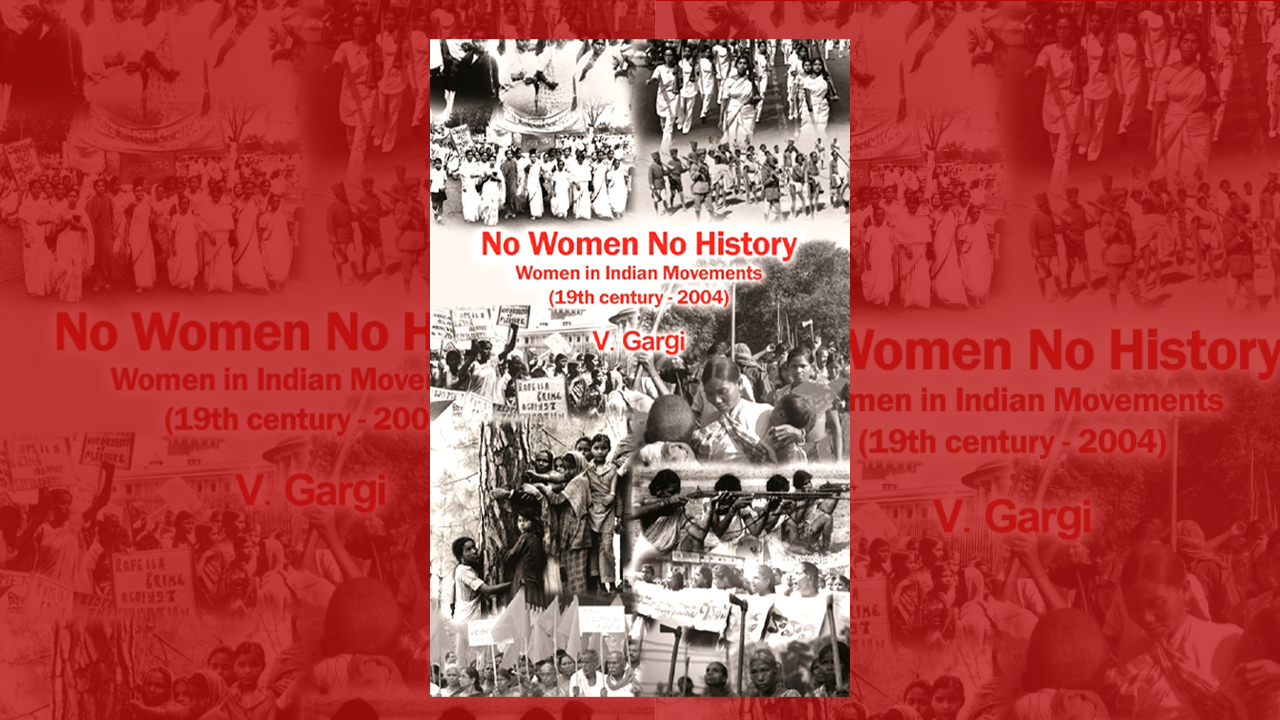
The first intriguing thing to notice about V. Gargi’s No Women, No History is the cover page of the book itself. Published by Virasam Books, the cover depicts women holding guns, marching with axes and also hugging trees. The image with its wide range of contrast yet a commonality of women as marchers and fighters interacts with its readers to convey the larger argument that this book seeks to make. The book was initially written as a collection of notes by V. Gargi, a revolutionary activist who dedicated this book “To all the women who fought against overwhelming odds, made great sacrifices to the extent of even laying down their lives to make this place better for all of us…”
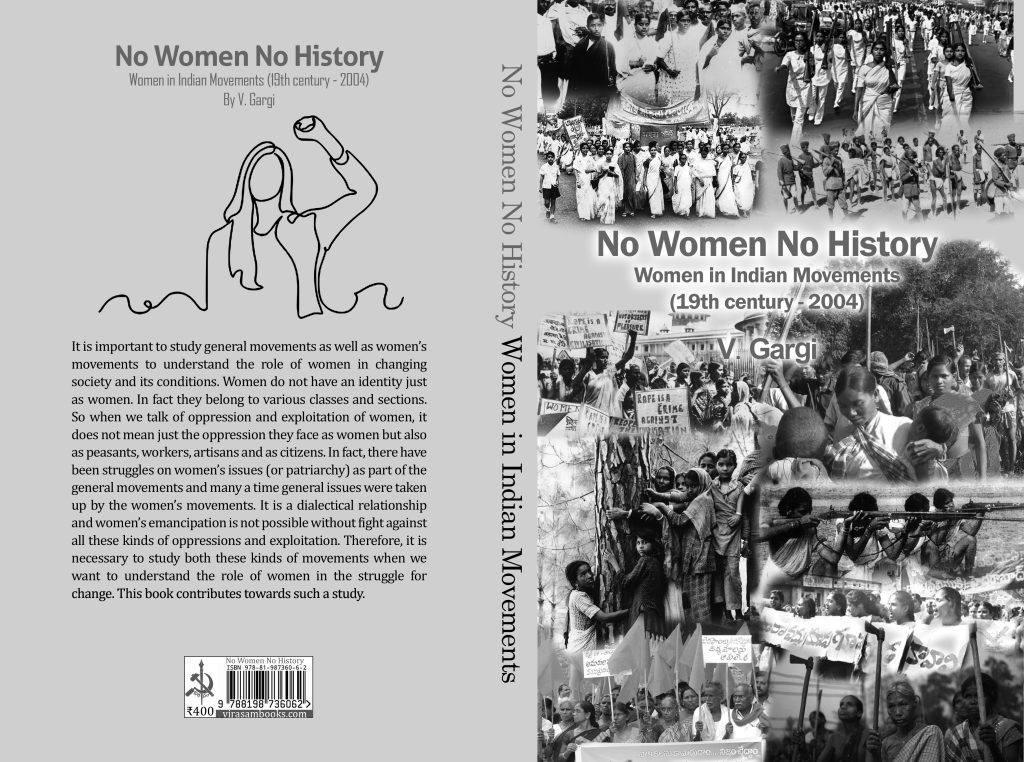
The first edition of No Women No History: Women in Indian Movements (19th century – 2004) was published last year in August, at a pit stop, when the mainstream feminist discourse in India and abroad mostly associate women with power of intellect and pen, which are all quite a matter of privilege and can therefore be politically disabling at times. In that context, reading No women No History is refreshing as it takes us down the road of history of women’s struggle, almost on a rampage to discover the truth of the fighting spirit that Indian women have always stood for.
An extraordinary range of political histories
The book covers an extraordinary range of political histories and geographical contexts from 19th Century to the year 2004 covering histories of peasant and Adivasi uprisings, anti-caste struggles, labour movements, revolutionary politics, autonomous women’s organisations, ecological movements, struggles in the North-East, cultural organisations and contemporary campaigns. Its approach is broad and, for the most part, non-sectarian. Rather than treating “women’s issues” as a separate political category, Gargi locates women within the wider structures of social and political struggle, as peasants, workers, artisans, Dalits, Adivasis and members of minority communities.
This method of writing makes gendered oppression therefore appear not as an isolated structure but is seen in relationship with caste, class, feudal relations, economic exploitation and political power. This is among this book’s most important methodological contributions which allow the history of women’s liberation to be read as history of movements rather than that of organisations. A history of movements in which women fought over land, wages, labour, caste hierarchy, food, displacement, forests, political representation and state power. The breadth of the historical canvas is therefore significant to explore beyond conventional boundaries of women’s history.
Beginning with women’s participation in tribal and peasant rebellions, Gargi moves between the histories of Ranis and Begums and those of ordinary women who participated in the political ferment of the nineteenth and early twentieth centuries. The juxtaposition prevents women’s history from becoming a gallery of exceptional female figures. It takes a dive into the political labour of ordinary women, particularly peasant, working-class, Dalit, Adivasi and other marginalised women, who have so frequently remained outside the central narrative of political history.
One of the salient feature of discussions around movements is the notable references made to the women pioneers, for instance, of Self-Respect Movement which is mostly associated with Periyar but more often than not misses to speak of Maniyammai, the woman who went on to lead the Kazhagam after Periyar’s death. Similarly, Gargi talks about Ambedkarite and Dalit movements including women’s role at length. Other such references include the distinctive forms of women’s participation in movements like Jail Bharo Satyagraha of 1960–65. The histories of women in the freedom struggle, women revolutionaries and communists are similarly placed alongside organisational histories that are less familiar in mainstream accounts.
Similarly, the book discusses collectives which are again, less talked about. For instance, The Mahila Atmaraksha Samitis (MARS), which emerged as an important form of women’s mobilisation before Partition. The further chapters trace the experiences of women during and after Partition, discovering a phase in history where despite political upheavals, women liberation struggles were negotiated and resisted by its women participants through gendered forms of collective action. In the facet of organised women militia, the book digs into the history during the Tebhaga struggle by the formation of The Nari Bahini which was one of the early attempts to organise women into a militia. It provides the readers another striking example of women’s participation, this time, in agrarian politics. The history then extends into working-class movements under colonial rule and to women workers’ struggles across regions, from Tamil Nadu to Chhattisgarh.
The geographical movement across these histories is itself an important intervention. Women’s political history does not belong exclusively to metropolitan centres or to organisations explicitly identified with feminism. It is in factories, villages, forests, agricultural fields, working-class neighbourhoods and Adivasi regions. The movement across Tamil Nadu, Bengal, Telangana, Chhattisgarh, the North-East and Uttarakhand reveals a political geography in which gender cannot be separated from land, labour, caste, community, ecology and livelihood.
Participation is not the same as power
The chapters on Naxalbari and subsequent revolutionary movements extend this book into one of the most contested terrains of Indian political history. Gargi here brings into view women whose participation has often been overshadowed by the more familiar histories of male revolutionary leadership. Women appear as organisers, couriers, political workers and, in some instances, combatants. Their presence challenges the assumption that revolutionary politics was primarily a male domain.
But the histories gathered in the book also open a more difficult theoretical question, making us question if women’s participation in a radical movement necessarily transforms the gendered distribution of power within that movement?
The distinction between participation and political authority is crucial here. Women may be indispensable to a movement while remaining underrepresented in its strategic decision-making. They may organise, mobilise, carry messages, sustain underground networks and endure repression, while political authority remains concentrated elsewhere. The history of revolutionary movements thus becomes relevant not only for demonstrating women’s courage and agency but also for asking how organisational structures themselves reproduce or challenge patriarchy.
This question runs through the broader history that Gargi reconstructs. The participation of women in the Tebhaga movement, for instance, demonstrates both the possibilities and contradictions of radical mobilisation. Women could become central to agrarian struggles while encountering assumptions about physical weakness, domestic responsibility and the supposed disruption that women’s political participation could cause within families and communities.
The implication is not that progressive politics is necessarily patriarchal, but that progressive political ideology by itself cannot be assumed to dissolve patriarchy. Political movements have their own institutional cultures, hierarchies and divisions of labour. The question of women’s emancipation therefore has to include the question of who exercises political authority within emancipatory movements.
Women’s participation in Gandhian politics
Women’s participation in Gandhian politics undeniably expanded the terrain of political action available to them. Yet the terms of that participation can be a subject matter for discussion.
The spinning wheel and khadi, for example, could bring political activity into the domestic sphere and make participation possible for women who could not enter public political spaces on equal terms. But the very possibility of political participation from within the household also raises a question: when does the inclusion of women in political life alter the gendered division of labour, and when does it simply assign political meaning to labour women were already expected to perform?
Gargi’s historical approach is valuable precisely because it allows such contradictions to remain visible.
The 60s and 70s
The book’s account of the political transformations of the late 1960s and 1970s marks another important shift. Gargi follows women’s participation in the Nav Nirman movement, resistance to the Emergency and the emergence of autonomous women’s movements around rape, dowry and sex determination.
This period altered the vocabulary through which women articulated their experiences. Violence within the family, sexual violence, dowry and reproductive control increasingly came to be understood not as private or secondary concerns but as political questions involving law, institutions, social power and the state.
The emergence of autonomous women’s organisations was therefore not simply a new organisational development. It represented a redefinition of the political system itself. The question of women’s emancipation could no longer be deferred to a supposedly more fundamental transformation that would occur elsewhere, in the economy, the state or class relations. Women were asserting that the structures governing intimate life, sexuality, reproduction and family relations were themselves sites of political power.
At the same time, these movements remained connected to wider struggles over class, caste, communalism, labour and state power. The history that Gargi reconstructs consequently resists an easy opposition between “class politics” and “women’s politics”. It instead reveals the continuing negotiations between different political priorities and different understandings of emancipation.
Revolutionary movements and the question of emancipation
The book’s sustained engagement with communist and Maoist movements is particularly important in this context. Gargi documents the extraordinary participation of women in revolutionary struggles, including their organisational, political and, in some cases, armed roles. These histories are significant because they challenge the persistent representation of women in revolutionary politics as merely supporters of male revolutionaries.
Yet the historical material also raises questions that extend beyond the question of representation. What constitutes emancipation for women within a revolutionary movement? How are autonomous demands negotiated against larger political objectives? Does participation in a movement committed to transforming class relations necessarily transform gender relations within the movement itself?
These are not questions that can be answered by measuring the number of women who participated. They concern the relationship between political agency and political authority, between formal commitments and everyday organisational practices, and between women’s autonomous demands and the priorities of broader movements.
The significance of Gargi’s historical recovery is that it makes these questions possible which in itself is rare.
Going beyond the familiar contours of women’s movements
The later chapters further expand the geographical and conceptual field. The discussion of the Shah Bano case brings questions of gender, law, religion and citizenship into the history of women’s political mobilisation. The chapters on women’s movements in the North-East and ecological struggles in Uttarakhand demonstrate how questions of land, environment, community and livelihood become gendered political questions.
The history of women affected by the Bhopal gas disaster provides another important example in this regard wherein women survivors formed the Bhopal Gas Peedit Mahila Udyog Sangathan for medical assistance, relief and access to information. Such instances are rarely discussed in books around women’s struggle. In most narrations around the tragedy, women were victims of an industrial disaster, but in reality, they were not confined to the political identity of victims. They became organisers and claimants, transforming the experience of disaster into a sustained struggle for relief and rights.
It makes it difficult to speak of a singular trajectory of Indian women’s movements. The political experiences of a factory worker, an Adivasi woman resisting displacement, a Dalit woman confronting caste hierarchy, an urban feminist confronting sexual violence and a woman participating in an underground revolutionary organisation cannot simply be collapsed into one category. But the book tries to encompass it all and instead of understanding them in isolation, makes an attempt to connect each other’s struggle with the other through commonalities in terms of structures of power.
Post economic liberalisation
The historical trajectory assembled by Gargi also invites attention to the transformations in women’s political life after economic liberalisation. The terrain of struggle has changed substantially with the expansion of informal and contractual labour, migration, the growth of the service economy, the fragmentation of workplaces, the increasing significance of unpaid and care work, and new forms of commodification and social insecurity.
These transformations do not make the earlier struggles irrelevant. Rather, they complicate the organisational forms through which women can exercise collective political agency. The factory floor, the agrarian field and the neighbourhood remain important sites of struggle, but they now coexist with fragmented workplaces, informal employment, domestic labour, platform-mediated work and increasingly individualised forms of economic insecurity.
Viewed from this longer historical perspective, the question of women’s emancipation remains inseparable from the question of organisation. The forms through which women collectively acquire political voice have always changed with the economic and political structures around them. Gargi’s history provides the longer genealogy necessary to understand that changing terrain.
Women at the Centre of History
Though the book suffers from scholarly limitation because of lack of footnoting, making it difficult for its reader to trace or verify the historical claims. This is perhaps understandable given its notes-like, underground origins, but the good part is that even that does not diminish the force of its intervention asking us to reconsider the very architecture of political history that we have been taught.
Gargi through her work demonstrates that to write women into history is to alter the categories through which political history is understood. The women Gargi brings into view carried messages, organised workers, confronted landlords, challenged caste hierarchies, sustained underground networks, fought for land and wages, built women’s organisations, resisted state repression and, in some struggles, took up arms. In the light of such an incredibly wide range of women’s contribution to history, the central achievement of No Women, No History lies in its challenge to the writing of history itself. In conclusion, as a reader I would like to thank Gargi for this attempt to challenge the grammar of history to restore us all from its making.
Vertika Mani is a feminist writer and legal practitioner at the Supreme Court of India, currently serving as the Organisation Secretary of the People’s Union for Civil Liberties (PUCL).