
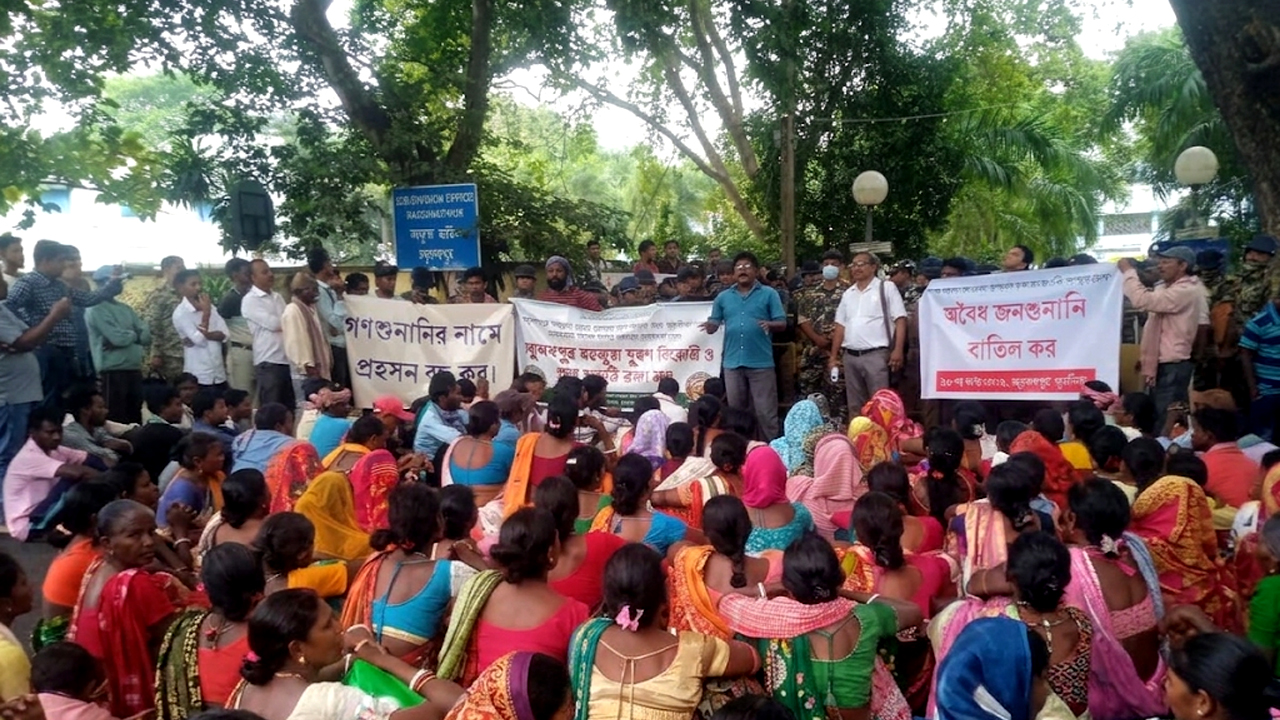
Accusing the administration of staging a secretive, stage-managed public hearing for Shakambhari Ispat and Power Ltd in Purulia, villagers blocked a state highway, raising concerns over air pollution, water scarcity, and loss of farmland and the health of communities already living amid polluting industries.
Raghunathpur, October 28, 2026: Residents of several villages in Raghunathpur sub-division of West Bengal’s Purulia district blocked the Raghunathpur–Santaldihi State Highway on Wednesday in protest against the public hearing for a proposed Rs 10,000-crore steel and power complex of Shakambhari Ispat and Power Ltd. The villagers accuse the administration of keeping them out of the hearing, held at the office of the Sub-Divisional Officer (SDO) of Raghunathpur, by deploying a large police force, barricading the approach and locking the main gate, while a handful of people allegedly handpicked by the company were allowed inside, so that what they describe as a farcical hearing could be staged to manufacture public consent for the project.
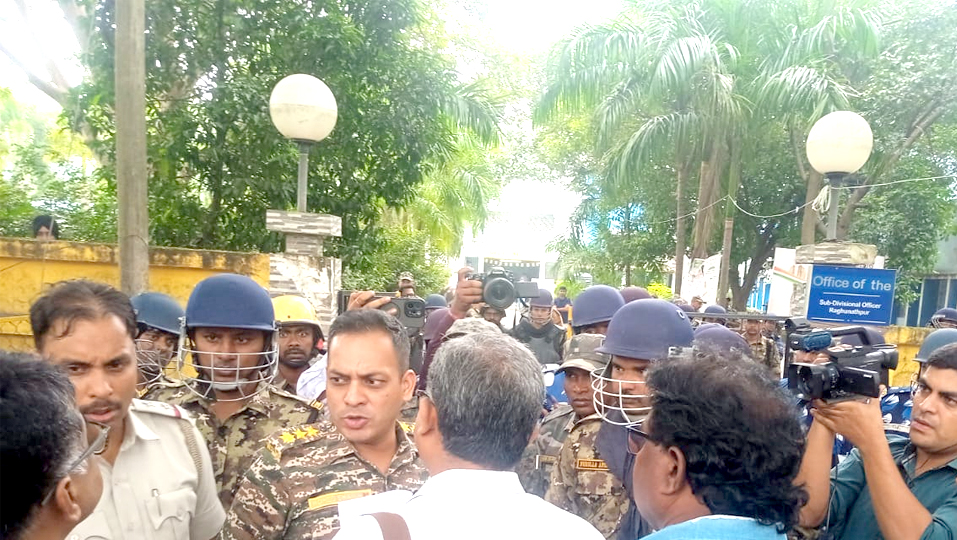
A large police force, barricaded the approach and locked the main gate of the SDO office
The hearing, scheduled for noon, has revived long-standing fears in a region that is already heavily industrialised, where communities have for years been living with the consequences of industrial pollution and now worry about further threats to their water, their agricultural land and their health.
In an emergency press release issued the same day, the Forum for Opposition to Pollution and Protection of Life and Nature said that villagers from Durmut, Hurra, Nildi, Manipur, Kewabathan, Joradi, Jharukhamar and Layekdi had reached the SDO’s office before 11 am to exercise what they described as their constitutional right to take part in a hearing that would decide the future of their lives and livelihoods, only to find police barricades and a locked gate standing between them and the proceedings.
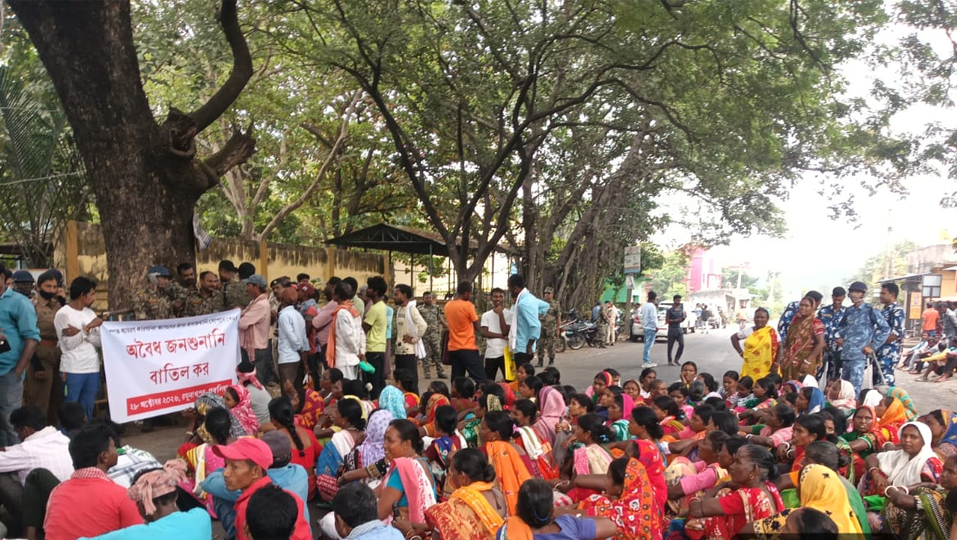
Villagers sit on road in protest against the sham public hearing
A hearing without notice or translation
The forum further alleged that the hearing had been organised without adequate public notice. According to its statement, there were no announcements by loudspeaker, no traditional forms of public announcement and no posters in the affected villages during the mandatory 30-day notice period. It also alleged that residents of the predominantly Adivasi villages were not given the relevant project documents in Bengali, or in Santali in the Ol Chiki script, leaving those most affected without any meaningful means of understanding what was being proposed.
These allegations go to the heart of the process. Under the Environment Impact Assessment Notification, 2006, the public hearing is the principal stage at which people likely to be affected by a project can place their concerns on record before environmental clearance is considered; the notification requires at least 30 days’ notice and the availability of a summary of the draft EIA report in the local language. A hearing from which the affected public is physically excluded, the forum argues, cannot be regarded as a hearing at all, and it has demanded that the proceedings be cancelled and the project’s environmental impact assessment (EIA) report be rejected.
Industrial expansion beside homes, schools and forests
The proposed complex is to comprise a steel plant with a stated capacity of 2.73 million tonnes, a ferro-alloy unit of 0.54 million tonnes per annum, a cement plant of 2 million tonnes per annum and a 484-megawatt power plant.
According to the press release, the facility would sit immediately adjacent to Hurra village, with Kewabathan reportedly 140 metres from the project boundary, Nildi 380 metres, Durmut 400 metres and Manipur 420 metres. Hurra Primary School is said to lie roughly 150–160 metres from the site and Nildi High School about 410–430 metres away, while seven protected forest areas are located between 200 metres and 1.7 kilometres from the proposed project.
The forum warned that the plant would add to the cumulative pollution burden of an area already ringed by major polluting industries. It identified five large red-category industrial units within a 10-kilometre radius of Durmut mouza:
Shakambhari Ispat and Power, Nakshit Iron and Steel, Odisha Alloy Steel/Odisha Metallics, the Damodar Valley Corporation’s Raghunathpur Thermal Power Station and Shyam Steel. Nakshit Iron and Steel, whose own project is also at the proposal stage, is reportedly located only 600 metres from the Shakambhari site.
The forum alleged that the Shakambhari EIA report concealed information about other proposed industrial facilities in the area and made no attempt to assess their combined impact, raising the question of whether the cumulative effects of several large industrial units on air quality, water resources, forests and public health in Raghunathpur have been assessed at all.
Water-intensive industry in a drought-prone district
Among the villagers’ foremost concerns is the effect of further industrial expansion on water resources that are already under severe strain. Purulia is a drought-prone district, and many of its villages depend on wells, ponds and tube wells for their daily needs, particularly through the summer months. The forum claims that the five major industrial facilities in the area could together draw between 251,324 and 361,724 kilolitres of water a day from the Panchet Dam and the Damodar River.
The statement also alleges that around 15 ponds within the proposed project boundary, together with the Uttala River that flows through the area, face destruction or severe damage. These water bodies, it says, recharge the groundwater on which villages depend and sustain wildlife including wolves, jackals, pythons and peafowl.
The forum has raised further concerns about agricultural land within the project area, claiming that 39.78 hectares (approximately 98.31 acres) of privately cultivated land have not yet been acquired from the farmers concerned, and that the EIA report contains contradictory information about the status of this land.
Residents raise alarm over silicosis and other illnesses
The press release alleges that residents and workers in the Raghunathpur industrial belt are already suffering from silicosis, chronic obstructive pulmonary disease (COPD) and asthma as a result of industrial dust and emissions, and that many of those affected are struggling without adequate medical care. Citing earlier reporting by BBC News on silicosis in the region, the forum has demanded a comprehensive health audit before any further industrial expansion is permitted, arguing that approving another large complex without first assessing the existing burden of disease would expose already vulnerable communities to still greater risk.
These health concerns form part of a wider dispute over the environmental and social costs of industrialisation in the region, where communities fear that the promise of investment and employment will be paid for with their clean air, safe water, agricultural livelihoods and health.
Serious flaws alleged in the environmental assessment
The forum has also questioned the manner in which the EIA report was prepared and disclosed. According to the press release, the Union government issued the project’s Terms of Reference (ToR) on August 16, 2026, and a 550-page draft EIA report had been prepared by August 22, within roughly six days. The forum alleges that 14 of the 20 specific conditions stipulated in the ToR were withheld from the public before the hearing.
It further claims that the report wrongly identifies the project’s location as Raigarh district, which lies in Chhattisgarh, suggesting that material from another project’s report had simply been copied into the document. These allegations have not been independently verified; if substantiated, however, the reported omissions and errors would raise serious questions about the integrity of the environmental assessment and about the information made available to local residents before the hearing was held.
Residents demand cancellation of the hearing
The forum said that, having been prevented from entering the SDO’s office, it sent a written legal objection by email to the district administration and to the Union Ministry of Environment, Forest and Climate Change at noon on October 28. Its demands include the immediate cancellation of the public hearing, the rejection of the allegedly flawed EIA report, and a high-level inquiry into the conduct of the officials and organisations involved in the process.
The statement also recalled that residents had allegedly been kept out of the same SDO office during the public hearing for Nakshit Iron and Steel on August 4, 2026, and described the two incidents as evidence of a recurring pattern in which police force is used to silence communities opposed to polluting industrial projects.
The events in Raghunathpur raise a fundamental question about industrial projects in ecologically sensitive areas: whether a public hearing can serve any purpose at all when the people most directly affected allege that they have been denied entry to the proceedings and that their objections have been suppressed. For the residents of these villages, the demand is not merely that a fresh hearing be convened, but that they should be given a process in which they can participate meaningfully and be heard on the future of their land, water, forests and health.