

West Bengal’s latest crime figures are being wielded as political ammunition. But the gap between crimes committed and crimes recorded raises a deeper question: whose suffering does the state choose to count?
by Tinku Khanna
For the past few days, an image has been circulating on WhatsApp and Facebook under a large headline announcing an “explosion of crime” in West Bengal since the BJP government took office in May. Beneath it is a table drawn from a Right to Information (RTI) reply attributed to the State Crime Records Bureau (SCRB): between 1 May and 24 September 2026, a span of 147 days, the state recorded 600 murders, 13,114 attempts to murder, 2,454 rapes and 32,341 cases of assault causing grievous hurt. An English-language news report carrying the same figures, in a more measured tone, is circulating alongside it. We added up every monthly figure in both, and the arithmetic is sound.
The RTI application was filed by Saket Gokhale, a Trinamool Congress leader and former Rajya Sabha MP, and the party published the figures on 7 October under the banner “2,400+ rape cases in Bengal in just 5 months under BJP”. The BJP’s response, through its spokesperson Debjit Sarkar, was that many of these cases concern offences committed under the previous government: delayed complaints, including those of rape and post-poll violence, were registered only after the change of government. The date on which each offence occurred, Sarkar argued, should therefore be checked before anyone speaks of a crime trend. Read together, the two parties have made the central argument of this essay without meaning to. One is brandishing a ledger that its own police kept thin for fifteen years; the other is admitting that the ledger is now swollen with crimes that were never written down.
The problem lies elsewhere. An “explosion” is a claim about change, a statement that something is now far larger than it used to be, and neither document says what it used to be. Once these figures are placed beside the state’s own earlier record, the picture that emerges is far less simple than the headline, and far more troubling in a different way.
The argument of this essay is an uncomfortable one: in West Bengal, crime statistics have long been less a measure of crime than a measure of power. Whether a complaint becomes a case is decided at the police station, and in this state the police have always moved to the rhythm of whoever governs. Under the Trinamool Congress, the ledger was suspiciously thin; in five months under the new government it has suddenly swollen. Both deserve the same suspicion, and at the centre of that suspicion should stand the women whose names never make it into any government’s ledger at all.
II
Anyone who works with crime statistics knows why murder is treated as the most reliable figure in the set: a body is hard to hide, a post-mortem is mandatory, and a police station has very little room to refuse a case. If violence in a state has genuinely surged, murders should rise with it. Murder is, in that sense, the control variable against which every other category can be read.
By the SCRB’s own figures, the state has averaged about four murders a day under the new government, roughly 124 a month or 1,490 a year. In 2023, the NCRB recorded 1,686 murders in West Bengal, about 140 a month. Murder has not exploded; it has fallen by roughly 12 per cent.
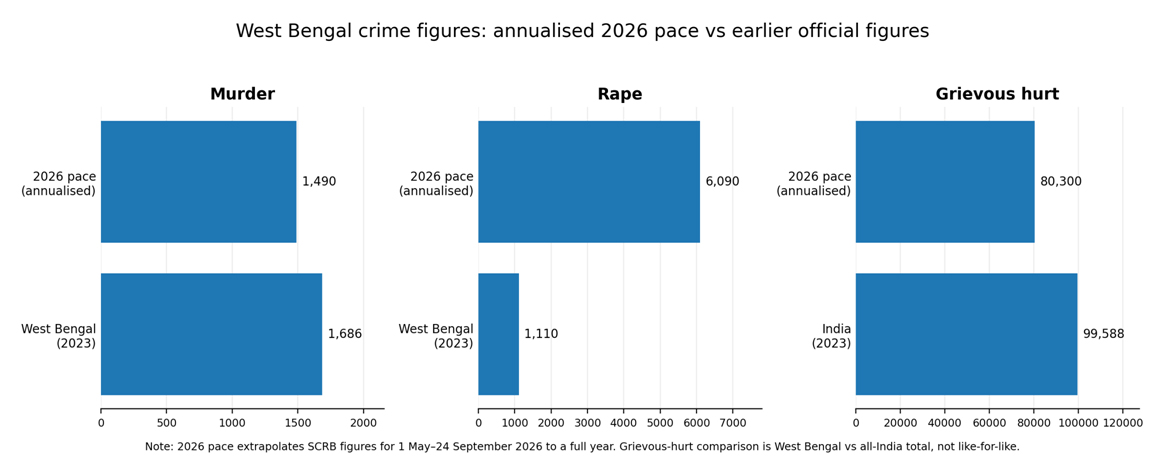
Figure 1. Annualised pace of reported cases in West Bengal in 2026 compared with earlier official figures.
Note: The 2026 figures are annualised estimates based on the SCRB totals for 1 May–24 September 2026. The grievous-hurt comparison is between West Bengal’s annualised pace and the all-India total for 2023; it is not a like-for-like comparison.
Now look at the other two rows. The NCRB recorded 1,110 rapes in West Bengal in all of 2023; the SCRB records 2,454 in fewer than five months. The grievous-hurt figure is stranger still. At the current pace, the state would register around 80,000 such cases a year, against 99,588 for the whole of India in 2023. A single state does not, in the space of a season, begin to account for four-fifths of the country’s serious assaults while its murder rate holds steady. That is not the signature of rising violence. It is the signature of a change in what is being counted, or in what the police are now willing to write down.
Which of these it is, we cannot say, because the SCRB has not told us. The NCRB follows a “principal offence” rule, counting only the gravest charge when an FIR carries several, and it records sexual offences against children separately under the POCSO Act. Has the SCRB counted every section invoked in every FIR? Has it folded POCSO cases into the rape figure? Or are police stations genuinely registering more complaints than before? Until these questions are answered, one cannot honestly call this an explosion, and one cannot honestly call it business as usual either. A government that, five months into its term, cannot or will not explain what its own crime ledger is measuring has already given us a political fact worth recording.
III
A crime committed and a crime recorded are not the same thing, and between the two stands the duty officer at the police station. Whether a woman’s complaint becomes an FIR, or whether she is sent home and told to settle the matter within the family, determines next year’s statistics. The economist Maitreesh Ghatak, comparing NCRB data with the National Family Health Survey, has shown that sexual crimes in West Bengal are recorded at much lower levels than in other states, and that the gap has widened over time. Much of the ‘safe Bengal’ of the Trinamool years, in other words, was manufactured at the police-station door.
The incentives are not hard to read. A government in office wants a thin ledger because low numbers are presented as proof of good governance. A new government may want the opposite, because a swollen ledger appears to prove how much its predecessor was hiding, and in this case the BJP has said almost exactly that. In both cases the figures rise and fall with the needs of whoever rules, not with the safety of women.
The month-by-month pattern sharpens this suspicion. Rape cases ran at about 13 a day in June, jumped past 25 a day in July, and fell back to around 15 in August. July was the month in which the rape and murder of an eleven-year-old girl in Baruipur convulsed the state. That police stations take more complaints in a month of public fury, and slip back into old habits once the cameras move on, is a pattern familiar to anyone who has worked on these cases. It means that whether one woman’s complaint is written down depends heavily on whether another woman’s body is on the television screen that month. September’s figures cover only 24 days and so look smaller, but on a daily basis they run higher than August’s; anyone who reads this data as evidence that “crime is coming down” should be reminded of that arithmetic.
One more pattern deserves attention. Attempts to murder and cases of grievous hurt were at their highest in May and June, immediately after the change of government, before settling at a lower level. Whether in 2011 or in 2021, a transfer of power in Bengal has meant a season of territorial violence in neighbourhood after neighbourhood, and that violence enters the police ledger as ordinary assault or attempted murder, not as political violence. Whether the same happened this year can only be established with district-level data, and the decision not to publish it is itself a political choice.
IV
R.G. Kar, Kasba and Durgapur: these names were carried through the 2026 election campaign as proof that the Trinamool government could not keep women safe. The BJP’s promise was simple: the daughters of Bengal would be protected under its rule. But the word ‘protection’ carries a particular way of seeing women. In this view, women are not citizens with rights but daughters of the household, bearers of family honour, to be guarded by fathers, brothers and, finally, the state. In this guardian’s role, the state is less interested in women’s freedom of movement or in the slow work of getting a survivor through a trial than in demonstrating its own strength through exemplary punishment.
Baruipur showed what that looks like in practice. One of the men arrested for the rape and murder of the eleven-year-old was shot dead in police custody during a “reconstruction of the crime scene”, and the government presented that custodial killing as justice delivered. At the end of August, after a fourteen-year-old Santal girl in Belpahari was attacked, protesters were already demanding not a trial but an encounter. This is the real sleight of hand in encounter politics. A trial means investigation, evidence and cross-examination, the process through which a survivor’s account is established as the truth in law. An encounter erases that process and replaces it with something fast, visible and cheap. A single bullet accomplishes in a moment what it would take years to build through fast-track courts, functioning forensic laboratories and protected witnesses.
The cost of that substitution shows up in the conviction figures. Data for 2023 place West Bengal’s conviction rate for crimes against women at just 3.7 per cent, among the lowest in the country: fewer than four convictions for every hundred cases. In five months, the new government has not once said how many charge-sheets have been filed, how many new courts have been set up or how many witnesses have been given protection. A government that collects applause for a single gunshot while staying silent on what has happened to 786 cases filed in a single month is not offering women safety. It is staging a performance of it.
V
The SCRB’s reply contains months and totals, and nothing else, but it would be unfair to blame the bureau alone for what is missing. India has no system for recording crime by the caste or class of the survivor. The one official register that did record caste was the prison register, and in October 2024 the Supreme Court, in Sukanya Shantha v. Union of India, ordered its caste column deleted, because prison manuals had used caste to segregate prisoners and assign them labour. The only window the crime data opens onto caste is the count of cases registered under the SC/ST (Prevention of Atrocities) Act, and what that window shows in West Bengal is revealing in itself.
Scheduled Castes make up nearly a quarter of West Bengal’s population, yet for more than a decade the state has registered barely a hundred cases a year of crimes and atrocities against them: 104 in 2022, when the national figure was over 57,000. Over the same years, the state’s police have booked around a thousand cases a year against foreigners, 1,021 in 2023, the highest of any state, the overwhelming majority under the Foreigners Act and the Registration of Foreigners Act. A police force that books ten times as many “foreigners” as it registers atrocities against Dalits is telling us what it is built to see: not who is harmed, but who does not belong.
The trafficked girl has fallen out of the ledger even more completely. In 2016 West Bengal recorded 3,579 trafficking cases, 44 per cent of the national total. By 2021, the cases reported by its anti-human trafficking units had fallen to just 61. No one who works in the source districts of the Sundarbans or Murshidabad believes that trafficking fell by 98 per cent in five years; what fell was the willingness to record it. The SCRB’s RTI reply, tellingly, contains no category for trafficking at all. Anti-trafficking workers have long documented how Bangladeshi women and girls rescued from brothels are booked as illegal entrants under the Foreigners Act instead of being treated as victims, so that a trafficking survivor enters the ledger, if she enters it at all, as an offender. Under a government whose politics in Bengal is built around the figure of the “infiltrator”, there is every reason to fear that this confusion will harden into practice.
What the state does not count, it does not have to answer for; what is absent from the ledger, in the language of government, did not happen. This is not a technique the BJP is unfamiliar with. The NCRB collected data on deaths by mob lynching, killings ordered by khap panchayats and murders for religious reasons for 2017, and then left all of it out of that year’s Crime in India report; a Home Ministry official later told PTI that the data was “vague or unreliable”, and the bureau withheld data in 25 categories on the same grounds, among them hate crimes, offences under cow-protection laws, rape during communal riots, and attacks on journalists and RTI activists. The quietest way to make a form of violence politically invisible is to leave no column for it in the register.
The heaviest price for that invisibility is paid by the girl who lives at the margins of society. The Adivasi teenager in Jhargram whose home is twenty kilometres from the nearest police station; the Dalit girl whose accused is the son of the village’s most powerful family; the trafficked girl who comes back, if she comes back, to find herself recorded as a foreigner: for none of them is reaching an FIR the same thing as it is for a middle-class young woman in Kolkata. A data system that has no way of seeing caste or class, and that has all but stopped seeing trafficking, will never reveal that difference. And a difference that cannot be seen is a difference no one is obliged to close. These girls are absent from the ‘explosion’ headline, and they will be absent from the government’s reply to it. For both sides, they are a fraction dissolved inside a total.
Our demand, then, is not an argument over numbers but a citizen’s right to them. There are four demands, and none of them is difficult for a government that actually wants to know:
- The SCRB must state publicly which legal sections were counted under each category, whether POCSO cases are included in the rape figure, and what the figures were for the same months in 2025.
- Alongside these four categories, the SCRB must release monthly, district-wise figures for cases under the SC/ST (Prevention of Atrocities) Act, for trafficking under sections 143 and 144 of the Bharatiya Nyaya Sanhita and the Immoral Traffic (Prevention) Act, and for bookings under the foreigners’ laws, stating how many of those booked were women and children rescued from trafficking.
- For every registered rape case, the number of charge-sheets filed, trials begun and convictions secured must be published every three months.
- The presentation of custodial killings as justice must stop. The Baruipur killing must be investigated through a judicial inquiry.
This government came to power by counting the names of dead women. It must now give an account of justice for living ones, and that account will not be measured in FIRs, nor in encounters, but by a single question: how many women received justice?
References
- “Explosion of Crime in West Bengal under New BJP Government.” Image circulated on social media, citing an RTI reply from the West Bengal State Crime Records Bureau, October 2026.
- Kunal Chatterjee, “Bengal Records 2,454 Rape Cases, 600 Murders in Five Months under BJP Rule,” National Herald, 7 October 2026. https://www.nationalheraldindia.com/politics/bengal-2454-rape-cases-600-murders-five-months-bjp
- Rajib Chowdhuri, “2,454 Rapes, 600 Murders Reported After BJP-Rule in WB; Mamata TMC Slams CM, BJP Says Old Cases,” Deccan Chronicle, 8 October 2026. https://www.deccanchronicle.com/nation/2454-rapes-600-murders-reported-after-bjp-rule-in-wb-mamata-tmc-slams-cm-bjp-says-old-cases-1994008
- Press Trust of India, “Bengal Registers over 34,500 Cases of Crimes against Women in 2023: NCRB Data,” The Week, 30 September 2025. https://www.theweek.in/wire-updates/national/2025/09/30/cal24-wb-ncrb-women.html
- National Crime Records Bureau, “Violent Crimes: Year and Crime Head-wise Number of Violent Crimes Committed in India” (data set), Dataful. https://dataful.in/datasets/22496/
- “West Bengal Has Second-Lowest Conviction Rate in Country for Cases of Crimes Against Women,” The Wire, 16 October 2025. https://thewire.in/government/west-bengal-has-second-lowest-conviction-rate-in-country-for-cases-of-crimes-against-women
- Maitreesh Ghatak, “Crime Stats Miss Plight of West Bengal,” Hindustan Times, 2024. https://personal.lse.ac.uk/GHATAK/HT_column_Sex_Crime_WB_2024.pdf
- Supreme Court of India, Sukanya Shantha v. Union of India, 2024 INSC 753, order dated 3 October 2024. https://api.sci.gov.in/supremecourt/2023/51059/51059_2023_1_1502_56228_Order_03-Oct-2024.pdf
- Ministry of Home Affairs, Lok Sabha Unstarred Question No. 2625, “Atrocities against SCs/STs,” answered 19 December 2023. https://eparlib.nic.in/bitstream/123456789/2972977/1/AU2625.pdf
- Khan Global Studies, “NCRB Report: Crime in India 2023,” Current Affairs. https://currentaffairs.khanglobalstudies.com/ncrb-reportcrime-in-india-2023/
- “India Registers 21.2 Per Cent Increase in Crimes Committed by Foreigners in 2023,” ETV Bharat, October 2025. https://www.etvbharat.com/en/!bharat/india-registers-21-dot-2-per-cent-increase-in-crimes-committed-by-foreigners-in-2023-enn25100805208
- “Trafficking Survivors Fight Social Stigma and Legal Battles in West Bengal,” The Wire, 18 August 2018. https://thewire.in/women/sex-trafficking-west-bengal-justice-stigma
- Rajya Sabha Unstarred Question No. 862, “Human Trafficking in the Country,” answered 14 December 2022. https://rsdebate.nic.in/bitstream/123456789/733968/1/PQ_258_14122022_U862_p245_p250.pdf
- “Despite Collecting It, NCRB Hasn’t Published 2017 Data on Lynchings, Religious Murders,” The Wire, October 2019. https://thewire.in/government/despite-collecting-it-ncrb-hasnt-published-2017-data-on-lynchings-religious-murders
- “MHA Says Lynching Deaths Excluded from NCRB Report as Data Was ‘Unreliable’,” The News Minute, 23 October 2019. https://www.thenewsminute.com/article/mha-says-lynching-deaths-excluded-ncrb-report-data-was-unreliable-111042
- Chaitanya Mallapur, “NCRB’s Reclassification of Old Offences Problematic: Expert,” The Quint (via IndiaSpend), 24 October 2019. https://www.thequint.com/news/india/ncrbs-reclassification-of-old-offences-problematic-expert