
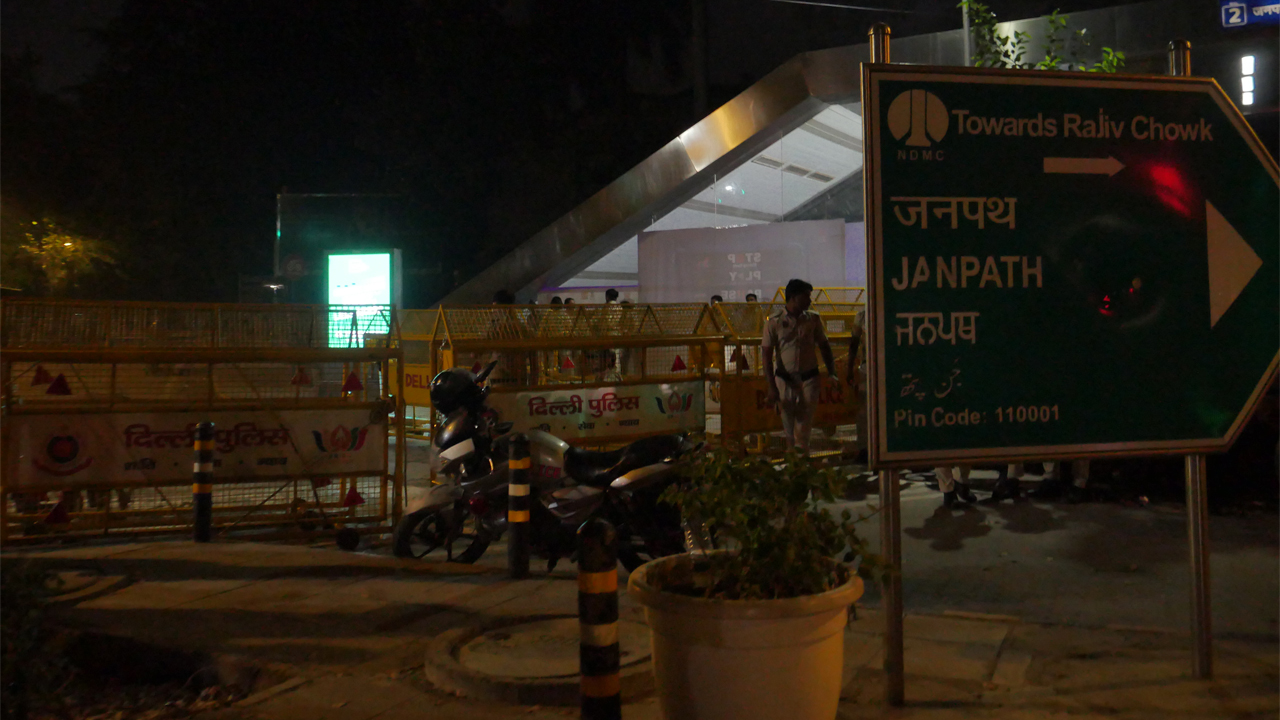
The administrative streets of central New Delhi have now become a terrifying labyrinth of surveillance and armed lockdown – except for the VIP residents who live there, and the exotic nightly businesses that entertain them. Mouli Sharma report on New Delhi on the eve of October 10.
10 October 2026, New Delhi: At the stroke of the midnight hour on Saturday in the administrative district of India’s capital, a quiet terror overtook the once – illusorily – safe expanse.
Preparations for the coming morning’s protest call, for people to take the streets all over the capital, not just the “designated” protest site of Jantar Mantar that has now become a designated “detention” site with an indefinite application of the controversial Section 163 (which empowers district and other magistrates to issue ‘special prohibitory orders’ and temporarily suspend constitutional freedoms in a given region during ’emergencies’) that has since expanded to the India Gate region, the Kashmere Gate region, and then through 54 other localities over ten days of continued protests, began early in the morning a day prior.
First, the office of the Joint Commissioner of Police (Transport Range) at Jai Singh Road issued an unprecedented order for the indefinite suspension of Metro rail entry and exit ways (as well as a reduction of train frequencies) in an unprecedented 57 stations, due to ostensible (and unspecified) suspicions of “mob movement”.
“In view of the proposed protests at Jantar Mantar and other locations in New Delhi District in 10.10.2026 and the likelihood of unruly mob movement towards sensitive locations, frequency of Metro trains passing through the following Metro stations may be reduced and their entry/exit gates may be closed from 9:00 PM on 09.10.2026, continuing on 10.10.2026 till the situation normalises,” said the notice issued to the Managing Director of the Delhi Metro Rail Corporation (DMRC), Vikas Kumar on Friday.
A bench comprising Chief Justice of India Surya Kant, Justice Joymlayla Bagchi and Justice V Mohana was hearing the petitions challenging the curbs imposed in Delhi, and observed on the same day that the total shutdown of the services would affect the rights of citizens who are entitled to avail them. But these services nevertheless remained closed from 9PM onwards, at least within the New Delhi region.
Next was a network blackout. Internet services were suspended in a 4km radius extending from the Jantar Mantar protest site an hour after the transport lockdown. A “top secret” circular from the office of the Deputy Commissioner of Police Special Cell, Manishi Chandra, instructing private service providers including Airtel, VI, Jio, along with MTNL Delhi to indefinitely suspend internet services in the region began circulation during the late evening of the 9th, and the over 50 kilometre square expanse was consequently turned into a complete blackbox.
***
Pushing 10 PM outside the barricading of the site nearest to the Kerala Bhawan, while the networks were still on, the police were bashful. The speakers hanging from trees announced that any violations of “the prohibitions under the order” issued under Section 163 of the BNSS would be punishable by law, but when asked what these prohibitions are, or if this order could be produced such that public could indeed heed its prohibitions, officers present at the scene stood clueless.
Come dawn, Vikas Meena, Harnit Singh Sudan and Bharat Bhushan pulled a few reporters to the side, reassuring them that no press would be detained or obstructed during the protests, provided that press themselves did not obstruct the detentions of common folk.
“We request that you stay far away and do your job,” Meena said. “If we are detaining someone, don’t try to stop us or come close to us or film what is happening. We have no problem with the press, but recently, journalists have started intervening in our processes and asking questions while we conduct our operations, which makes it difficult for us to distinguish them as press.”
When pushed on the precise details and prohibitions listed in the magisterial order, though, Meena repeats a familiar refrain: “Where is the order? It must be somewhere. You’ll have to ask the New Delhi DCP. I’m not from the district, so I don’t know.”
Ask at the station, though, over a hundred journalists have, but DCP Sachin Sharma has refused to respond in plain terms, and even plainer actions. After a protest and strike staged by journalists outside the Parliament Street police station for the registry of at least five FIRs against police officers for alleged molestation, including against ACP Vivek Bhagat by News Diggy journalist Rosy, while the demanded FIR was never registered, Bhagat was promoted to the post of additional DCP, and an FIR was registered against 17 individuals protesting in Rosy’s support, including students as young as 19 years old.
Dharmendra Goswami, a 2nd year college student, was found covered in bruises as large as four inches long along both his upper arms, a black eye, and left traumatised after his alleged custodial torture alongside another student. Both were allegedly beaten by police officers, including one Ankit Kasana
“This man forced us to pledge allegiance to the Delhi police, called me Islamaphobic slurs, targeting me because they thought I was Muslim, and threatened that they would tear the clothes off of our female co-protesters and do heinous things to them,” Goswami said at a press conference in the afternoon of the 9th, breaking down. “I was shoved into the back of a police van like an object, and I remember thinking, genuinely thinking, that I just wanted to make it out of this whole mess alive. I’m done with protesting. I’m done with resisting.”
Rosy’s own testimony is equally devastating, and while the police have so far denied the allegations, and counter accused the 17 individuals of destruction of property and assault of police officer, edited and muted videos posted as evidence of their claims tell a different story, as do thousands of videos currently circulating the internet of the altercations in reference. Rosy herself alleges that both female officers of the Delhi police and DCP Sachin Sharma himself, told her to retract her complaint, the latter promising her an off record apology from Bhagat on the condition of not pursuing the matter further.
“First, we were told that the matter would be investigated on a preliminary basis under an independent inquiry at the Parliament Street police station. Then, the matter was shifted to the crime branch in Rohini after days of inaction and counter action against the people supporting me. Even now, the police are withholding the CCTV evidence of their attempts to suppress the complaints at that station, and upon visiting the crime branch, I was told that if every molestation incidence resulted in the registry of an FIR, then “they will be registering FIRs all day,” and therefore I should drop my case,” Rosy said. After the conference, Rosy’s Instagram account was suspended, as were those of Gajendra Singh and independent journalist Ayaan.
When asked how journalists could get any clarifications from the Parliamentary Street Station under these circumstances, though, all Meena and his fellow officers have to say is that they do not know.
Back on the grounds surrounding the Jantar Mantar protest on Friday night though, as the clock passed 10 and the internet connections of on field journalists began fading away and dawn was far from breaking, the police’s bashfulness had turned to open hostility.
“You cannot be here,” this reporter was told in no uncertain terms by officers at the Janpath road. “You will be detained.”
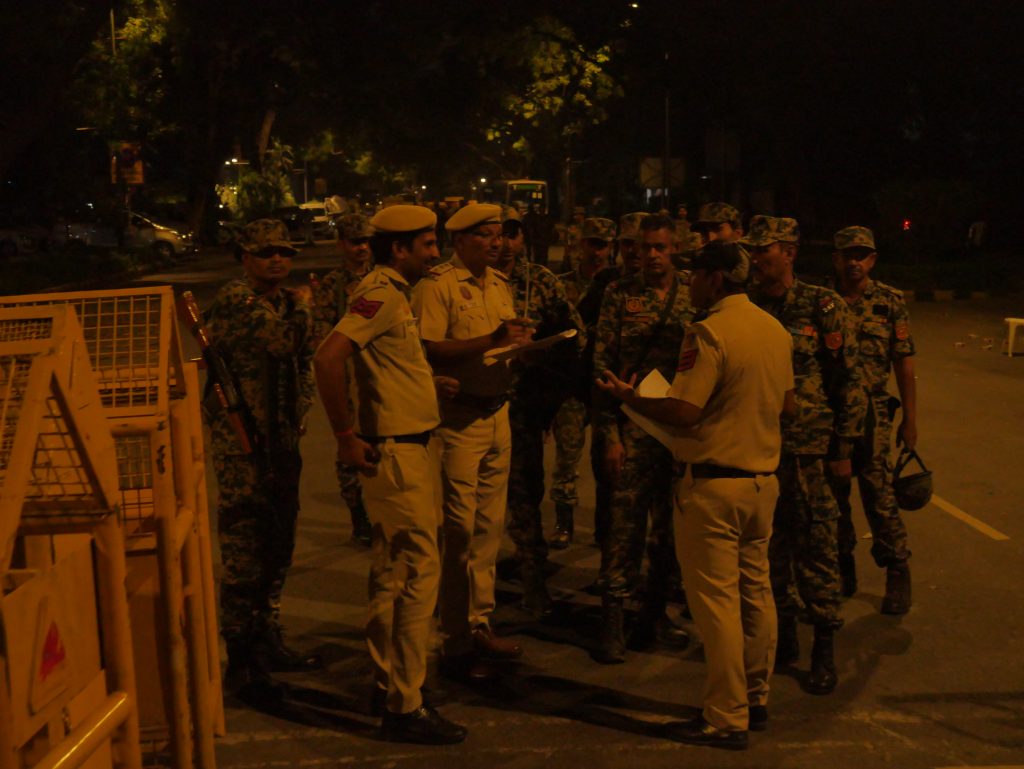
Through the slow, terrifying night that followed for those of us who remained on ground, the only sound that could be heard was that of a woman on government issue speakerphones infirming us to kindly follow the prohibitions of the Section 163 order that cannot seem to be found: a physical broadcast echoing through the streets informing people that they did not belong there.
***
What happens inside a blackbox? By definition, the answer is anticlimactic and obvious: nothing you can know.
Till 2 AM at night, individuals began to be singled out and picked off of the quiet streets by police officers on the lookout for stragglers. Some were taken to the Connaught Place Police station, caught on camera by reporters who stayed through the night before they too were driven away. The question of what went on outside the blackbox, however, is much simpler to answer.
Through the “secured” regions of the capital, including Jungpura, Lajpat Nagar, Okhla, Jamia Nagar, Nizamuddin, and many more, the city assumed a post apocalyptic form: trucks filled with unidentifiable items carrying police officers by the dozen blockaded footpaths and walkways; officers wielding barricades shut in the dead of night formed schools in front of the police activity, threatening journalists, even those travelling alone, or in groups of two or three (less than the 5 person curfew pasted on banners across the region) with immediate detention should they not have made themselves scarce at the earliest. 24*7 coffee shops, panwadis, teastalls, and toilets that form the lifeblood of the metro were sealed shut, leaving behind eerie silences and dust storms kicked up by police vehicles.
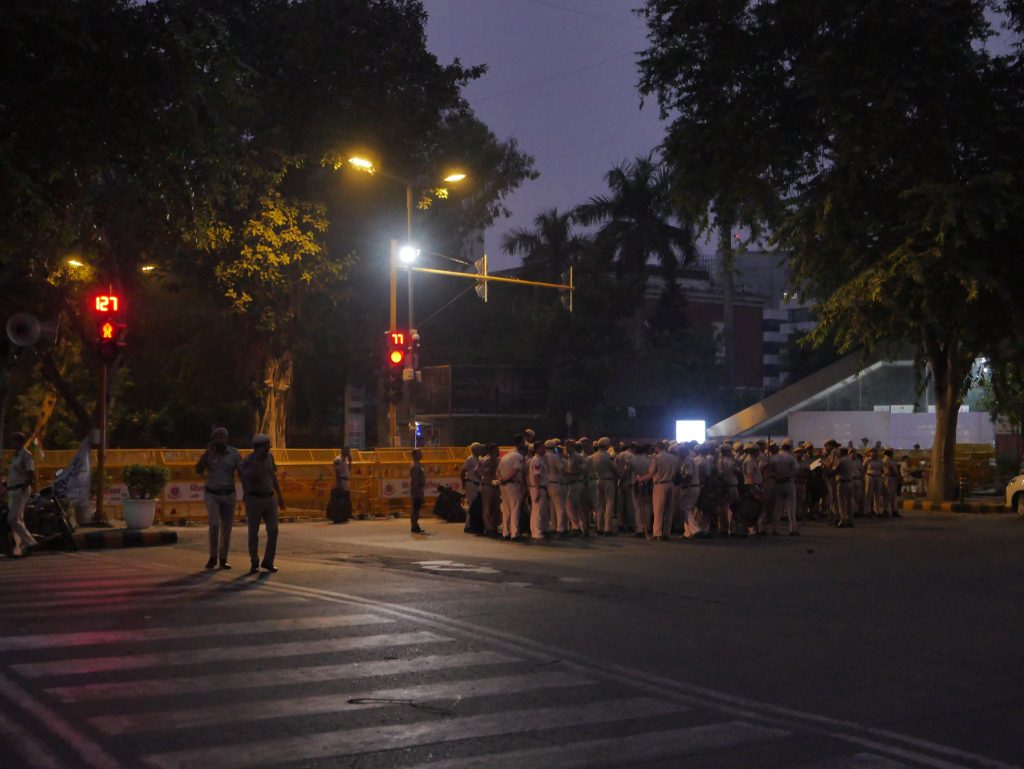
You see, the unspoken security detail unannounced between the internet shutdown of the night and the road closures of the following morning, was a designated surveillance and intimidation campaign, targeting journalists, activists, and students around the city, and beyond.
In Haryana, an elected councillor of the CPI-ML Happy Ratia was detained during the early evening on Friday, said State Secretary of the party, Vinod Dharouli.
Past midnight at 12:30 AM, seven Muslim Students Federation (MSF) activists, including the organisation’s Jamia Millia Islamia unit general secretary, were allegedly detained by Delhi Police from Julena and taken to Jamia Nagar Police Station, including four women. The activists said they were merely travelling to Old Delhi when they were picked up. There is still no confirmation of their release.
University gates at JNU were chained shut as the ever expanding Section 163 crept its way down to the Baba Ganganath Marg, far outside the designated 4km radius of central policing.
Journalists across the city, including independent reporter Harsh Yadav, Jibraan Uddin of Maktoob Media, and several others began getting phone calls from individuals claiming to be police officers, demanding their locations and whether they planned on covering the day’s protests, they say.
Ironically, the last standing space of unrestricted gathering, less than a 100m from the infamous and coveted protest site, became the front gates of the Royal Plaza Hotel. The same radial road where Yogendra Yadav, Neha Bora, and nearly 400 others had been detained a week ago on 2 October 2026, as the clock strikes 3 becomes an impromptu site of the world’s oldest business. While no one present was willing to speak to the reporters on site, conversations of “purchasing nights” for Rs. 5,000 to Rs. 7000 went around unabounded. At least 50 women were present there, standing by the wayside and being picked off the street by men in cars one after another. Notably, the gathering, which totalled about 150 people, saw no intervention from the hordes of police on either side of the hotel, where a curfew on public gatherings is ostensibly still in place.
What goes on inside a blackbox? Nothing you can prove.
Mouli Sharma is a journalist based in New Delhi. She currently writes for GroundXero, and her work has appeared in various publications.