
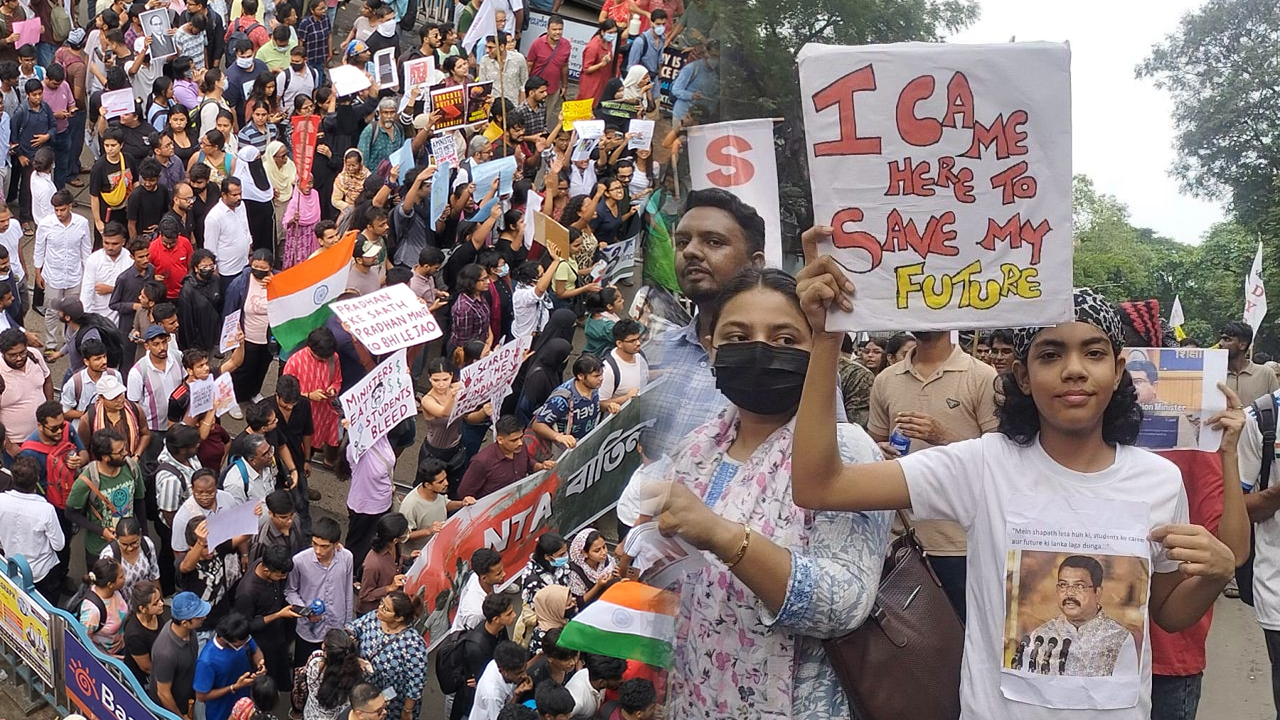
A massive youth rally in Kolkata on 24 July, held in solidarity with protests against exam-paper leaks at Jantar Mantar in Delhi, has raised questions about the future of traditional student politics in West Bengal. With most participants being unaffiliated to political organisations, the rally appeared to signal a new form of youth and student mobilisation. Subho Maitro examines what this generational shift may mean for the Left, campus democracy and the state’s wider political landscape.
“Did you take permission from your parents?” a young boy of seventeen or eighteen asked the girl sitting beside him on the local train. The girl replied conspiratorially, “No, I said I’m going to a friend’s birthday party.” And they laughed,” said Kalatan Dasgupta, a young left-wing leader, describing his experience of the student and youth protest rally in Kolkata on 24 July. A massive youth rally, from Sealdah station to Esplanade, took place in solidarity with the ongoing Gen Z protest against the exam paper leak in Delhi and across the country. The rally stunned Kolkata, a city once known for its student movements and politics. Will this rally shake away the slumber and rejuvenate the present moribund student politics of West Bengal? To answer this, one must look at the prevailing atmosphere of student movements and politics in the state.
The massive turnout at the rally on 24 July made everyone realise that something new is happening, and Bengal cannot look away. Student protest and movement is not a new thing in West Bengal, once a bastion of left politics. From Naxalbari to the Singur and Nandigram movements, students and young in Bengal were always engaged with larger political issues. Along with that, a fiercely competitive campus politics was always present dominated by the student organizations affiliated to political parties. But it was always more about ideology than campus. Students voiced support for Vietnam and protested against the US imperialism with equal vigor as against the rise of college fees.
Yet from the beginning of the 21st century, with the exception of the Nandigram movement, which saw substantial student and youth participation, the politics narrowed down into campus issues only. After the end of Left Front rule, TMC came to power and the student politics changed, which also changed the nature of the politics.
During the last fifteen years of TMC rule, the state saw a steep decline in government jobs, especially in the education sector. The scam of the School Service Commission stalled the employment process, and even in higher education permanent employment dried up. Students fresh out of colleges and universities struggled to secure other government jobs. While in the colleges the student unions were captured by the student wing of the ruling party named Trinamul Chhatra Parishad. Their grip was firm in most places, with only one or two exceptions, such as Presidency University and Jadavpur University in Kolkata and the student union elections were withheld indefinitely. Thus, there was anger and frustration on the one hand, and little scope for campus politics on the other. SFI, the student wing of CPIM and other left-wing student organisations fought this onslaught within their limited capability. But the student politics remained more or less on campus issues and of scams around SSC which couldn’t connect to a greater mass.
The rape and murder of a junior doctor on duty at RG Kar Hospital changed the situation, as large numbers of students and young joined the protests, particularly women. That was one of the game changers which created a huge anger against the incumbent government. There was spontaneous participation from people across the state, especially women. But though the primary protestors were junior doctors, the movement known as ‘Abhaya Andalan’ remained apolitical overtly and left student or youth organizations though gained some ground neither could control nor lead it. In the May assembly election, the BJP seized power in the state. The right-wing BJP used this discontent to gain in the election (though the mass deletions of voters through SIR will never let us know how much gain the BJP actually made).
The sheer number of Gen Z protesters and the enthusiasm they brought is now raising one question – will West Bengal see a new kind of youth movement and politics in West Bengal? Traditionally here the student politics revolves around campuses with students led by student unions. The rally on the 24th changed the equation. This student protest over the NEET paper leaks didn’t gain much ground in West Bengal when it was ongoing in Delhi and other Northern States, though the issue was a national one. On 24 July we saw a spontaneous participation of the young generation within the age group of 16 to 30. And the representation cuts across caste, class, gender and religion. This rally was called by eight students’ and youths’ organizations, but the majority of participants were not affiliated with any organisation. Their body language, slogans and ways of protests were attuned with that of the protest of Jantar Mantar, which is something new in this state. All the veteran activists admitted they had neither seen this before nor expected such a rapid change.
The larger question, then, is in what direction the student and youth politics of Bengal will shift, which has a traditional pattern of left movement? As Kalatan Dasgupta said, he was flummoxed to see a baby’s nappy had become a symbol of protest; it took him several minutes to understand that it was to indicate the leakage of the exam. Dasgupta himself is a young millennial, a CPM leader working now on labour front, he was arrested during the Abhaya protest just two years ago, and even to him this is new, and said; yes, the politics need a change in Bengal too.
Malay Tiwari, a state leader of CPI(ML) Liberation, is an ex-student leader of AISA who took part actively in Singur-Nandigram movement. He said, “this newness is not only about student movement and campuses, even the last two major protests one by farmers and another by labourers—have also seen participation from the same generation.”” So, this change is not concentrated among the upper or middle class section. The total angst of the generation is erupting against the failure of the State as well as the economic course it has taken under the Modi Government. “Though there is a new BJP government in Bengal, the anti-incumbency has not been so strong, yet the new generation is much more aware and connected and they can feel what is happening nationally,” said Tiwari.
The BJP government’s new education policy and the strong-arm tactics of TMCP destroyed the campus-based natural democratic student politics of the state, and the old way of class campaign and campus activity were becoming increasingly uneasy. The corporate profit churning education industry wants campuses to be union and politics free, which suited the rightwing philosophy. Engaging this new generation is difficult, admitted the veterans of student politics. But this Gen Z movement changed the perception. This generation has their own channels of communication and understanding, which the older generation failed to recognize so far.
Gen Z movement and aftermath
ABVP, the RSS student wing, and the wider right wing seem to be treading the same path like the erstwhile TMC. While the BJP, on coming to power in the state, said it would depoliticise the education system, their appointment in various college and university committees says another thing. In the same manner like TMCP they are trying to forcibly capture student unions instead of holding elections. And then comes the same aggression against Jadavpur University. This shows the same vilifying and terrorizing technique of anti-left politics is there, and in this state more than the cockroaches the traditional left is the main opponent, at least in the mind of the BJP and the rightwing ecosystem.
Yet the effect of Gen Z is felt, when the father of a CJP volunteer was killed. The volunteer Abdul Hafeez took part in the ‘School Thik Karo’ (fix the school) movement, and visited a school in Bankura district. His family was assaulted by goons with alleged vested interest in that school, and his father died. The family of the deceased said all of those goons were from the local BJP. The young volunteer refused to bow down and said he will continue his work.
The movement seems to resonate among the youth of Bengal, too, and it would be wrong to say that it has no effect on the West Bengal youth and students’ politics. In Bengal, student and youth movements have always addressed both education-related issues and wider political concerns. The Singur and Nandigram movements saw a large number of students actively participating. The same goes for the No-NRC movement. It was not always direct involvement of particular student organizations but there was a distinct leftist approach to those sometimes overtly sometimes underlying it. But this time it is felt that the paradigm may have shifted. Debalina Ghosh, lecturer and once a student activist, said, “yes, the things we have seen earlier and the movement of this generation are markedly different. There was always a class consciousness in the youth participating in the movement. But here there is an absence of it in the classical sense.”
According to her, this absence was seen in recent popular movements in the state and especially in the R.G Kar protest movement. And all these veered towards the rise of the ultra-right. Class angle and consciousness is also not present in the strict sense of the classical Marxist term in the protests of Gen Z. And along with that new slogans, new jargon and new forms of expression are emerging, which she said is perplexing for someone like her who followed the politics of Bengal.
The articulation changed with the generation more adept to social media, when they came out to the streets, they brought out all the memes and trolls to the actual ground, which amazed us, as this had never been seen before. Malay Tiwari, CPIML Liberation leader and a veteran of student politics raised an interesting point; there is class angle to this. Even in the ongoing farmers’ movement of Punjab and Haryana and the recent Labour movement the driving force is youth, “they are Gen Z too, Gen Z farmers and Gen Z labourers, so the class question is not totally diluted, rather it is taking a new form according to him. We have to learn from them much more than they need our guidance,” said Tiwari.
This process of understanding each other is ongoing. While travelling by local train with the young protesters to the July rally, I saw a few clusters of youth enthusiastically sloganeering their own kind of typical Gen Z slogans, but along with them there were activists from left youth organizations like AIDSO, DYFI who were teaching them the vocabulary of the traditional left. This exchange was spontaneous. Kalotan Dasgupta said, they already have a slogan ‘Neteo acchi, hneteo achhi,’ which means we are on the net as well as on our legs. So, a churning started to happen. AISA, the student wing of Liberation interestingly put forward a QR code in social media for youth and students to join their organization.
As the BJP came to power in West Bengal ABVP started flexing its arm. In the same tactics like TMCP they are trying to capture the campuses. The first attack seemed to be on the Jadavpur University, according to them which is the beehive of left politics. BJP which came to power after TMC made no pretense to hide who is their main opposition; the same is done by ABVP. Their target is left politics. The left student and youth organizations are also coming together in the state after many years of rift about ideology and party line. The rally of 24th July was called by eight organizations.
The question is what will be the role of anti-establishment students and youth protest. Is the Gen Z movement a shot in the arm to the radical left or it will weaken them?
Gen Z-fied Left and Beyond
Gen Z cannot be treated as a monolith or a hermetically sealed entity. Like previous generations, it is multifaceted and evolving. The geo-cultural influence cannot be nullified as one observes the difference between the tone, the body language and the direction of the Gen Z protest of Jantar Mantar and of Patna. So here in West Bengal, too, there is a local flavour to it. Debalina Ghosh said, “the participation of young girls in the protest and their enthusiasm is noticeable.” She stressed that she hasn’t seen this number of women from various classes and communities. In the case of R.G Kar and No-NRC movement this cross-community presence was not seen in this number. “As a teacher I am also surprised, I haven’t seen any interest in politics among them, and to be frank their knowledge of both theory and practice is quite poor. So, I didn’t have much expectation from this generation. But the way young students especially women came out is amazing and you will see there are non-Bengali-speaking young Hindu girls were at the rally. This I haven’t seen before. I have seen Hindi or Urdu speaking Muslim women participation in No-NRC movement, but this section I haven’t seen participating in any protest.” Debalina observes.
This new political awakening of a new generation couldn’t be predicted beforehand because of their existence in a different world. It is a world of digital media and social networking. Memes, reels and stand-up comedy have all created an ecosystem of their own. In West Bengal left parties and the student and youth organizations are now trying to have a syncretic relation with them otherwise they will lose whatever relevance they still have in the state. So, the demand of Gen Z became their demand. The left student organizations have taken up the ‘School Thik Karo’ movement of the CJP. Instead of brushing off CJP as an ephemeral apolitical movement the left is treading cautiously. It seems that there is a necessity of a symbiotic relationship between traditional left and the Gen Z. BJP after coming to power is trying to force a draconian rule, where individuals cannot go on fighting against them. The fear of physical attack, constant threat and legal steps are too much to handle. This kept left student organizations relevant, as they have the experience of tackling this. On the other hand, the new ways of communication have been learned by them from this new generation.
There is another vital impetus given by the Gen Z’s to these organizations. There have been debates and conflicts among left-wing groups over party lines and ideologies. This has a long past and it is not easy to wash away the mistrust, but the new generation made them come together in various issues. So, they are becoming a gelling force for a broad-based coalition of students and youths. From the issue of campus democracy to the lack of employment, corruption in education system to the abject condition in infrastructure – there are no dearth of issues – on which a broad coalition can happen between the left and democratic section which can become a strong opposition in the state. The vacuum left by the TMC in all the sectors as well as the student and youth politics after losing the election has given them a window of opportunity to gain ground, they have conceded gradually over two decades.
Subho Maitro is a writer and freelance journalist.