
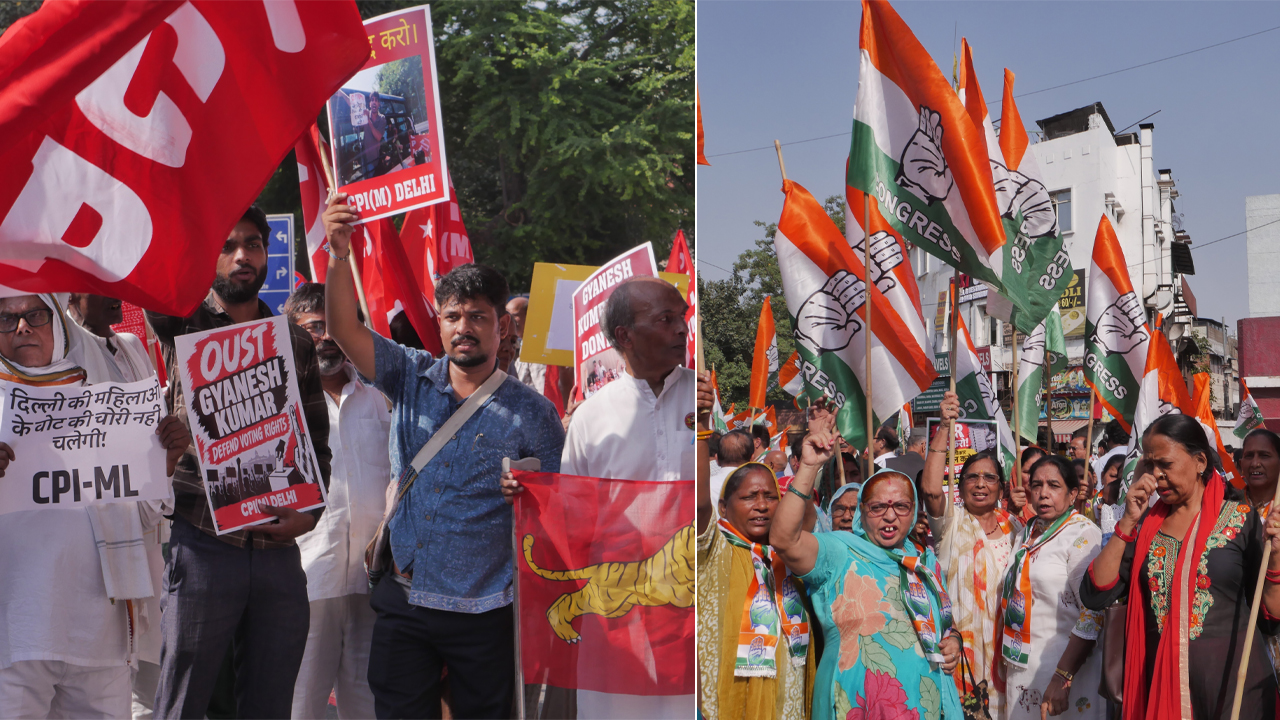
Hundreds protested outside the Kashmere Gate office of the Delhi Chief Electoral Officer Ashok Kumar on Monday demanding immediate rollback of SIR in the state amid 47 lakh deletions and 33 lakh notices issued for alleged ‘discrepancies’, with the INDIA block taking the lead. A report by Mouli Sharma.
New Delhi, 7 October 2026: Hundreds of people took to the streets for a short notice protest call outside the Kashmere Gate office of Chief Electoral Officer (CEO) Ashok Kumar on Lothiyan Road amidst ongoing SIR processes, which have seen massive voter deletion from the state’s draft rolls as well as the issuances of ‘notices’ to many more.
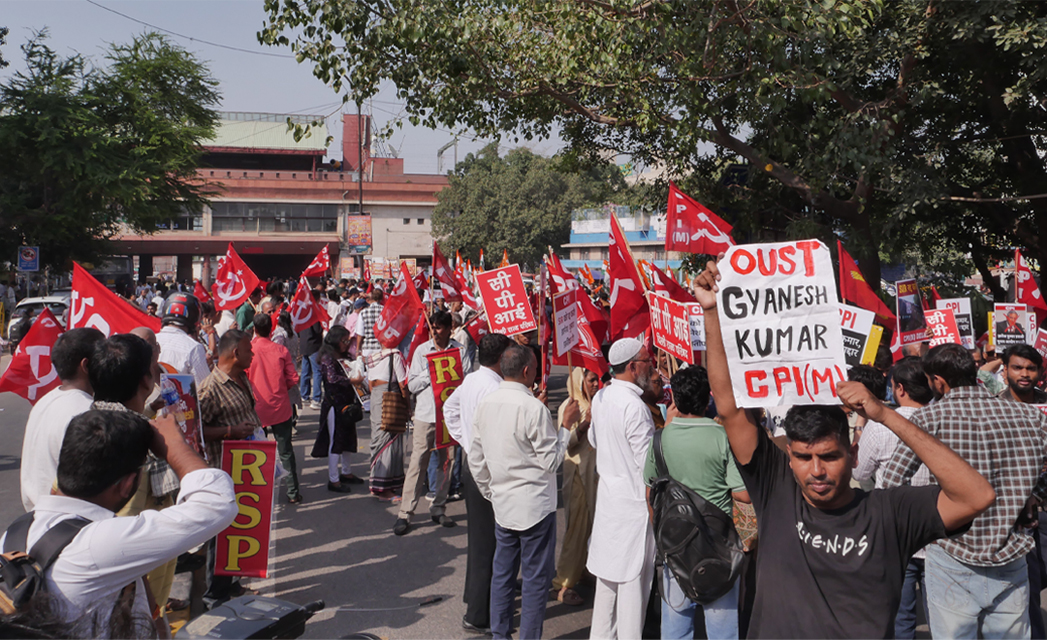
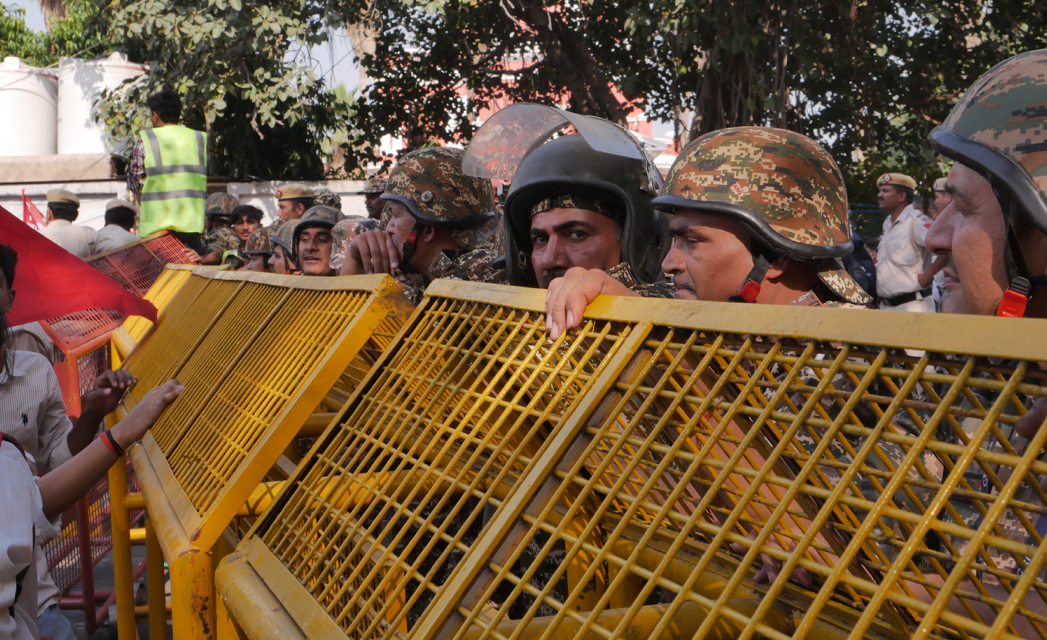
Police barricaded the roads, causing hours long congestion and traffic diversions between the hours of 12 and 4PM, following which a delegation of INDIA block representatives was permitted to have a private audience with Kumar during which they submitted a joint memorandum addressed to the President of India, Droupadi Murmu, through CEO Kumar.
“47,56,722 (32.78%) of Delhi’s voters have been removed from the rolls under SIR and 33,12,919 (34%) (sic) individuals have been issued notices. Deletions of this drastic a scale raise grave questions about citizens’ voting rights as well as the transparency of the electoral process,” the representation by the INDI alliance said, whose signatories included the state representatives of the INC, RJD, CPI, CPI(M), CPI(ML), RSP, AIFB, and TMC (MAMTA). Press were denied entry and efforts to contact the CEO have so far yielded no response.
Besides the INDIA block, though, large numbers of protesters from student and workers’ organisations, including the AICCTU, RWPI, Disha Students’ Organisation, and even the Aam Aadmi Party joined the protest in solidarity with the demands for an immediate rollback of SIR. Dozens of locals also joined the protest, expressing that recent revelations about the ECI’s functioning as well as the accusations against CEC Gyanesh Kumar had led them to lose faith in the electoral machinery.
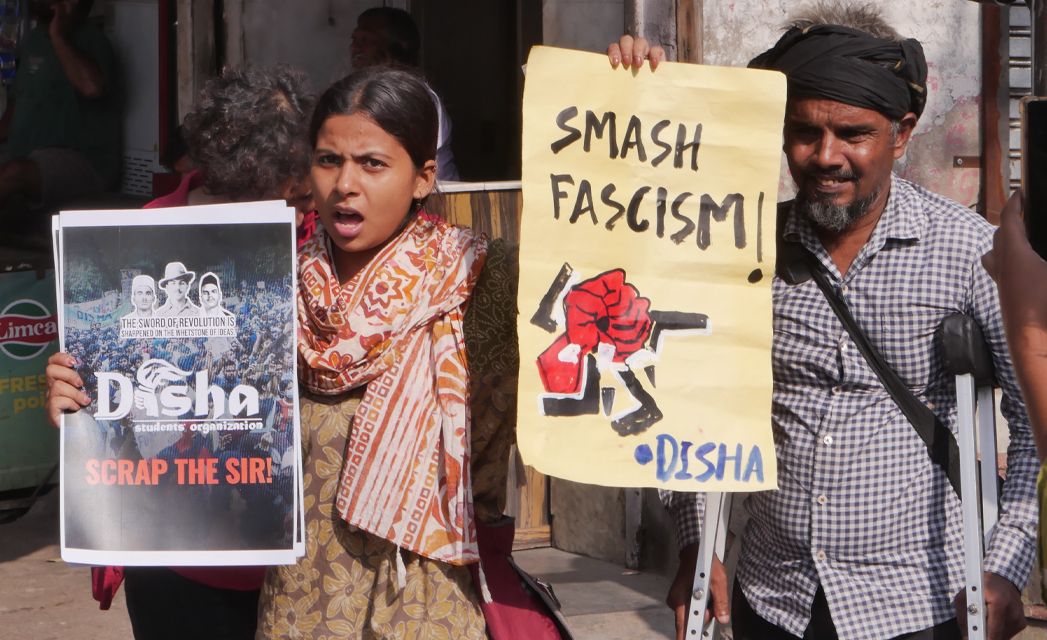
“The student character of the protests in Jantar Mantar might lead people to believe that this is solely a youth issue,” said Shweta Raj of the CPI(ML). “The Kashmere Gate protest clearly shows that this is not the case. People as old as 60-70 years old were there on the ground, women had travelled in large numbers from Shastri Park, because at the end of the day this is a universal issue. Day in and day out we get calls from people all over the city who have been pushed to the point of desperation trying to fulfill the bureaucratese of SIR who are still falling short, whose names are still being deleted.”
She also highlighted that the process of SIR, which severely disadvantages those without permanent residential addresses in their current states of residence, has followed a pattern of recurring displacement drives across the city, effectively earmarking those affected for immediate loss of their voting rights.
“The largest number of people affected were from bastis that had been demolished without any rehabilitation of the residents. There is no roadmap for a person like that to get back on the rolls; the whole thing is systematised,” she said.
The demands: rollback, resign, and EVM ban
The delegation submitted three demands to the CEO in writing: first, the immediate rollback of SIR in Delhi, along with the readmittance of all the deleted voters (barring the dead) back into the rolls and an indefinite stay on ‘processes’ such as responding to issued notices of ‘logical discrepancies’ in voters’ identities; second, an immediate resignation of CEC Gyanesh Kumar; and third, perhaps most longstanding within India’s electoral debate: a ban on EVMs and conduct of future all elections through ballots, in an effort to regenerate people’s trust in the electoral machinery.
In 2010, engineer Hari Prasad had demonstrated in an infamous live broadcast on national TV how India’s Electronic Voting Machines could be hacked to favour a preselected candidate. Prasad was arrested for his ‘demonstration’ at the time, under the then ruling UPA government. Ironically, it was the BJP led opposition at the time who was most vocal about the demand for a return to traditional ballot-paper voting. In fact, Prasad’s demonstration had followed a similar row between opposition and Election Commission in 2009, when L. K. Advani had demanded the reintroduction of ballots, following which the EC had rejected their accusations of ‘faulty EVMs’ and asserted the ‘non tamperability’ of the machines, leading to engineers like Prasad taking up the challenge.
“The EC is amply satisfied about the non-tamperability and the foolproof working of the EVMs. The Commission’s confidence in the efficacy of the EVMs has been fortified by the judgments of various courts and the views of technical experts,” the Commission had said at the time.
More than a decade and a half later, the ruling party and opposition have changed both roles and tunes, but Prasad remains confident that the EVM can still be hacked. In a 2019 interview for The Quint, he recounted the various different ways in which EVMs can be weaponised to favour specific candidates, display false votes through internal malicious code on the device’s chip, or ‘steal votes through externally installed malware or clip-on devices. The many vulnerabilities of the EVM at several stages of its manufacturing, assembly, or transportation make it such that computer scientists analysing the Indian EVM’s security have repeatedly reasserted Prasad’s findings, and advised on either an ‘open’ design that ensures external scrutiny or a return to traditional methods. Despite this, EVMs have not only stayed, but according to activists, have even gotten worse.
Gulshan, an activist working with the EVM Hatao Andolan, used to conduct weekly demonstrations at the Jantar Mantar protest site since the start of 2026, performing experiments on an EVM replica to show how the new machine design currently approved by the ECI actively worsens transparency compared to older designs through a ‘black screen’ and LED lighting system that prevents voters from seeing their ballots except for a brief second.
“Previously, this black screen was not there,” Gulshan said. “So you could see your ballot throughout while casting your vote: during printing all through till the vote is dropped into the collection box. But now, what this essentially means is that you don’t actually see your vote being printed or collected. Meaning that several voters may be shown the same slip, bringing down the number of votes cast for that particular candidate down from however many x vote for them to just a single one.”
After June, though, when the controversial burning of 4000 EVMs in West Bengal made headlines and brought the state’s already controversial and recently held assembly elections under spotlight (over 90 lakh voters had been deleted in the state rolls. In former CM Mamata Banerjee’s constituency, 50k voters had been removed. She lost by about 15k. The data is no longer accessible on the Election Commission’s official website), Delhi Police seized Gulshan’s machine, and told him to conduct his campaigns “theoretically”.
“As you can imagine,” he told this reporter, “that was quite a challenge.”
‘Where did our votes go?’
Speaking to this reporter after seeking assurance that she was not ‘Godi media’, a group of Muslim women travelling from Shastri Park, who had joined the protest to make their voices heard about water contamination and other alleged governance failures in the region.
“We have travelled here since 8 in the morning from Shastri Park. There isn’t a single woman police officer here,” they said. Observably, there were no female police officers on site, just large numbers of male police personnel.
The public’s reasoning for participation was not as direct as some of the political leadership may be able to verbalise. Their concerns were rooted in problems of everyday governance: water, inflation, transport—all of which they are coming to learn, as the protest against Gyanesh Kumar gained more and more visibility, might have to do something to do with the politicians they chose to represent them, or perhaps were not allowed to choose.
“When Kejriwal had come to power, we had no difficulty with water,” said one of the women in the group. “But now the water is disgusting. We don’t have water to drink, to wash. The buses used to be free, which supposedly they still are, but now we have to get passes made? What is the point of free bus fare if you need to get a pass?” Another asked. The problems went on, as did the frustration: Whole wheat has become Rs. 40/kg, oil is touching 200. An economic crisis has engulfed Delhi’s residents, and for a large part of them, the woman responsible (currently in office), CM Rekha Gupta, is not who they chose to be there.
“We all voted for Kejriwal. Everyone in our neighbourhood did. We did not want Rekha Gupta, but we figured we had been outnumbered. We did not know about all this fraud within the election commission,” the women said. “We are not so educated, but now we have to wonder. If so many people’s votes have been stolen, then who can prove to us ours wasn’t? Where did our votes go?”
Section 163 spreads to Kashmere Gate, public irate
The electoral process and ordinary governance failures are not the only institutional mechanisms that the public of Delhi are frustrated with. Dozens of citizens were stranded on the Lothiyan Road for hours before, during, and after the protest due to a now familiar refrain of ‘Section 163’ being verbally announced in the region. Lothiyan road is a high-traffic region which sees direct passage to the Kashmere Gate ISBT, metro station, as well as the Old Delhi Railway Station. Many of the dozens of people left by the wayside, dropped off by DTC buses and rejected by rickshaw pullers due to the road closure hadn’t even been aware till date that the COE’s office was located there.
“The bus dropped us all off halfway,” said Reema Devi (name changed). A middle aged woman, she walked with a limp. “The police have sealed the road it seems. How am I supposed to get to the railway station now?”
“These bastards have sealed up the roads again,” said an irate ragpicker. Past 4 PM, once the crowds would disperse, he would return to the barricades, just to confirm that they were still there, even after protesters had been dispersed. “There are barely any people on the roads. What is the point of closing the road?”
An elderly couple thanked this reporter for directions to the railway station, which they would now have to reach on foot 3-4 kilometres away.
In early 2025, when temporary workers of the IMT Manesar car plant of Maruti Suzuki were on indefinite strike, they faced repeated detentions and ultimate displacement from their protest site. The leaders of that movement had made a memorable claim then: “Wherever we go, Section 144 (of the erstwhile CrPC, equivalent of the current Section 163 of the BNSS) follows us around.”
New Delhi during the ongoing Gyanesh Kumar protests is oddly reminiscent of the claim. After Jantar Mantar and India Gate, Kashmere Gate marks the third verbal declaration of the section in the NCT within a single week. The referred magisterial order has so far not been produced or published in any of the three instances.
“An order?” A group of constables deployed for security in the region told this reporter upon being asked to show the magisterial order detailing the prohibitions made under Section 163. “Yeah, it must be around somewhere with our seniors.”
“Actually 163 has only been implemented on this side of the barricades,” said another officer, pointing to the direction of the COE’s office. “People are free to protest on the other side. They just can’t go toward the office. One person can go submit whatever letter has to be submitted.”
The senior officer in question, Inspector Prakash Yadav though, also was not in possession of the order, and said that it must be “somewhere”. When asked how the proceedings on public restrictions were being carried out without publication of the order (as the section entails), Yadav said, “Publication? How should we know anything about publication? The press would know more about that.”
This casual nature of operations around a legal provision that empowers judicial magistrates to suspend basic constitutional freedoms for as long as six months at a time, stands in stark contrast with the legal precedent surrounding it. The Supreme Court has repeatedly ruled that the arbitrary and recurrent use of section 163 constitutes ‘abuse of power’.
Mouli Sharma is a journalist based in New Delhi. She currently writes for GroundXero, and her work has appeared in various publications.