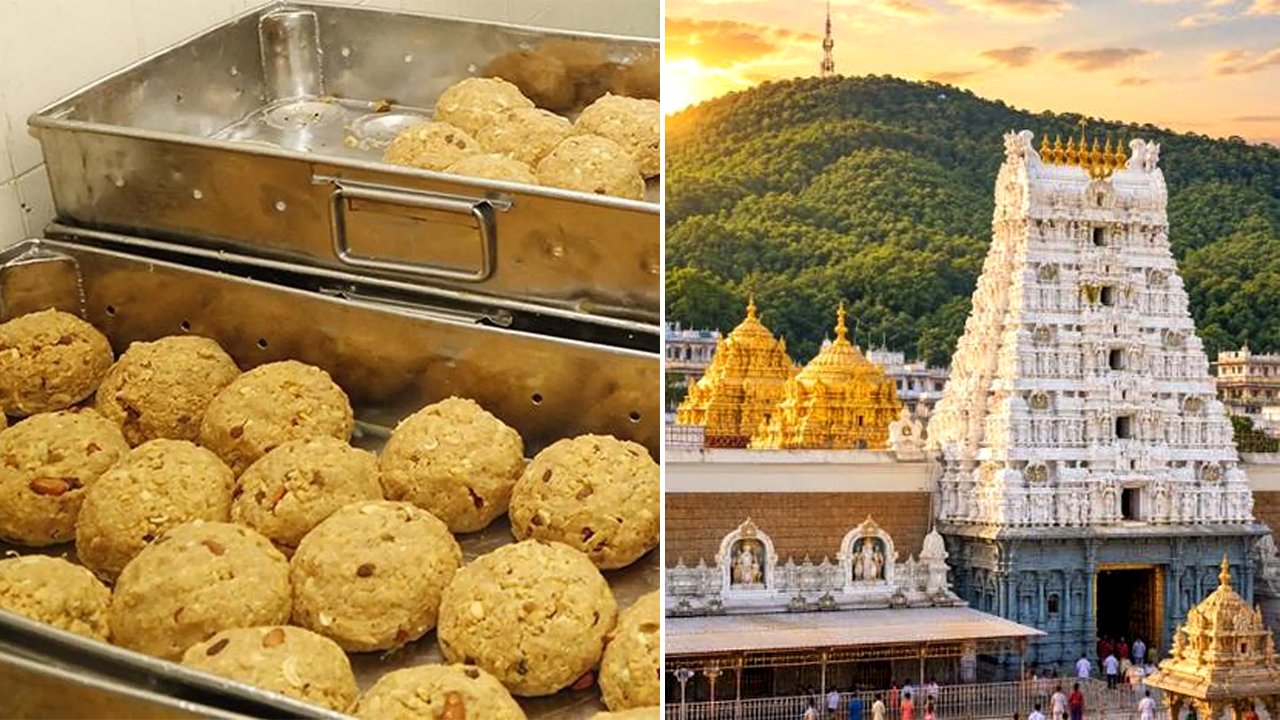
In a press release on 17 September 2026, eight months after the Supreme Court-appointed CBI Special Investigation Team (SIT) explicitly ruled out the presence of animal fats in the ghee used for manufacturing the Tirumala Tirupati temple’s prasadam, the Enforcement Directorate has arrested a promoter of a private food company allegedly involved in contamination after lab forensic analysis revealed the presence of seven adulterants. Notably, none of them are animal fats, specifically ‘beef tallow’, the allegation of whose presence triggered outrage and investigation in the first place, and cemented a political upset in the state by amplifying communal tensions.
by Mouli Sharma
On 19 September 2024, Andhra Pradesh’s Tirumala Tirupati temple had taken over national and regional news by storm for an unsavoury reason: an allegation of the presence of animal fats in the temple’s prasadam (consumable offerings to Hindu deities given as blessed alms to devotees), specifically the accusation that ‘beef tallow’ was used in the rendering of adulterated ghee used to make the temple’s laddus. Unverified accounts of ‘lab reports confirming the allegations’, which were amplified by TDP’s CM Chandrababu Naidu himself, eventually led to an FIR about the same being registered on 25 September 2024, followed by a PIL being filed in the Supreme Court by one Dr. Subramanian Swamy.
Over a year later, the allegations were debunked by a Special Investigative Team constituted by the CBI to investigate the case, whose forensic examination categorically ruled out the use of animal fats, though the presence of synthetic adulterants was confirmed.
On 17 September 2026, almost exactly two years later, the enforcement directorate reproduced the same findings. Seven adulterants were listed in an ED press release announcing the arrest of a food promoter allegedly involved in multi-crore transactions behind the procurement of the adulterated ghee—Refined Palm Oil, Palm Kernel Oil, Palmolein, MG-90, Monoglycerides, Myvacet Soft 400 and Acetic Acid Ester—none of which are animal fats of any kind, let alone fats of particularly polarising animals, like cows.
On 17 September 2026, almost exactly two years later, the enforcement directorate reproduced the same findings. Seven adulterants were listed in an ED press release announcing the arrest of a food promoter allegedly involved in multi-crore transactions behind the procurement of the adulterated ghee—Refined Palm Oil, Palm Kernel Oil, Palmolein, MG-90, Monoglycerides, Myvacet Soft 400 and Acetic Acid Ester—none of which are animal fats of any kind, let alone fats of particularly polarising animals, like cows.
In the light of both revelations, the dozens of mainstream media outlets across the country who expounded the now debunked claims without any evidence of their legitimacy back when the controversy had first surfaced, fanning communal sentiments within the country’s dominant caste-Hindu population, triggering a rise in hate speech, and cementing the popularity of the then newly elected NDA government in the state, have remained conspicuously silent.
“Unfortunately, we cannot use any news content against the AP government. I cannot say more than that,” he said.
Major newspaper outlets with the largest circulation rates in India; channels with the highest viewership statistics, and websites at the top of Search Engine Optimisation and provenance score rankings—The Times Group, The Express Group, Firstpost, The Hindu, Dainik Bhaskar, NDTV, and many more—all solicit their newsdesk items from this agency. This is possibly why the only visible headlines currently in the public domain that acknowledge this debunking, are the opposition party’s own social media posts, and an article by The News Minute, an independent alternate online news portal focusing on the South.
A noteworthy aspect of the entire controversy was that the allegations, from the outset, were being made in retrospect. Though the Telugu Desam Party had already come to power by the time the FIR was registered, with Naidu having replaced YSRCP’s Jagan Mohan Reddy (who was then targeted for his Christian identity) during the Legislative Assembly elections in May 2024, the complainant made it clear that his accusations were about procurements made during the preceding government’s tenure.
The evidence as such was so tenuous that when the matter
was heard in the Supreme Court on 30 September 2024, the 2-judge bench of Justices B.R. Gavai and K.V. Viswanathan noted that the ghee samples being used for initial testing had never been meant for use at Tirumala Tirupati—the investigation at that point was based on rejected samples. The bench thus criticised CM Naidu for making polarising speculations while investigation was still under way.
“We are, prima facie, of the view that it was not appropriate on the part of a high constitutional functionary to go in public to make a statement which can affect the sentiment of crores of people and when investigation to find out if adulterated ghee was used to make laddus was underway,” reads the order.
“We expect the Gods to be kept away from politics,” Justice Gavai said during the hearing. “It is very clear from the report that this is not ghee that was used. Unless you are sure, how did you go to the public with that?” Justice Vishwanathan asked.
As such, it became clear that the conflict, like so many in India, was one of alleged corruption being made into one of communalism; with propaganda and disinformation taking centre stage over facts or genuine anti-corruption sentiment in the bickering battle of parliamentary politicians. The collateral damage, of course, was the nation’s sense of reality, scientific temperament, and conscience.
In a party statement titled, ‘ED findings expose Naidu’s false Tirumala propaganda’ published on 19 September 2026, YSRCP addressed the latest findings, stating that they have, “further exposed the false and politically motivated propaganda spread by Chief Minister N. Chandrababu Naidu and the TDP over the sacred Tirumala Laddu.”
“Without waiting for a proper investigation or conclusive scientific evidence, Chandrababu Naidu publicly alleged that animal fat was used in the sacred Tirumala Laddu during the previous YSRCP government,” the release goes on to say. “He made this serious allegation while holding the responsible office of Chief Minister. His reckless statements hurt the sentiments of crores of Lord Venkateswara’s devotees. They also damaged the sanctity and worldwide reputation of the TTD. Chandrababu Naidu, his ministers, the TDP and their supportive media repeatedly promoted the animal-fat allegation and attempted to use the faith of devotees for political mileage.”
Party spokesperson, Karthik Yellagrappada, a self described ‘techie’ based in Amsterdam, was unavailable to comment on whether the sanctity and reputation of a religious institution in a secular nation took precedence over gross allegations of money laundering and chemical adulteration, but the aforementioned party press release says the following on the subject: “Adulteration is a serious offence, and everyone responsible must be punished. However, adulteration with vegetable oils cannot be dishonestly presented as proof that beef tallow or animal fat was used.”
Another concern raised by YSRCP, also seconded by the aforementioned Supreme Court bench, is regarding the veracity of the investigative process itself, which they allege leaves open the possibility of foul play. “Reports have indicated that rejected ghee stocks were allegedly repackaged and supplied again in August 2024, after the TDP-led coalition government came to power,” they said. “This raises serious questions about the quality-control and monitoring failures under the present government. Instead of explaining what happened under its own watch, the TDP tried to blame the previous YSRCP government and mislead devotees.”
This suggests the possibility that TDP itself had been reusing expired stock/stock that had failed quality control, and may have intentionally stirred up the controversy to have a dual effect: ensure plausible deniability in the event of this negligence becoming exposed and simultaneously malign the opposition. The Telugu Desam Party was contacted for comment on these allegations by this reporter but received no response.
The YSRCP ultimately demanded that CM Chandrababu Naidu immediately withdraw his false animal-fat allegation and tender an ‘unconditional public apology to Lord Venkateswara, the TTD and crores of devotees’. “Sacred faith must never be sacrificed for political mileage,” they said.
Mouli Sharma is a journalist based in New Delhi. She currently writes for GroundXero, and her work has appeared in various publications.