
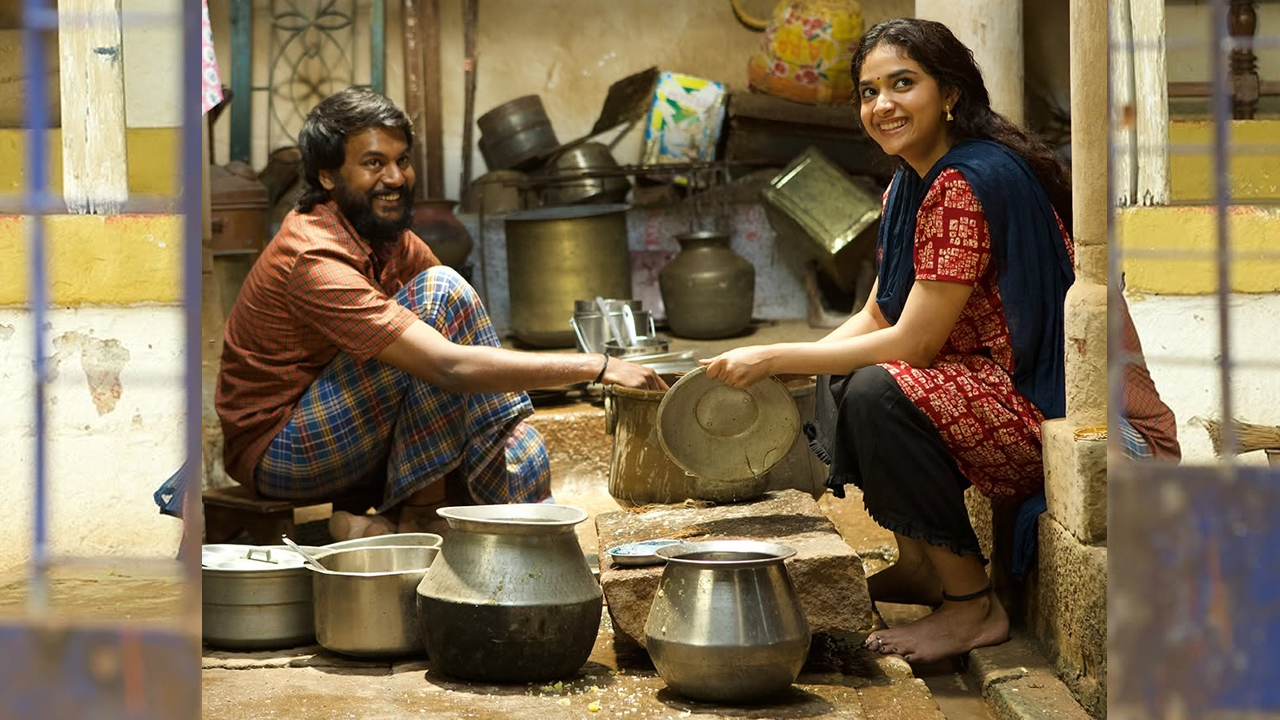
Ashley Tellis thinks Karthik Subbaraj’s Dorothy, currently making waves in Tamil Nadu, is, like some other of his films, a feminist cult classic
Karthik Subbaraj’s Dorothy ushers the return of Tamil cinema but, more importantly, will go down in history as one of popular Tamil cinema’s most powerful feminist films. At the heart of it, like his earlier film Iraivi, and arguably many other of his films, is a critique of Tamil patriarchy from the position of the feminine, this time occupied in the film (and in the world) not just by women but also by certain sexual minorities. That he combines this deftly with a critique of caste and class in the Tamil heartland makes it an even more powerful exposé of Tamil patriarchy.
Subbaraj’s central motif is the idea of woman as goddess (Iraivi means goddess), a very powerful trope in Tamil Nadu. But his genius is not just that he exposes the hollowness of the worship of woman as goddess in Tamil Nadu, by showing how woman (and woman-identified subjects (which include aravanis,1 effeminate gay men and trans women) are actually treated) but also wields the affective power of the goddess figure in Tamil Nadu to work against sexual oppression, caste violence and class inequality, in a very grounded, material sense, that actually has nothing to do with goddess worship.
Sexual Oppression: The feminist heart of Dorothy
The film’s protagonist is an aravani who has been in denial of her aravaniness all her life, not least because of the terrifying violence her misogynist, classist and casteist family (comprising only of men – a father and two much older brothers) will visit upon her should she reveal it, but also because she is terrified of losing the love of her life, her childhood friend, whom she plays male buddy to all her life against her ‘true nature’ just to keep him close. That he, the love of her life, is of a lower caste than her (as with all Tamil cinema, actual castes are never mentioned in the film, especially when they are most at play – one of the curiosities of Tamil cinema) makes her eventual transgression even more delicious.
However, when things get out of hand, she explodes, becomes herself and the first words she utters while beating up her hideous brothers and father are, “Not ladyboy (what they insult her with, in her sari) but woman!
This identification with woman and wanting to be a woman is not the North American and Western European (including, especially, British) transgender claim to be woman, with its entitlement, abuse and nastiness, increasingly visible in India too, in the fledgling transgender movement here. It is an identification with women, with the position of woman in culture, woman as placeholder for different kinds of violences, all of which are contested in the film.
Indeed, images of dead, violated and violable women float through the film: the murdered mother, the murdered (and possibly raped) sister and the eponymous figure, who is so beautiful, she is likened to a doll (also possibly raped and definitely murdered) – all three women’s murders passed off as suicides; the lower caste woman who comes to ask for her pawned jewellery back so she can pay her son’s medical bills as he is in hospital and who is threatened with rape; the woman beaten by her father and mother for entertaining a boy at home. All the women in the film are under siege.
Yet these women, through, and, perhaps, because, of their oppression, identify with other figures claiming the placeholder woman. It is a precarious claim, to a very precarious position and the women see the utter bravery and the sheer madness of it. It is what they have done themselves.
There is a very interesting verbal Freudian slip of the tongue in the film where the word the lover wants to use for women is ‘acceptance’ but he instead says the ‘arrogance’ of women. He is immediately corrected but the word is actually appropriate because Subbaraj actually believes women are arrogant, and should be arrogant, about their values of empathy, warmth, love, acceptance, anti-casteism, anti-marginalisation of any kind, anti-violence and anti-murder, even when murder seems so powerfully called for (as in a key moment in the film), and the ability to love the unlovable ie. men.
Of course, the lover is using the word for the protagonist, who is not a woman, but she identifies as one. She is one of the many figures that constitute the figure woman in the film and in the world. She is the aravani as woman, quite happy to join the biraadari of aravanis, go through the initiation ceremony at the Bahuchara Mata temple in Gujarat and become the woman she knows she is, not the woman but a woman, like the effeminate gay man, like the trans woman (most of whom in India make no demand that they be considered ‘real’ women). These figures see what it is to claim the space of woman, and what it opens you to: incendiary violence, sexual congress as violence (rape), the impossibility of love, and hatred by all those you love. Nowhere does Subbaraj make biological motherhood the cornerstone of womanhood, and that is a triumph.
To be sure, Subbaraj’s is a particular reading of woman (not all women, we know, share these values; not all aravanis share solidarity with women, many hate them, many consider themselves better than/superior to women) but his claim about women is universalist and historically, broadly, true. In the contemporary moment, the reassertion of its historicity and universality is a political statement.
Crucially, it does make of sex or womanhood a primary contradiction. This is because, Subbaraj shows how it is intertwined with class, caste and masculinity. Subbaraj’s is a utopian, hopeful reading of the place of woman/the feminine in culture as the place of redemption from the unceasing violence and destruction that men wreak upon the world.
Casteism: The rotten heart of Tamil Nadu
The dispensability of women in Dorothy is articulated across caste and is particularly evident in the frothing-at-the-mouth misogyny of the money-lending, sexually voracious yet woman-hating, homophobic and lower-caste murdering, upper caste father. The feminist vision that Subbaraj articulates, on the other hand, is his complete opposite: necessarily anti-caste, against caste violence, against sexual violence, against caste purity and against caste endogamy. The binary is too absolute but he’s making a symbolic point, not a literal one.
Caste is marked as male (once again, it is not as though women or aravanis are not casteist) but Subbaraj’s point is that the position of woman cannot but deny caste because of its fundamental commitment to empathy, acceptance, sensitivity and its own precarity. Caste is denied by the placeholder of woman, which in its own deep instability, in his reading, sees the instability of all identity markers. Once again, utopian, (not all victims of violence empathise with other victims of violence) but a gesture of hope.
Classism: The insignia of modernity
There are various insignia of class in Dorothy that also amount to insignia of modernity through which Subbaraj articulates a critique of class politics in the Tamil heartland. To begin with, the Christian name Dorothy and all the associations of Western modernity with Indian Christians (especially the fair-skinned, doll-like East Indian and, in this iteration, Malayali ones), both for Tamil Nadu and India as a whole.
In between, the idea of a companionate, friendly, equal conversation between men and women, which is seen as an unpardonable sexual/caste/class transgression that demands punishment, to save the ‘honour’ of the woman who is seen as the repository of the community’s ‘honour’ (not even her own) and must not exercise any autonomy.
Then, also the motif of travel to other states, into other languages, despite the seeming impossibility of it, other views of the world that also enable class transgression. Or cigarette- smoking, film music or watching pathetic porn in low-grade, rural cinema halls. The list of the enabling insignia of modernity forms the dense filmic text of Dorothy. Each image is carefully constructed, each frame is a cultural essay.
But the central contestation of class in the film is cinema. The exposure to the Hindi cinema of the 1980s (particularly the French kiss between Rishi Kapoor and Dimple Kapadia in Ramesh Sippy’s Saagar, which inaugurated the real kiss in Indian cinema anywhere) is a key moment that is repeated and the idea of what constitutes romance, which is a commingling of tongues in the mouth, not permitted by Hindu puritanism (to Hindus across India, kissing is dirty and men tell you proudly that they do not even kiss women on the mouth, let alone other men) and caste endogamy (the lover is punished for daring to attempt to kiss an upper caste woman, the woman promptly married off to a man of her own caste, though Subbaraj gives even that woman, a small cameo, a voice and a rage that are brilliant).
Love: The beating heart of Dorothy
Which brings us to love, the beating heart of Dorothy. The last kiss in the film, which should have been at least seven minutes long, and involved tongues (but this is still Tamil Nadu!) shows that what woman stands for is love. It makes the miraculous, utopian claim that love does and will conquer all. It is a beautiful claim, in all its utter hopelessness in the real world.
The final song, as the credits roll, invokes all the Tamil goddesses; all those women; it invokes woman. But it is not about religiosity or about worshipping women. It is about worshipping love which is manifested through the signature of woman, a placeholder we can all inhabit, even men, Subbaraj seems to be saying, if only we tried. It would make the world a better place.
[1] Throughout the article, I use the term aravani, even as I am aware that the preferred term in Tamil Nadu for some time now is thirunangai. The term thirunangai (which translates as ‘respectable woman’) was conferred upon them by ex -Chief Minister M. Karunanidhi and I want to reject this mantle of respectability for them, or for anyone.
Karthik Subbaraj clearly does not reject this term or the attendant associations with it. In the weakest and preachiest (a fatal flaw in Tamil cinema in general, though mostly undercut in Dorothy by humour) moments in the film, Subbaraj claims special status for aravanis and special goodness for them and not just a lateral association with women.
For me the film’s point and its strength lies in the claim on the position of the feminine in culture. While this comes historically from women and their roles in the world and. psychoanalytically, from the place of women/the feminine in the dyad of sexual difference in culture, to my mind, no one has any special status in/on that claim, not even women.
For Subbaraj, women and aravanis do have a special claim on the feminine; he does not engage with effeminate gay men. In that sense, my reading of the film is against the grain and contrary to Subbaraj’s own vision.