
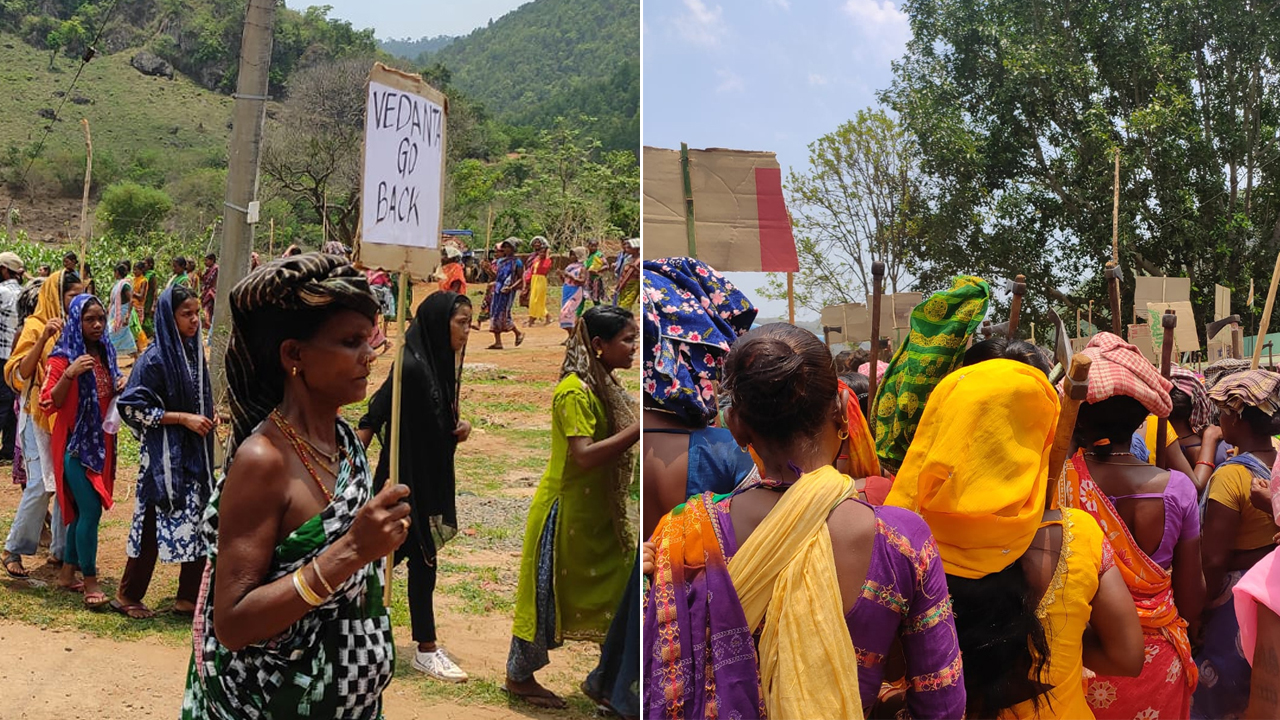
Vedanta’s Sijimali bauxite mining project has thrown Odisha’s Rayagada and Kalahandi districts into the eye of a storm. The predominantly tribal communities living in the villages at the foothills of Sijimali are opposing the project and the State has come down heavily on them.
Dr. Sankalpa Satapathy
Vedanta Limited’s Sijimali bauxite mining project aimed at supplying bauxite to the Lanjigarh refinery has thrown Odisha’s Rayagada and Kalahandi districts into the eye of a storm. The predominantly tribal, Kui speaking Kondh and Paraja communities have strongly opposed the project and the State has come down heavily on them. The violent clashes between the villagers and police personnel on April 7, 2026 were only the tip of the iceberg. The resistance has been ongoing for years now.
For the people living in the villages at the foothills of Sijimali, the mountain range, the forests, the streams are not just resources to be used but an integral part of their lives, an ecosystem that pervades every aspect of their lives. The dense deciduous forests along with non-timber produce, traditional ancestral lands, non-human dwellers and the watershed that these forested mountain range harbour, sustain traditional livelihoods and support the local economy. During lean agricultural seasons, families survive on wild food such as tubers, roots, fruits etc. They rely on deep traditional ecological knowledge built over centuries and transmitted through generations in orally codified forms which emphasize sustainable use rather than exploitation to maintain ecological balance. Indigenous community driven techniques and practices harvest, store, and manage rainwater and groundwater, protect trees, soil, and wildlife and use medicinal herbs, roots, leaves and barks for treatment of illnesses. They are culturally and traditionally deeply linked to these forests believing that their deity “Tij Raja” resides in the mountains. They get everything from the mountains and do not buy anything from outside adhering to Gandhi’s concept of self-sufficiency, Swadeshi and Gram Swaraj which focused on village independence, local production and simple living.
Beneath these forests lies an estimated reserve of 311 million tonnes of bauxite which is fundamental for the smooth running of the Vedanta Lanjigarh refinery to drive “growth and development of the region”. To reach the bauxite, the communities have to be displaced, the forests have to be felled and the mountains have to be dug in a large open cast mine. In short, the entire ecosystem has to be disrupted and destroyed. Felling forests in the mountain range leads to washing off of the rich top soil which is held together by the tree roots. These forests “catch” rain and refill underground aquifers, elevating water tables and nourishing local streams. Losing forests reduces local humidity and rain making the region hotter and drier.
The soil erosion, disruption of the local water cycle, destruction of natural wind and dust barriers turn fertile land dry and barren, leading to desertification. Ironically, India has ratified major UN environmental treaties like the UN Convention to Combat Desertification in 1996 and the Paris Agreement in 2016. After data confirmed that July 2023 was the hottest in recorded human history, the Secretary General of the United Nations, Antonio Guterres declared that “the era of global warming has ended, the era of global boiling has arrived”. It was in the same year 2023 that the auction of bauxite mining lease for Sijimali by the government of Odisha was won by Vedanta Ltd which as explained before, if comes to fruition will lead to desertification and add to the already soaring summer temperatures in Odisha.
Both the districts, Rayagada and Kalahandi, are designated as Scheduled Areas and fall under the Fifth Schedule of the Constitution which exists to protect indigenous tribal communities, preserve their unique culture, and prevent their economic exploitation. A Tribes Advisory Council (TAC) with mostly tribal members is mandatorily set up to advice on tribal welfare in these areas. This raises the question that if all necessary legislative procedures were followed why are the tribals up in arms in dissent against the state and why is there a military buildup in the areas? Why are there allegations from the tribals that the signatures on the Gram Sabha documents are in English whereas the people of the region write in Odia or give thumb prints? How can the signatures of people who are dead or had migrated for work during the Gram Sabha be explained?
The Fifth Schedule of the Constitution provides special powers to the President and state Governors to protect tribal lands, culture and local governance. Yet, in a cruel twist of fate, the people from the protesting tribal and Dalit communities have been violently manhandled and jailed despite the fact that both, the Honorable President of India, Smt. Droupadi Murmu and the Honorable Chief Minister of Odisha, Shri Mohan Charan Majhi hail from tribal communities themselves. As ancestral adivasi territories are brokered away to corporate, the adivasis are desperate for them to break their silence. What could be more ironic than tribals being arrested for demanding their rights to a life of dignity on Birsa Munda Day marking the birth anniversary of the iconic tribal freedom fighter Bhagwan Birsa Munda which is officially celebrated as Janjatiya Gaurav Divas (Tribal Pride Day). Their agricultural tools such as axes, sickle and hoes are registered as deadly weapons by the police while they are being lathi-charged, tear gassed and non-bailable warrants are being brazenly executed.
The criminalization of the protest and the gross and flagrant violation of human rights is taking a harsh toll on the health of the people. In addition to existing health conditions such as malaria, sickle cell anemia, undernutrition, and the protestors have sustained severe injuries. The days spent in protests and jails is adding to woes of missed work days compromising their already pinched incomes, loss of school days impairing education, along with mental distress and anguish that they endure from the police personnel’s vulgar behavior. The militarization of the areas and the constant drone surveillance intrude privacy and severely affect women’s bath and sanitation schedules. The coercive tactics of the corporate-state nexus are also affecting the social fabric by planting the seeds of distrust among the people. They are constantly under stress about their futures which are intimately linked to the forests and mountains and their daily lives have been filled with agitations and consultations to protect the mountain range. The mining activities will affect their socio-economic and health status negatively. The fly-ash will pollute the air, water and soil affecting their health and economies. The warning is stark in neighbouring Koraput district where residents of villages located at the foothills of the Kodingamali region, including Talakaipadar under Odiapentha Gram Panchayat in Laxmipur Block have raised concerns over the discharge of red-coloured water flowing through their village, which they attribute to bauxite mining activities in the area.
Yet, they refuse to give up. In the words of Gobinda Naik, a resident of Benteji village “if fighting for myself and my community’s rights makes me a criminal, so be it. I am not afraid of going to jail for my mother, my jungle.” Cities have already gobbled up their green cover. The rural village people and the Adivasis remains the last bastion between human greed and the last vestiges of life sustaining ecosystems. Paradoxically, their city bred brethren have chosen to stand as mute spectators. It is high time the city dwellers stand in solidarity and take concrete action with the forest dwellers to redefine growth and development. Benedict Anderson, the great scholar of Indonesian nationalism wrote “no one can be a true nationalist who is incapable of feeling ashamed if her/his state or government commits crimes, including against their own citizens”. The civil society’s deliberate mutism and aversion of gaze while the already marginalized tribal communities bear the ruthlessness and injustice of the state will come back to haunt the entire civilization when there will be no more green and blue cover of vegetation and water respectively on the earth to sustain life. The deafening silence of the civilized urban society will ultimately lead to a spectacular failure for entire human civilization and life as we know it. At a time, when “belonging” to the country is being put to test again and again, protests against the inhumanity of the process and calling the leaders of the nation to safeguard the interests of its citizens will be true nationalism.
Sankalpa Satapathy is an Assistant Professor at the Institute of Public Health Kalyani, West Bengal