
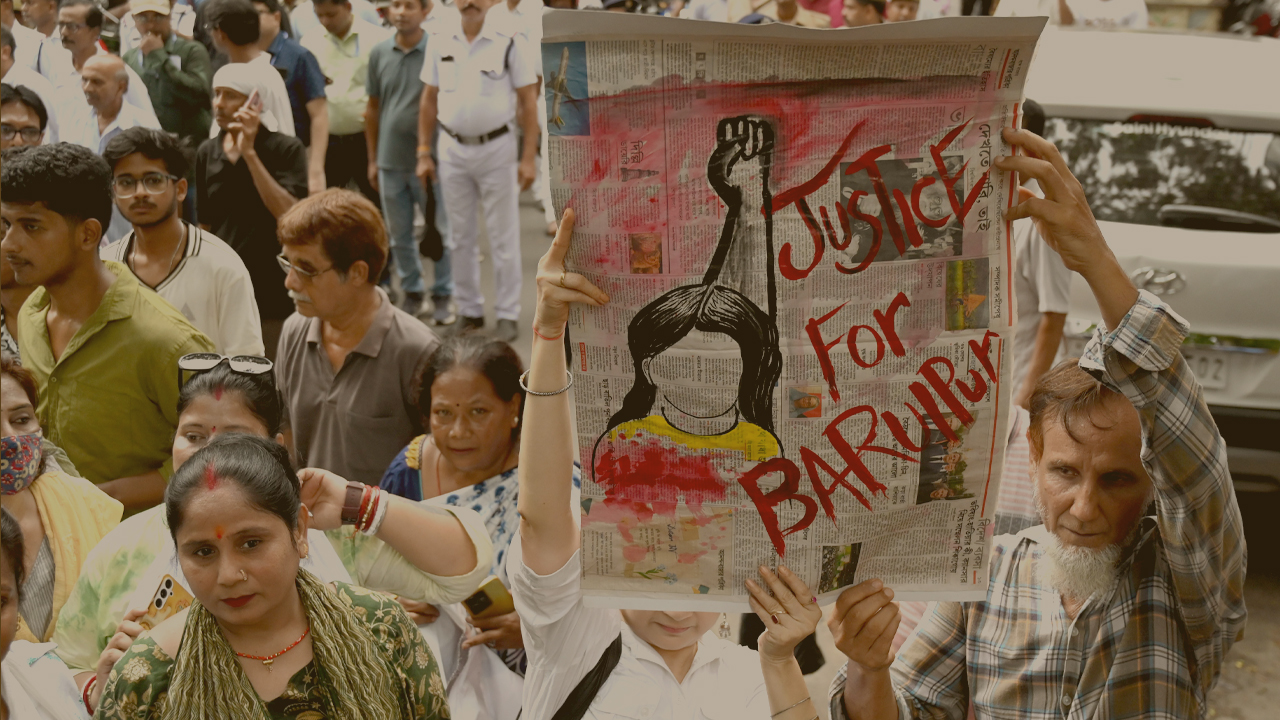
In a society where political leaders publicly endorse custodial deaths, support those accused or convicted of sexual offences, and scrutinise the ‘moral integrity’ of victims, the fear persists.
Debasree Sarkar
For the last few months of Bharatiya Janata Party’s (BJP) ascendency to power on May 5, 2026, in West Bengal (WB), news reports of rapes of minors and women have become part of our daily routine. For example, in May, in Bankura’s Jaipur area, a BJP leader was arrested after being accused of raping a seven-year-old girl; an Adivasi woman was found dead in the Amrakola forest in Kharagpur after being brutally raped in May; in June, in the Chandrakona Road area of Paschim Midnapur, a woman accused a local BJP leader of dragging her from her home, physically assaulting her, and attempting to rape her while her husband was away; also in June, reports came of an alleged gang-rape of a minor Adivasi girl in Durgapur. There are many other cases, such as the alleged rape of a minor in Malda’s English Bazar area and the Baruipur minor girl rape and murder case in July; the Dhupgiri gang rape case in August; the alleged rape of a minor tribal girl in Belpahari on August 23; the alleged gang rape of a tribal woman in Lalgarh, and the Dinhata minor assault case in September, and so on. The Adivasi community has been expressing outrage over incidents of sexual violence against tribal women over the past few months in the Jangalmahal region. The tribal social organization Bharat Jakat Majhi Paragana Mahal recently held a rally in Jhargram demanding women’s safety and swift justice for the complainants of sexual assault and violence. People from the various tribal communities of the region—including Jhargram, Purulia, Bankura, and Paschim Medinipur—along with local residents and representatives from various student and youth organizations have participated in the procession. Tribal community members stated that the atrocities against women witnessed in the few months following the change of government, are unprecedented in Bengal.
If we juxtapose this brief chronology of crimes against women in WB with the contemporary situation on a national level, these events illustrate a concerning depiction of the ongoing susceptibility of women, especially minors, Adivasi women, and those belonging to the minority community and economically disadvantaged social groups. The month of September only can reveal the concerning trend of women’s safety in the BJP-ruled states. As The Print reported, from a teenager allegedly gang-raped and killed in north Delhi to minors allegedly assaulted in homes, hotels, and various public spaces, at least 13 cases of alleged rape and sexual assault have been reported across the National Capital Region in September.
Several women students from different Delhi University colleges marched on September 25 in protest over violence against women following the alleged rape of a minor girl at the Aastha Kunj park with the slogan “Hum Auratein Azaad Hain” (we, the women, are free). The organizers criticised “protectionist policies” taken by the Delhi Development Authority’s alleged move to bar women from public parks after sunset, alongside colleges enforcing stricter hostel and PG curfews that effectively cage women rather than tackling offenders. It is not safe for women to drive on the roads of Delhi anymore. On September 12, a woman scooterist alleged that two men riding a motorcycle stalked and harassed her before hitting her scooter near South Delhi’s Panchsheel Metro Station, and the very next day, a video recorded by a camera mounted on Shivani Chauhan’s bike, appears to show a white car moving close and hitting her motorcycle. In the Hasanpur-Kotwali area in Uttar Pradesh’s Amroha district, two police personnel and two Central Reserve Police Force personnel have been arrested for allegedly raping a woman on 23rd September. And how can we forget the harassment and sexual assault of the minor girl from Jamui? Within a few days of this shocking incident, another minor girl was molested at Samastipur, Bihar.
The political affiliation of the perpetrators varies, but complaints of institutional reluctance, delayed arrests, pressure to withdraw complaints, and blaming the women for the sexual assaults/violence perpetrated on them recur across multiple incidents. The recently developed fascination with the call for encounters (a term often used to describe extrajudicial killings by the state) of the alleged perpetrators of sexual assault and/or violence has done nothing for women but espoused governing without real accountability. The insistence of Yogi Adityanath’s government in Uttar Pradesh to valorize encounters as instant justice to victims was mimicked by the political leaders of the party in different states, their supporters, and a section of the netizens. This was also reflected in the political standpoint of the BJP leaders even prior to their coming into power in West Bengal. For example, on August 23, 2023, the then leader of the opposition in the WB State Assembly, Suvendu Adhikari, said that police should resort to encounters, if necessary, to ensure the safety of women in WB, and only a person like Adityanath could control the law and order situation in WB. Not surprisingly, the BJP spokeperson Debjit Sarkar validated the alleged encounter killing of one of the main accused in the Baruipur rape-murder case as “divine justice” in a post on X.
The political orientations in a society have important implications for the development of what type of political, social, and judicial system it engenders and aspires to. For example, the incident of the Bihar CM Samrat Choudhary’s release of the photograph of the Jamui minor girl along with her parents from his official X handle on September 24 talks about the continuity of the social faux pas that men in power enjoy. The complete lack of sensitivity and respect towards the law is nothing new for the political patriarchs of Bihar. For instance, there were many criticisms against the former CM Nitish Kumar’s uncivil behaviour towards women. The last one during his tenure as the CM was the December 15 incident, when at a government event in Patna, Kumar was seen gesturing towards a woman in veil/niqab, asking a question about it, and before the woman could react, Kumar was seen reaching out and pulling down the hijab, exposing her mouth and chin. Choudhary – the Deputy CM back then – was seen trying to stop Kumar while the people were laughing in the background! Social perception is often a product of political socialisation.
Keeping this in mind, the issue of sexual violence against women remains a problem of gender discrimination, social perceptions that are biased towards patriarchal heteronormativity, and largely, the inequality that stems from other social identities—economic, caste, ethnic, or religious. This is why when we look at the atrocities against tribal women, even the society at large is not as sympathetic as it would have been if the cases were related to middle-class and high-caste women. The many cases from Unnao and Hathras of UP, the brutal rape and murder of an eight-year-old girl in Kathua of Kashmir, the violence that erupted against women in Manipur since ethnic clashes broke out between the majority Meitei and Kuki-Zo tribes on May 3, 2023, also bore the testimony of this disparity in social attention.
Together with the unequal distribution of sympathy, the administrative impunity and infrastructural faults in the BJP-ruled states have made the situation worse in recent years. The convicted rapist and murderer and chief of the Dera Sacha Sauda, Gurmeet Ram Rahim Singh, who was sentenced to 20 years in prison in 2017, was granted bail in 2022, and during that period, he hosted a virtual ‘satsang’ event, counting many politicians, including the mayor of Haryana’s Karnal and several leaders of the ruling BJP, among guests.
Imitating ‘rape culture’ or importing ‘encounter culture’ cannot provide a safe environment for women or to anyone in the society, so to speak. “Bhoy Out, Bhorsha In” (Fear Out, Trust In) was a central slogan of the BJP’s campaign during the 2026 WB Assembly elections. Framed as a battle of ‘fear versus trust’, their campaign heavily leveraged women’s safety and security to challenge the former Trinamool Congress (TMC) administration, specifically noting their inefficiency in handling the R.G. Kar Medical College rape and murder case that shook the entire nation in 2024. But as can be seen from our current discussion, in Bengal and the other BJP-ruled states, the reality is far from what was promised. In a society where political leaders publicly endorse custodial deaths, support those accused or convicted of sexual offences, and scrutinise the ‘moral integrity’ of victims, the fear persists.
The author is a Doctoral Candidate, Diamond Harbour Women’s University, Sarisha, West Bengal.