
[21 September 2026, New Delhi: More than a year after the National Human Rights Commission (NHRC) took Suo motu cognizance of a heinous case of a father’s attempt to murder and assault with acid his own teenage daughter in a small village in Haryana’s Bhiwani district, local police have still not fulfilled their directive of investigating the case and ensuring relief for the survivor.
The alleged crime took place on 3rd August 2025. The latest order to the Bhiwani Police, issued by the NHRC on 18 March 2026 (yet another in an allegedly long line of directives for an urgent Action Taken Report (ATR) to be filed along-with a call for additional information) has long passed its two-week deadline.
“This matter has been with us for over a year,” the NHRC told GroundXero on Monday, 21 September 2026. “The latest order was issued in March demanding the submission of additional information regarding the victim’s rehabilitation and financial compensation according to the Women and Child Development Department’s Scheme for Relief and Rehabilitation of Women Acid Victims, but has received no response.” The NHRC declined to comment on their further plan of action.
Such orders have been issued repeatedly to the Bhiwani Police since a former member of Haryana’s State Commission for Protection of Child Rights (SCPCR) complained to the NHRC regarding the police’s inaction on 7 August 2025, just as they have been repeatedly ignored. No further action has been taken in the matter since the first week of April, when the latest call for ATR was due.
We are publishing a year-old investigative report into the incident by MOULI SHARMA and VISHNU KHANAWALIA]
‘They Knew He Wanted to Kill Me’: 17y/o Survivor of Near Fatal Acid Attack in Bhiwani Exposes Rural Haryana’s Cultures of Silence and Inaction
On 3rd of August 2025, 17-year-old Monica from Ghuskani—a small village in Haryana’s Bhiwani district—survived not only an acid attack and horrifying murder attempt by her own father, but also a centuries long culture of silence where familial secrecy and honour codes disguise a long legacy of controlled—and legalised—violence. One that dictates women’s lives, and so too their brutal, quiet deaths. Monica’s assault was far from the sensational, freak incident local news made it out to be, but a consequence of systematic cover-up of serial abuse and violent crime. Now, she wants justice; who will make sure she gets it?
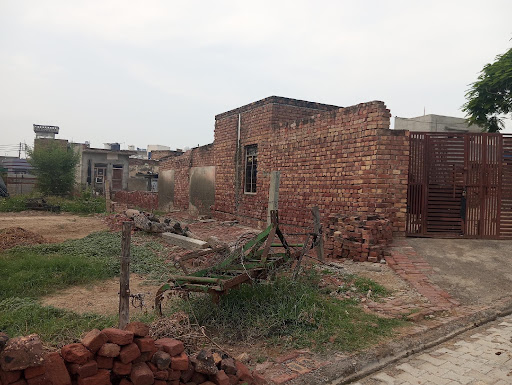
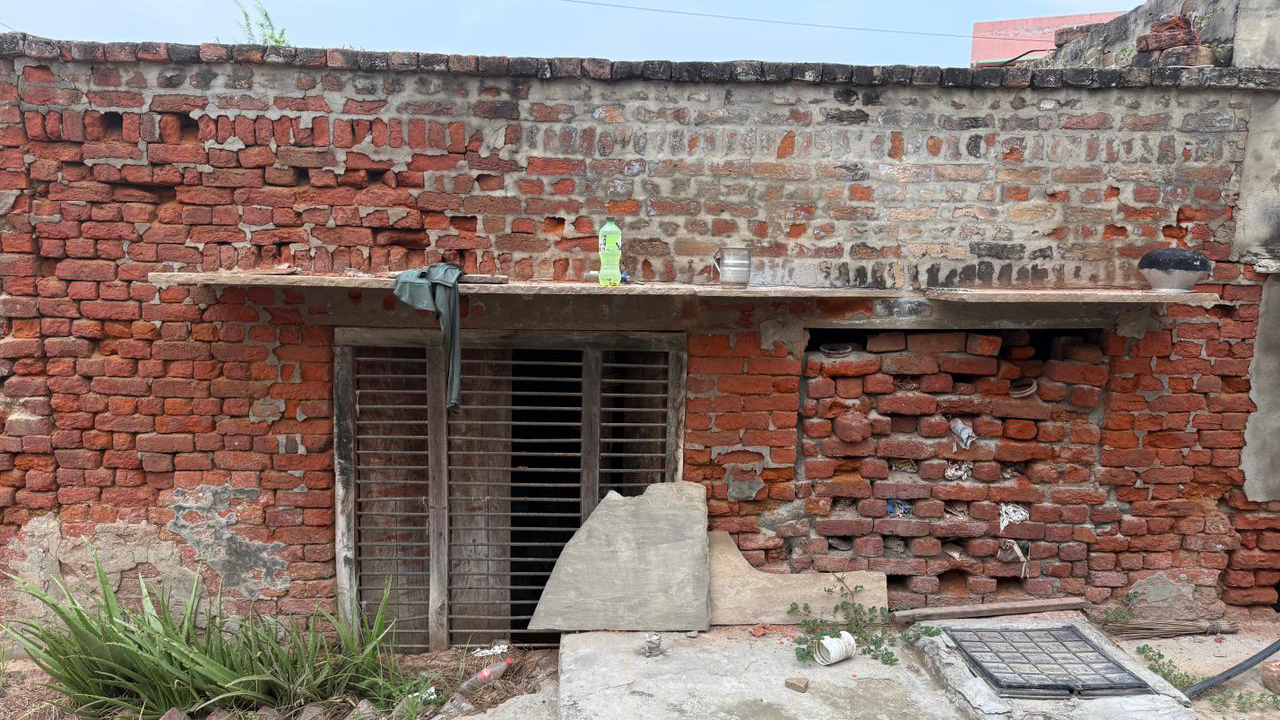
Rear side of the house of Monica, Mangal and Satyavaan. Monica’s screams were reportedly heard up to this location. August 2025/MOULI SHARMA
21st August 2025, Ghuskani, Haryana: Sunday morning, on the 3rd of August, seventeen-year-old Monica woke up to a slow day in her home in Haryana’s Bhiwani district. Her father, Satyavaan, wasn’t home very often from his full-time job at the local nursery—and he wasn’t very nice when he was.
“He didn’t much like me. He used to like my brother before, but since he began siding with me more and more often, even he got into his bad books,” Monica tells Groundxero.
On Sunday, her brother was going to return from a few days away at an aunt’s home in another village, and Monica felt lighter. She had a cup of tea, scrolled through the apps on her phone, completed the chores around the house and fell asleep, looking forward to a good day after a long week.
She turned out to be very, very wrong.
“I woke up to fire all over my face and body. My father had thrown acid in my face, and then tried to kill me,” Monica says.
3 days after the assault, an anonymous phone call to a social activist sent the matter to the National Human Rights Commission (NHRC), with allegations of serial murder added to the mix of titillating family crime. Monica’s case became not only the first of an acid-attack in her village, but the beginning of something huge; unbeknownst to her, she had survived not only a particularly bad day, but an alleged history of quiet killings and corruption in her family as well as her culture going back at least fourteen years.
A Particularly Bad Day
After attacking her with acid while she was sleeping, accused father Satyavaan Dalaal unsuccessfully attempted to kill Monica, who goes by her first name.
“I ran to save my life, screaming,” she says, but running away from one’s assailant becomes considerably trickier with acid working its way into one’s eyes.
“I couldn’t see much, but I managed to get out into the courtyard; there, he grabbed me and shoved me into the underground water tank, closing the lid. I surfaced 2–3 times to try and save my life, but he would shove me back in. Eventually, he managed to close the lid with me inside the tank. I continued to scream but eventually swallowed water. Two men heard my screams and came to help—they pulled me out of the tank.”
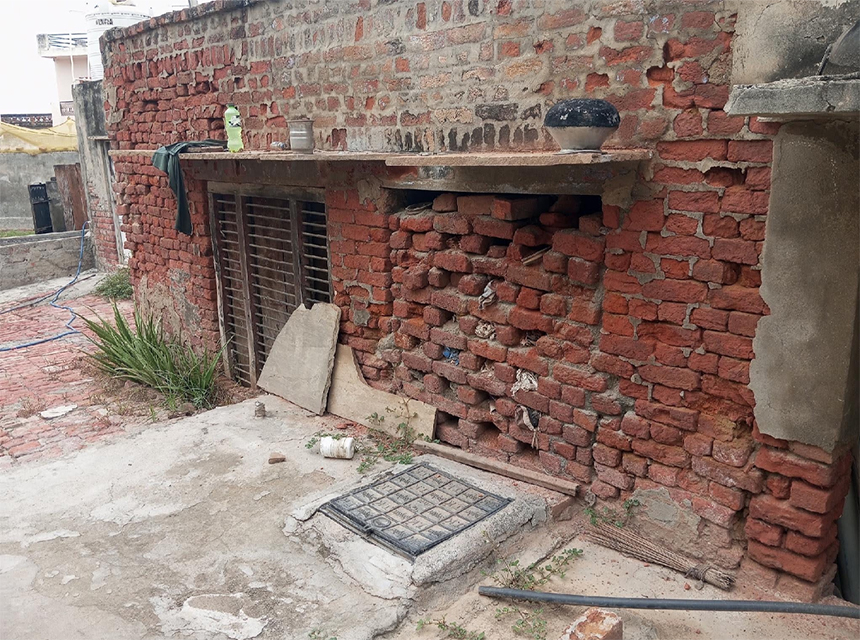
The tank—after attacking his only daughter with acid, Ghuskani’s Satyavaan Dalaal tried to drown her in the underground water tank of their home’s courtyard to stop her trying to get away. August 2025/MOULI SHARMA
But it wasn’t over yet.
“At the time, I was in so much pain, I couldn’t really tell what was going on. I knew two men had pulled me out, and that there was a woman there—a neighbour,” says Monica, recalling three of four eyewitnesses to her brutal assault: two young boys named Rahul and Mohit, along with an older woman who did not wish to be named.
“The woman left to call someone, but then my father grabbed me off the floor and dragged me inside the house. None of the boys followed us inside, where my father tried to kill me again.”
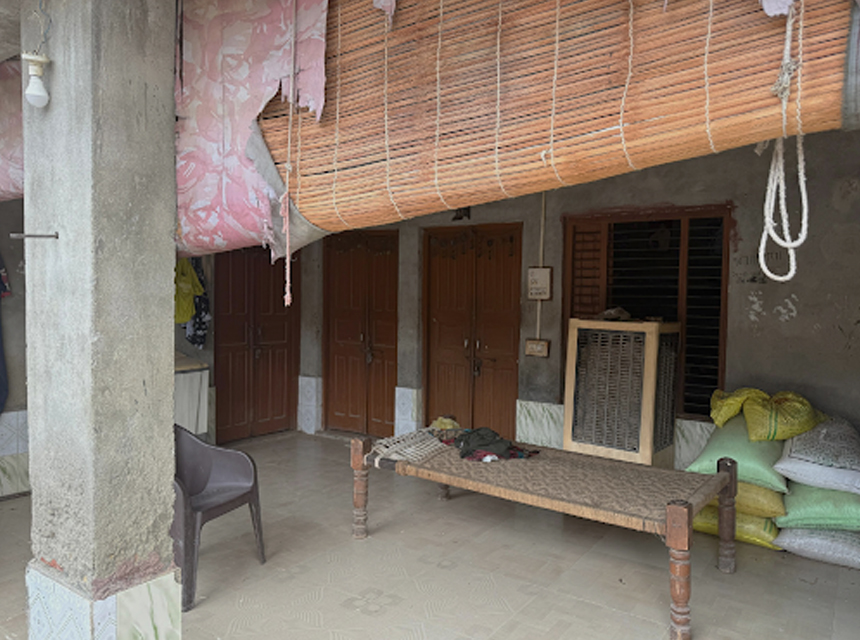
Monica, Mangal and Satyavaan’s home: After attempting to drown her in the water tank in their home’s courtyard, Satyavaan dragged her inside to try to strangle her. August 2025/VISHNU KHANAWALIA
According to Rahul, Mohit, and a fourth eyewitness named Sameer—and at the time unbeknownst to Monica—the acid and assault had eaten away half her clothes, and the boys had remained outside out of respect to her modesty. They thought that perhaps her father had taken her inside to change her out of her torn, wet clothes; instead, he smothered her with a pillow and tied a towel around her neck.
“He covered my face with a pillow so I couldn’t scream. Then he wrapped a gamchha (thin Indian towel) around my neck and tried to kill me. When I struggled, he tried to smother my face with his hand, but I got free. I got out.”
When asked how she managed to find the strength to fight him off in such a horrifying state, Monica smiles. Her brother answers for her, proud: “She bit him.”
One acid attack and two alleged attempts of first degree murder later, the village finally caught on to Monica’s ordeal. Family members were sent for and decisions were made; after much deliberation, it was decided that neither the police nor an ambulance were to be called, according to villagers who do not wish to be named. But Mohit, one of the young men who first noticed the crime taking place, had already called the ambulance.
“No one had told me not to call the ambulance, so I did,” Mohit says. “But I left immediately after that.”
Casual Nature of Violence
On the other side of the village from Satyavaan’s home, in the Panchayat complex, singer and school teacher Rajesh Dalaal, who gained infamy during the 2020 Farmer’s Protests for singing the satirical ragini, Dilli Billi—which earned him a 25-month suspension from his government job at the behest of the Narendra Modi led BJP government—performed at the village as part of a 9-day-long travelling celebration of the 100th anniversary of the historic Kakori Train Action. Mere hours before he arrived, Monica’s ordeal landed the entire opposite end of the village to the street outside her house, where the unsavoury details of the matter were shared, invented, and metamorphosized into the communal anecdotes that make up a village’s collective memory.
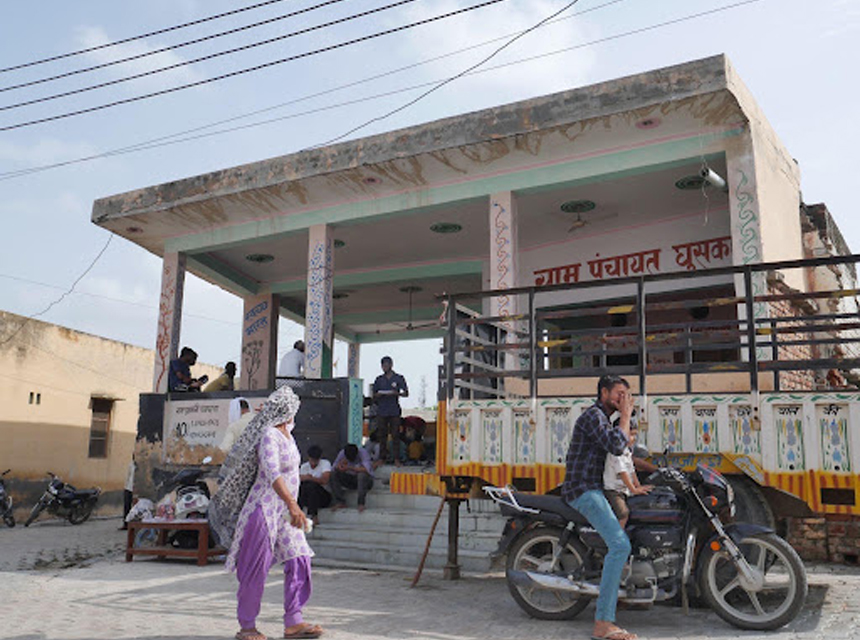
Gram Panchayat Ghuskani: The panchayat programme featuring Rajesh Dalaal was scheduled around the same time the incident occurred, due to which many villagers were occupied with the preparations and attending the event. August 2025/MOULI SHARMA
It took another day for these details, disseminated through village WhatsApp group forwards and whispered over neighbours’ walls, to reach the Panchayat complex, where this reporter had been present before, while, and after Monica survived hell.
After Monica was taken to the hospital, Satyavaan himself was left to his devices, free to return home and even go to work the following day. When Monica’s younger brother Mangal arrived in the village at around 4PM, he was in fact encouraged not to follow his sister to the hospital at all—it was labelled a ‘mistake made in the heat of the moment’, he says.
“They tried to stop me going to the hospital. Because if I’d gone, the truth would’ve come out immediately,” says Mangal, explaining that he could only leave the village by the time Monica had already been shifted to Rohtak’s Pandit Bhagwat Dayal Sharma Post Graduate Institute of Medical Sciences (PGIMS) hospital, where she is now recovering.
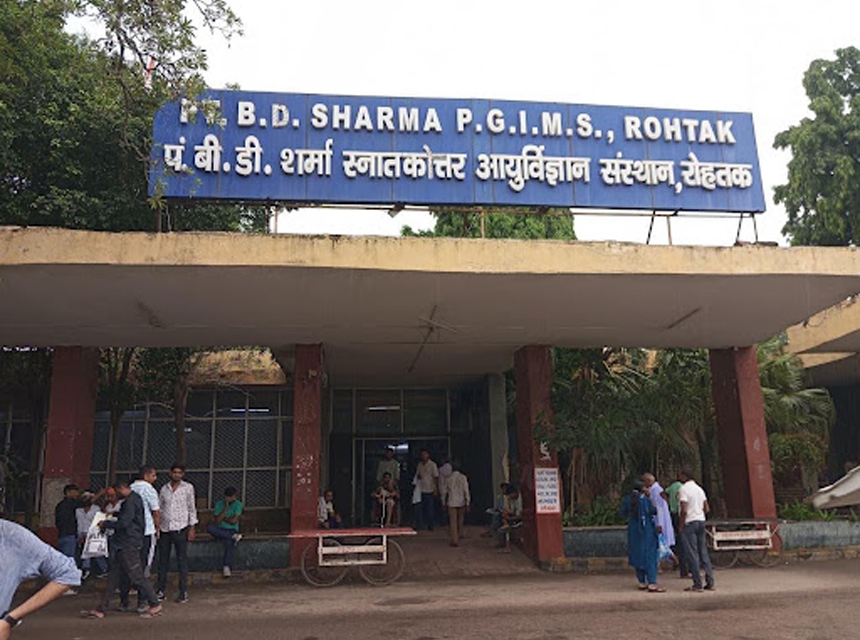
Pandit Bhagwat Dayal Sharma Post Graduate Institute of Medical Sciences, The 65-year-old campus spread across 350 acres of land. Monica was referred to PGIMS through Bhiwani Civil Hospital. August 2025/MOULI SHARMA
According to Mangal, first responders had been falsely informed by accompanying family members that Monica had hurt herself cleaning the fridge. The nursing staff at Bhiwani’s Chaudhary Bansilal Civil Hospital (CBCH) as well as the doctor on duty confirmed this.
“When the patient arrived, she was clearly in severe pain, so I immediately referred her to PGI Rohtak for plastic surgery and burn treatment. Her family members told me that ‘the acid fell on the child while doing some household chores,’” said the on-duty doctor, who did not wish to be named. “Nevertheless, it is routine procedure to call in a ‘PI’ or Police Information report in [acid related cases], so I did that.”
History of Chronic Abuse and Police Inaction
This wasn’t the first time Satyavaan had raised his hands to his daughter or even the first time he tried to kill her; more curiously, though, this was also not the first the police learnt of this chronic abuse and the threat to the children’s lives.
In the months of November and December 2023 alone, Satyavaan struck Monica on two separate occasions, including one where he pushed her out of a tempo—much like he allegedly did to the children’s late mother fourteen years ago.
On the 27th of November, Satyavaan hit Monica on the head with an unidentified blunt object, causing her to collapse and bleed profusely from the head. When Mangal heard the commotion, he asked his father what he’d done. According to Mangal, Satyavaan at the time claimed that Monica had a ‘stomachache’.
“I asked him, ‘what are you saying? She’s bleeding from the head, and you’re telling me she has a stomachache!?'” says Mangal.
Monica and Mangal recall their father taking them to the general hospital under the guise of treating this ‘stomachache’, and then throwing Monica out of the vehicle taking them there.
The children’s aunt Usha Devi also recalls the incident on 27th November as having gotten particularly out of hand.
“[In November], he’d hit her on the head hard enough that she’d got 28 stitches,” says Usha. She also alleges that he repeatedly beat his children. “This kind of thing happened thrice that month. Only after the third [serious incident] did they finally think to report it to the police,” Usha recalls.
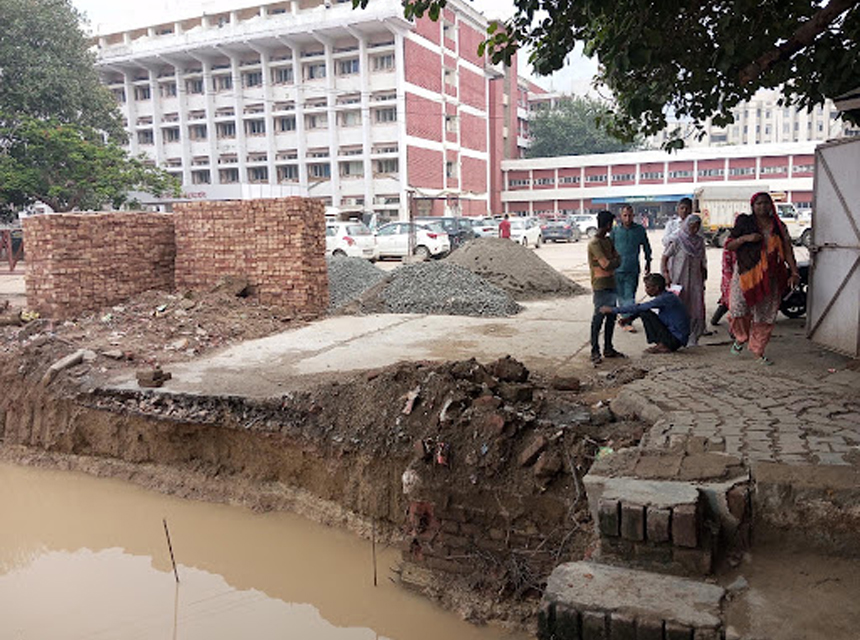
The Chaudhary Bansilal Civil Hospital, Bhiwani, pictured above, is the nearest super speciality government hospital to Ghuskani. Doctors at CBCH immediately referred Monica to PGIMS for plastic surgery after filing a police information report upon her admission to the emergency. August 2025/MOULI SHARMA
On December 7th the same year, Satyavaan again attacked Monica with alleged intention to kill, striking her with an axe and causing her yet another head injury, say the children.
Mangal, 15, also endured his share of abuse at the hands of his father as well as his extended family, though he hardly finds it noteworthy.
“That doesn’t count!” he laughs and says when asked about his father beating him. “This much happens in every home.”
One such ‘unnoteworthy’ incident took place in May of last year, when a tussle between Mangal and his father escalated to a point where Satyavaan threatened to kill him. Monica, who’d been out at the time, defended her younger brother upon arriving home, only for Satyavaan’s ire to be extended to her as well.
Despite the clear normalisation of domestic abuse in the children’s understanding, this incident scared them enough for Mangal to call the police—only for the matter to be unceremoniously dismissed by them.
Though Satyavaan was taken to the station after Monica and her brother reported him for grievous assault at the Gujrani Police Chowki, he was quickly released without any charges being pressed after his cousin, Kishan Singh (also known in the village as Boda) requested the same.
“They wouldn’t take it seriously. They said, ‘you’re kids, you don’t understand anything’. They did send a car to take us all to the station, but there [my uncle] managed to achieve some kind of compromise, and the police told us not to worry and to return home.”
Little over a year later, Mangal is recovering from a head injury after his uncle Virender struck him with a rod in April, and Monica has survived four attempts on her life and a bottle full of acid thrown over her in her sleep.
Discrepancies in FIR, Botched Investigation
Another crucial detail thus far omitted in its entirety from all coverage of the case is that Satyavaan Dalaal has not only been previously accused of killing, but has in fact gone to jail for the same.
On 10th May 2018, Satyavaan’s maternal uncle Rameshwar was murdered in a premeditated attack against himself and his wife. Satyavaan was among five people charged with his murder in the first degree, and spent several months on and off in judicial custody before he was acquitted for the same on the 1st of November 2021.
According to his children, Satyavaan’s behavior was permanently altered after jail.
“He changed,” say the children, recalling that their father, while still violent in the way they understand to be universal—was certainly less extreme, and far better tempered before going to jail. “He became angrier, picked up more fights, became considerably more violent,” the siblings say, though Monica has a clarification to make.
“Actually, over the last few years he hasn’t much beat me at all,” Monica says with a straight face. “He just tries to kill me once every few months.”
Monica and Mangal’s three-person home is haunted by Satyavaan’s history with prison, along with the ghost of Renu Dalaal, the children’s late mother. Renu passed away 14 years ago in, as the teenagers try to recall, either an accident, or an illness, or a miscarriage, or a possession; or murder.
“We were quite young,” says Mangal, who was just over a year old when he lost his mother. “Everything we’ve heard, we’ve heard from other villagers after growing up.” Renu, who was allegedly pregnant at the time of her demise, died under ‘suspicious circumstances’ as per the complaint to the NHRC for police investigation into Monica’s case, and remains rumoured to have been killed by her husband.
Add to this the fact that the police had already been made aware of Satyavaan’s chronic abuse of his children, along with the fact that he had threatened to kill them, and it becomes particularly noteworthy that an FIR against him was not registered, nor an arrest made by the Gujrani police chowki until 6th August 2025—3 days after the first call had been made to them from CBCH.
As per section 154 of the BNS 2023, police are legally obligated to file written complaints—and have them signed by complainants—should they receive information relating to the commission of a cognisable offence, say acid attacks, attempts to murder, or child abuse.
In the FIR that did get filed, a most curious omission was made from Monica’s testimony as the underage victim and primary witness of the crime: any mentions of the two consecutive attempts made on her life following the acid attack, either via drowning or via strangulation, were removed.
“On 3rd August 2025, on a Sunday, at about 2 o’clock, when I was sleeping, he threw acid on me. I was alone at that time. My brother had gone to my aunt’s home [for a festive ritual]. After this, some neighbours came running to the sound of my screams, and they called my uncle and aunt. My uncle and aunt got me admitted in the government hospital,” reads the FIR, entirely omitting any mention of the condition in which the neighbours found her—drowning inside a closed underground water tank with her father standing on the lid.
Arresting officer of the case from the Sadar Police Station in Bhiwani—under whose jurisdiction the Gujrani police chowki falls—Sub-Inspector (SI) Mukesh says that Monica’s written statement that the station received was included as is in the FIR, but Monica herself insists that not only had she mentioned her father attempting to kill her in no uncertain terms at time of her statement being recorded, she had also made sure to read the statement to check that it was written down.
“I told them everything, ‘I was sleeping when he threw acid on me, then he tried to drown me. When people pulled me out, he took me inside and attempted to strangle me.’” Monica tells Groundxero.
As per Section 256 of the BNS 2023, such an omission from public record as is likely to ‘save a person from punishment’ is a cognisable criminal offence and punishable by up to 3 years.
Interestingly, Monica’s statement was recorded not once or twice but a total of three times. At first, the police attempted to record the statement on the 4th of August, by their own admission in ‘violation of ordinary procedure’.
“The first statement was recorded without the presence of a female Deputy Magistrate (DM) or approval of the doctor in charge, which is not correct procedure,” they said. “This is why we could not register an FIR that day, nor could we make an arrest.”
As per legislations, Children in Need of Care and Protection (CNCP), i.e. minors without natural guardians, like Mangal and Monica whose mother is no more and father is in judicial custody, do indeed require the police to follow certain separate procedures during investigation. It is however noteworthy, that requiring the presence of a female DM during the recording of statements, or delaying the registry of an FIR for lack of the same are not part of them.
The following day, on the 5th of August, another statement was recorded, this time in the presence of a female DM, but due to a doctor’s objection—say the police—the statement was declared invalid. Satyavaan remained free another night.
On the night of 5th August 2025, though, something unexpected happened. Priyank Kanoongo, member of the NHRC, received a phone call from an activist and a former member of SCPCR regarding alleged police inaction in Monica’s case, initiating an unforeseen process of national scrutiny of the same.
The very next day, on the 6th of August, Monica’s statement was retaken without issue; an FIR—albeit incomplete—was filed; and Satyavaan was finally arrested and placed in judicial custody, where he remains to date awaiting trial.
Sushil Verma and Involvement of NHRC
In November 2015, 13 years after he first entered the world of children’s welfare, Sushil Verma was appointed a member of Haryana’s State Commission for Protection of Child Rights (HSCPCR), an organisation for the welfare of children mandated by the CPCR Act, 2005.
A three-year term and seven more years of independent work later, Verma felt as if working for the state, beyond the nominal authority it provided, handicapped him. “Sure, there are benefits to being part of the system—say calling up a police officer directly and inquiring about a case that you would struggle to do from the outside. But at the end of the day, child rights are far from a priority for the state. Rather, they form obstacles in their way of ‘progress,’” says Verma.
In November 2018, after a full term of forcing authorities to act and dodging the obstacles thrown his way, he retired from his post, hoping to leave behind both the nominal power that came with holding a constitutional position, and the guilt and strings attached therewith. On the night of the 4th of August 2025, though, Verma received a phone call that reminded him that neither was possible.
“They were men, these callers. Drunk, distraught; wracked with guilt,” Verma told Groundxero. “They told me a young girl had been brutalised in their village by her own father, a man suspected of having killed his children’s mother 14 years ago, having got away with it then, and who they now felt was going to get away with it again, because the police simply isn’t interested in solving these cases.”
The phone call, in reference to Monica’s case and made a day after the attack took place, was a crack in the chassis of Ghuskani’s 14-year-strong vow of silence, and credibly the sole trigger behind the unravelling of Satyavaan’s criminal past.
“They felt so helpless; I had to look into it,” says Verma, who visited the village to investigate the matter the very next day, and quickly became familiar with both Satyavaan’s horrifying history of violence and the police’s habitual inaction regarding the same.
“It was very obvious they had little interest in getting to the bottom of the case,” Verma says, explaining his decision to approach Priyank Kanoongo of the NHRC immediately upon reviewing the prima facie details of the case. “When an associate of mine spoke with the Superintendent of Police (SP) and Investigating Officer (IO) at the time to confirm the status of the case, the two couldn’t even agree on whether the victim’s statement had been taken,” he added.
“Yet another member of the force even misled me regarding the case,” Verma recalls. “He told me the girl’s father wasn’t involved in the matter whatsoever. This despite the fact that at least one eyewitness of the crime other than the survivor was even willing to speak on record.”
Rahul, the eyewitness in question and the young boy who first saved Monica’s life by pulling her out of the underground tank, says that he indeed was interviewed by the police, but not as an eyewitness, and certainly in no detail.
“They didn’t really ask me any questions. Just confirmed the date and time,” he told Groundxero.
“I was hanging out with a few of my friends in one of their homes, just a few houses away. Suddenly, one of my friends burst in the door, saying he could hear a woman screaming. I laughed it away, saying it was probably a child; I thought he was joking,” Rahul recalls.
“When he came around another time, I believed him. We went around Monica’s house to check, and heard screams coming from inside the tank. Her father was standing near the tank lid; doing nothing. I pulled her out, but then her father immediately took her inside. A few minutes later she came out screaming that he was trying to kill her; it was only then that I realised her clothes weren’t just torn, they were burnt.”
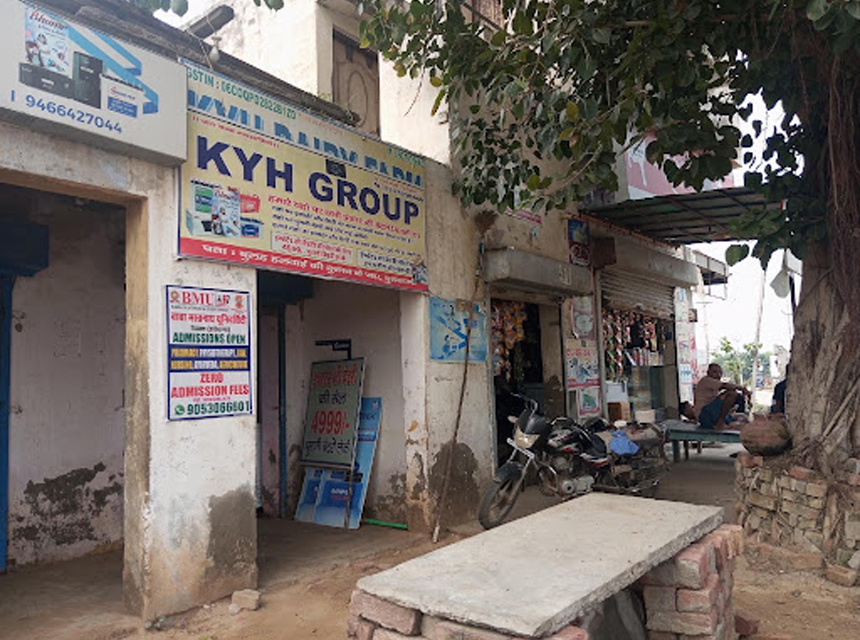
Mohit, one of the eyewitnesses, first heard screams around this place while he was buying something from the nearby general store. August 2025/MOULI SHARMA
Instead of Rahul, Mohit, Sameer or the neighbouring woman who did not wish to be named, a family member who hadn’t even been present at the scene—previously mentioned aunt Usha Devi, whose husband is incidentally a senior police officer in a different station—was interviewed by the police in the capacity of primary witness.
“Well, why should outsiders be witnesses?” asks Usha Devi, justifying the police’s decision. “It should be family.”
Both Usha Devi and Rahul’s statements, along with a search of the family’s home wherefrom a half empty bottle of acid and Monica’s tattered clothes were recovered among other evidences, were taken by the police on the 6th of August 2025—the same day Monica’s statement was approved, an FIR was registered, and Satyavaan was arrested all in a matter of hours a day after the NHRC received notice of the case.
More than 15 days later, the police still haven’t learnt what Sushil Verma managed to do in a single day, and an action taken report for the NHRC is nowhere near in sight.
“I don’t really know much about the case,” says its investigating officer SI Baljeet Singh, in-charge of the Gujrani chowki. “We have no information of any orders from NHRC at the chowki, so there has been no report compiled. As for the case, arresting officer SI Mukesh at the Sadar police station should know more, as I haven’t really been active on it since 5th August. I’ve never even spoken to the accused,” he says.
Arresting officer SI Mukesh, on the other hand, says that things are exactly the other way around.
“I’m not really involved in the investigation,” she says. “I was merely sent to make the arrest as [Singh] was busy with some work at the time. This case is of the Gujrani chowki. I’m from the Sadar station, the chowki would know more.”
“They’re lying through their teeth,” alleges Verma regarding Singh’s denial of not having received notification from the NHRC. “I know for a fact that SP Sunil Kumar is well aware of the NHRC’s orders as I have a copy of the correspondence myself. As I said, they are uninterested in solving this case,” he says.
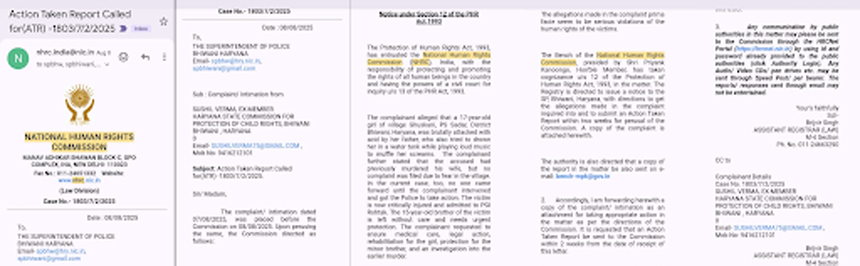
Screenshots of the NHRC order to Superintendent of Police regarding orders for preparation of an Action Taken Report (ATR). August 2025/SPECIAL ARRANGEMENT
“Here in Haryana, law, its enforcement, justice… None of these things work quite like they’re supposed to. There’s a culture here, of matters being closed out ‘internally’—a culture of compromise. Whether that be within the family, within the village, or within the four walls of the local chowki itself. I suspect if I hadn’t involved the NHRC they wouldn’t even have registered an FIR,” he confessed.
“When people know everything about everyone else, they become extremely weary of outsiders; everyone’s keeping everyone’s secrets.”
Anger, Apathy, Stagnation
When asked why she thinks her father did what he did to her, Monica asks an apt question back: “How on earth should I know?”
Though a written statement could not be made available, arresting officer SI Mukesh told Groundxero that not only had prime accused Satyavaan given the police a plausible motive for the attack, but that he had in fact confessed.
“He said, ‘that the children wouldn’t listen to me,” said Mukesh. “That, ‘they were disobedient. He admitted that he attacked her with acid. He said he did it because he suspected she was ‘going in the wrong direction’.”
Monica, though, is not interested in rationalisations.
“What I want is for him to be punished in a way that he doesn’t even dream of doing this again,” she says. “I want him to hang.”
When asked how they plan to ensure he does, though, the teenagers seem uncertain.
“Everybody in our family is on our father’s side,” says Mangal. “They are telling us that he made a mistake, please forgive him.”
The District Legal Services Association (DLSA), responsible for providing legal aid and ensuring a fair process of judicial trial for CNCP victims has already made a transfer of Rs. 1,00,000 of legal aid to the survivor, but has provided them no lawyer to advise them on how to spend it at time of writing. Bubbly of the DLSA, says an advocate will only be provided to the children after the trial commences, which may take up to three months under the liberty of the police to file their chargesheet. In these three months, the teenagers will remain CNCP’s whose legal guardian is the state itself, left to the mercy and care of the very family accused of supplementing, enabling, and hiding their abuse.
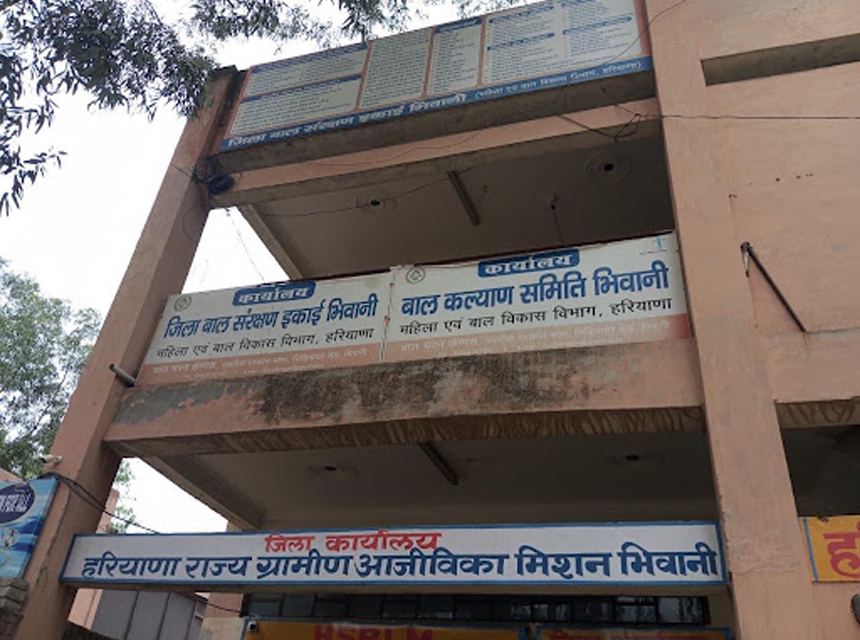
Bhiwani’s Child Welfare Committee (CWC) office, is situated in an empty-halled building on the Zoo Road next to the offices of Haryana State Rural Livelihood Mission (HSRLM) and other state welfare departments, currently employs only 3 of its mandated 5 members, notably all men, and has been unchaired for over a year. August 2025/MOULI SHARMA
‘If She Wants to Fight, She’ll Have to Fight Alone’
The attitude of apathy toward Monica’s brutal assault isn’t limited to the family alone; as Sushil Verma describes, the predominant culture in the village of Ghuskani like most he encountered in Haryana, is one of mutual silence.
“If the family doesn’t want to do or say anything, why should we?” Say villagers who do not wish to be named.
It is only with the escalation of Satyavaan’s infamous abuse of his own children and family—throwing acid on his own daughter and trying to murder her guiltlessly in broad daylight—that the villagers have broken their decades long silence, possibly due to the sensational nature of the assault.
In 2022, the most recent year for which the Haryana State Crime Records Bureau and the National Crime Records Bureau have released data—there were 48,755 recorded crimes against women and 20,550 against children. In just the last month, Haryana has witnessed a disturbing series of incidents in which women have been assaulted, brutalised, and murdered.
Evident in Ghuskani as perhaps elsewhere in Haryana—possibly all of India—is a paradigm of transient outrage: one where familial abuse by men is disregarded and eventually legitimised.
“I don’t want to have anything to do with this matter!” Says Monica’s aunt—who doesn’t wish to be named—while sitting next to her hospital bed. “If she wants to fight, she’ll have to fight alone.”
Monica, though, isn’t alone. She and her younger brother are on the precipice of a new life; one without the shadow of their parental family’s histories of silence.
There is no visible fear on her face when she addresses her return to school, and no insecurities when she expresses her interest in future studies—the only thing she and her father agreed upon. She likes history, political science, and geography. She wants to move forward in life. She plans to see this through to the end.
“I can do that,” she says in response to her aunt’s comment.
“I will do that.”
Mouli Sharma is an author and journalist from New Delhi. She has been featured in publications like The Mooknayak, GroundXero, Frontline, Maktoob Media, The Observer Post, The Leaflet, Nivarana, The Polis Project, Article 14, NewsClick, SabrangIndia, Think Global Health, etc.
Vishnu Khanawalia is an activist and a graduate of French Literature from Jawaharlal Nehru University. He has previously worked on research and logistics for various resistance movements such as the 2020 farmer’s protest, the 2024 MNREGA strike, and the recent indefinite hunger strike at JNU addressing student concerns under NEP 2020. This is his first journalistic work.