
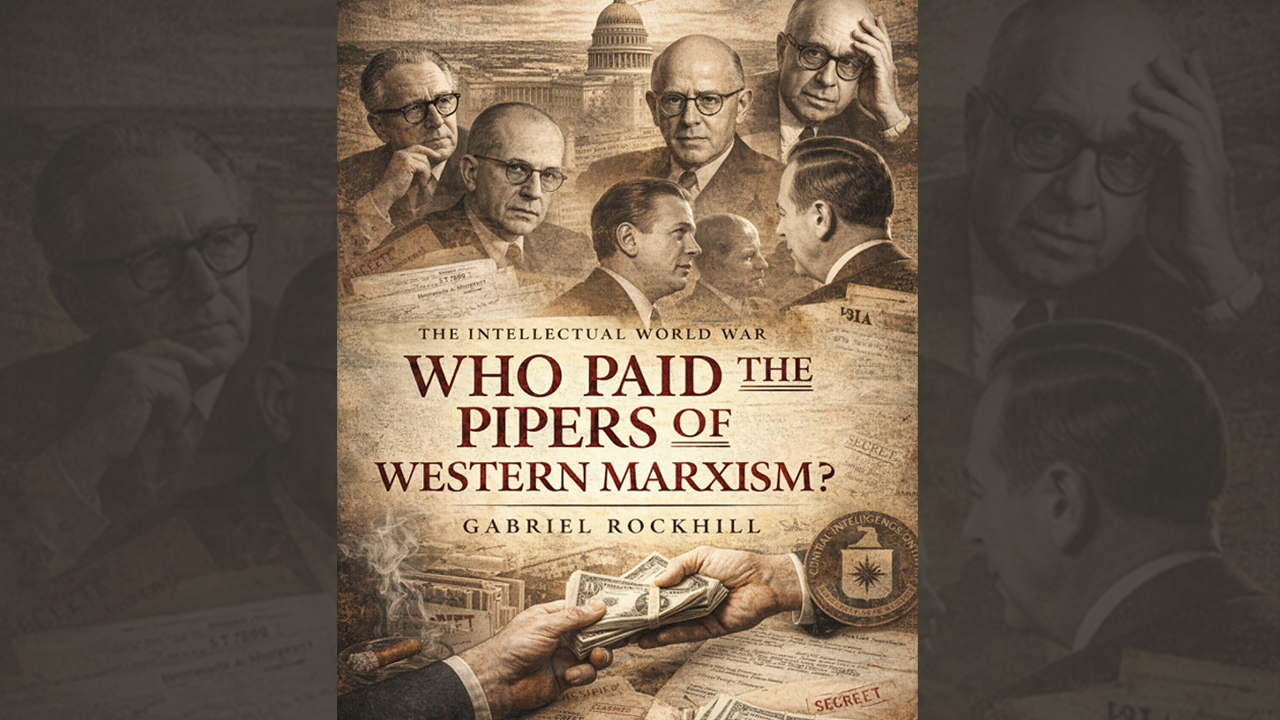
Gabriel Rockhill’s book Who Paid the Pipers of Western Marxism (2025) is a lot more than what its critics are saying.
Shyamoli Jana
Gabriel Rockhill’s book Who Paid the Pipers of Western Marxism has ruffled a lot of lefty feathers. The Jacobin Magazine, which describes itself as a “leading voice of the American left”, published a critique of it titled No, Western Marxism Wasn’t a CIA Plot. The piece begins with warnings against the return of “the class line”, and continues with accusations of assigning “guilt by association”. The journal Historical Materialism, affiliated with the SOAS University of London, published a four-part review, out of which about three parts are criticism of “Stalinism”.
As good a researcher as Rockhill might be, he is not the most engaging writer. It isn’t until the middle of the book that one gets to the facts that can refute the lazy “guilt by association” charges levelled by the Jacobin and the HM reviewers. So in the following paragraphs, I’ll try to very briefly summarise Rockhill’s description of the anticommunist propaganda machinery and the three Frankfurt scholars’ – Theodor Adorno, Max Horkheimer and Herbert Marcuse – role in it. If you are new to the topic and do not have the time to read the 400-odd-page book, I’d recommend you read the chapter Imperial Intellectual Apparatus. At the end, I will engage with parts of HM’s critiques. The facts I cite here are only a small subset of the facts Rockhill mentions in his book.
A ‘left’ for the Empire
To give an idea about how the anticommunist propaganda apparatus operates, we will discuss two examples, the Information Research Department (IRD) and the Congress for Cultural Freedom (CCF).
After World War II was over, the ‘red scare’ propaganda phase began anew, overtly and covertly. British Labour MP Christopher Mayhew drew up a proposal to create a “Third Force” propaganda campaign that “would attack capitalism as well as Communism and promote the Social Democratic values associated with the Labour government”1. In Mayhew’s words, the creation of this Third Force would be “purely tactical – a cover designed to undermine any left-wing opposition”2. And from this proposal was born the Information Research Department (IRD), an outgrowth of the British propaganda agencies of wartime, becoming “one of the largest and best-funded departments in the Foreign Office”.3
How did the IRD operate? It used a network of academics and journalists, many of whom were given material from the IRD that they passed off as their own work. Journalists in its web worked for “the Observer, the Guardian, the Financial Times, the Times, the Daily Mirror, the Daily Mail, the Telegraph and the Sunday Express.” This network included “freelance journalists and journalists working for ITN and Reuters.” 4
“The BBC was completely controlled at multiple levels, and MI5 – the UK’s domestic Security Service – vetted “its staff for ‘subversives’ from the 1930s until the practice was revealed in 1985.”” 5 The list of agencies that the IRD “established, penetrated, subsidized, collaborated with, or took control of” included Reuters, Foreign News Service and Arab News Agency, among many others.6 It was involved in the production of TV programmes, supported NGOs, and founded the Institute for the Study of Conflict (ISC) with funding from Shell, British Petroleum and the oligarch Richard Mellon Scaife. The ISC became one of the IRD’s propaganda outlets. 7
The IRD had a very solid distribution strategy for its propaganda material. It would publish and promote books that suited its purpose, sometimes bulk order prints in order to subsidize production, distribute them widely and translated them in multiple languages. 8 One such author the IRD favoured was George Orwell, who made a list of suspected communists and gave it to the IRD. The IRD had “the foreign rights to a significant portion of Orwell’s literary output, and it spent years distributing his anticommunist literature all over the world, translating it into at least twenty languages, creating an animated film version of Animal Farm, and collaborating with the CIA on a feature-length film based on the same book”. 9 A famous IRD academic was Robert Conquest, who was in the IRD and used the IRD files for his book The Great Terror: Stalin’s Purge of the Thirties (1968). 10
This is just scratching the surface of the IRD’s activities. To read more about the IRD, you can read the chapter Imperial Intellectual Apparatus. Even if you don’t, the above should give you some idea about the scope and nature of anticommunist propaganda.
After the IRD, we turn to its collaborator from the United States – the Congress for Cultural Freedom (CCF), run by an undercover CIA officer, with its headquarters in Paris. Established in 1950, it had similar goals as the IRD – using a ‘compatible left’ to combat communism. Its honorary presidents included Benedetto Croce, John Dewey, Theodor Heuss, Karl Jaspers, and Bertrand Russell, among others, and it promoted academics like Hannah Arendt and Raymond Aron. 11
It used a vast network of prestigious journals and magazines to establish its academics as authorities in academia and promote their works, which also created an appearance of unison among seemingly unrelated people and sources, making it look less like propaganda and more like agreement among different renowned scholars. 12
I would not reproduce here the details about the CCF or how the CIA promoted people, books, stories, art with the aim of spreading anticommunism. I would only add a bit about how some of the bigshot academics who had the CCF patronage reacted when, in 1966, it was revealed without a shred of doubt that the CCF was a CIA front. The news was a big scandal of the time, even finding much space in multiple well-known newspapers, such as Le Monde, the New York Times, Newsweek, New York Herald Tribune and so on. What did theorists like Theodor Adorno and Max Horkheimer who were intimate with the CCF, and Michel Foucault who was part of its network, say about this revelation? Nada. For all their critiques of power, criticising the power operating behind the network was a bridge too far. 13
Where do the Frankfurt Scholars fit in?
Rockhill pays particular attention to three of the luminaries associated with the Frankfurt school – Theodor Adorno, Max Horkheimer and Herbert Marcuse. Horkheimer became the director of the Institute for Social Research, known popularly as the Frankfurt school, in 1930. In the early 1930s, as Nazism rose in Germany, the Institute for Social Research relocated to the United States.
“Horkheimer had words like Marxism, revolution, and communism expunged from its publications in order to avoid offending its U.S. sponsors. Lӧwenthal, the managing editor of the Institute’s Zeitschrift für Sozialforschung, publicly admitted that “we stylistically reformulated certain expressions that might have been misunderstood politically.” In a telling example, when the Institute published Walter Benjamin’s well-known article on “The Work of Art in the Age of Mechanical Reproduction,” it changed the final sentence: “Benjamin had written: ‘This is the situation in which Fascism is rendering aesthetic. Communism responds by politicizing art.’ In the Zeitschrift version, though, ‘the totalitarian doctrine’ was substituted for ‘Fascism’ and ‘the constructive forces of mankind’ for ‘communism’.” 14
The paragraphs above show that the Frankfurt school censored one of its most famous scholars in order to stay in the good graces of its U.S. financiers. It shows that the Frankfurt scholars knew what they could say and what they couldn’t if they wanted funds. This is precisely the kind of influence that money has on the research it funds. Funding sources influencing content is not the unhinged assumption that HM and Jacobin are implying that it is.
Adorno, Horkheimer and Marcuse were all generously funded by the US government and produced literature that attacked socialism in various forms, while keeping generally quiet about the social security benefits like housing, ration, healthcare, education that socialism brought, rapidly improving the quality of life for the masses. Adorno and Horkheimer were closely involved with the German CCF, and the United States government paid generous sums to relocate the Frankfurt school back to West Germany in the 1950s. All of these people worked with the American secret services – the ‘association’ Jacobin and HM tell us to not read much into – and frequently spotted fascist tendencies among communists. Horkheimer’s defence of the US war against Vietnam, and Adorno’s calling the police on protesting students in West Germany are known, and their anticommunism is a lot less subtle than Marcuse. Rockhill writes:
Adorno and Horkheimer published one of their most overtly political texts in 1956. Rather than supporting the global movement for anticolonial liberation and the building of a socialist world, they celebrate — with only a few minor exceptions — the superiority of the West, while repeatedly disparaging the Soviet Union and China. Invoking stock racist descriptions of the purported barbarians in the East, whom they describe using the overtly subhumanizing vocabulary of “beasts”, they flatly proclaim that they are “fascists” who have chosen “slavery”. Adorno even chastises Germans who mistakenly think that “the Russians stand for socialism”, reminding them that the Russians are actually “fascists,” adding that the “industrialists and bankers” — with whom he identifies — already know this.
“Everything the Russians write slips into ideology, into crude, stupid twaddle,” Adorno brazenly asserts in this text… Claiming that there is “an element of re-barbarization” in their thinking, which is also to be found in Marx and Engels according to him, he unabashedly proclaims that it is “more reified than in the most advanced bourgeois thought.”… Horkheimer doubled down on their social chauvinism by averring, in a world-historical conclusion that provoked no rebuttal on the part of his “Leninist” collaborator: “I believe that Europe and America are probably the best civilizations that history has produced up to now as far as prosperity and justice are concerned. The key point now is to ensure the preservation of these gains.”
Yeah, these ‘left’ thinkers saw fascism in communists while Nazis in West Germany were being reinstated and laws were being passed banning their further prosecution. At a time when much of Asia and Africa were fighting their European and American colonisers, Horkheimer was seeing the best of history in Europe and America.
HM reminds us that Adorno was a Jew who was fleeing the Nazi regime, and his survival was on the line. It is an understandable motivation. However, it is not an argument against the case Rockhill is making. The question isn’t what compelled these Frankfurt scholars to cooperate with the US government and its anticommunist propaganda apparatus. The point is that they did cooperate, in various capacities, and well after the end of Hitler, as the above discussion shows.
The intellectual hero of the New Left, Herbert Marcuse, worked for the Office of Secret Services (OSS), the precursor to the CIA, along with many other scholars of the Frankfurt school in the United States. Rockhill writes:
As briefly mentioned, Marcuse had a “Top Secret” security clearance, and he was, according to Muller, “the leading authority” on communism “in the State Department in 1951.” He served as the head of the Committee on World Communism (CWC), which reported directly to Allan Evans, the director of the Office of Intelligence Research (OIR). When the OSS was disbanded in 1945, its Research and Analysis Branch (R&A) was integrated into the State Department, and it was officially renamed the OIR in 1947.
Yes, that is the kind of ‘association’ that looks perfectly fine to Jacobin and HM. “Guilt by association” they say, when the ‘association’ looks like this. Nothing to see there, just a man making an honest living as a ‘Marxist’ working for the State Department during the McCarthy era with a “Top Secret” security clearance.
Actually, there is a lot more to see there. Marcuse frequently contributed to intelligence reports of the State Department, and his positions seamlessly lined up with the ‘Bohlen line’. Rockhill writes:
… the Bohlen line of U.S. strategy: instead of seeing the Warsaw Pact countries as a totalitarian monolith that needed to be toppled from the outside, this orientation held that divisions within the system could be exploited to foster liberalization and revisionism, thereby cultivating an internal counter-revolution… This was one of the objectives identified by the Special Ideological Warfare Panel of the PSB in 1952: “Our task is to deepen these ideological rifts within Communism, to strengthen the heretical forces.”
… In a strategy paper titled “Conditions Engendering Defections,” which was “an official document requested by the CIA,” Marcuse and his employees in the CWC explained that the goal was “to marginalize communism in Western Europe that was loyal to Moscow and to increase the independence of communists in the Third World from the Soviet Union.”
In short, Marcuse was offering advice to the CIA – an organisation that is as anticommunist as they come – on how to weaken the Soviet Union. It takes a lot of mental acrobatics to see this as an innocent exercise in academics, and the critics at Jacobin and HM prove themselves to be quite the gymnasts.
Marcuse also secured a grant from the Rockefeller Foundation to write his book Soviet Marxism: A Critical Analysis (1958). In the acknowledgement section of the book, Marcuse thanks six people, all connected to the U.S. intelligence circles, and three of them were major CIA collaborators. 15 HM comments:
Nevertheless, even if we concede that Marcuse’s book largely continues the research he conducted for the State Department, that does not by itself debunk any of the claims advanced in Soviet Marxism. This book is not a simple anti-communist harangue – à la Robert Conquest or Richard Pipes. Marcuse notes that the USSR was not socialist in the sense envisioned by Marx and Engels. At the same time, he claims that the Soviet Union was ruled by a non-capitalist bureaucracy that oppressed the workers and peasants. But, in contrast to many Cold Warriors, he did not think that the Soviet bureaucracy was a new exploiting class. More like Isaac Deutscher, Marcuse was optimistic about the reform prospects for Khrushchev’s de-Stalinisation campaign. Finally, he rejected the idea that the USSR was an inherently expansionist state bent on global domination. Instead, he argued that the regime’s conservative commitment to “socialism in one country” tended towards coexistence and accommodation rather than aggressive expansion.
HM is right that the book being funded and helped by anticommunist bodies does not automatically invalidate everything it says. However, it does imply that the book was funded and supported by the anticommunist propaganda machinery. That the book is “not a simple anti-communist harangue” is perfectly in sync with Mayhew’s ‘Third Left’ approach to splintering and weakening the communist left. The content of the book Soviet Marxism needs a separate section, which is beyond the scope of this article. Soviet Marxism is a dreadful read, since whatever Marcuse might have been thinking while writing the book, he most definitely wasn’t thinking about the reader. The book describes the Soviet system as an aberration and states that Soviet theory suffers from “extreme poverty and even dishonesty”. As with most ‘critiques of the Soviet system’ originating out of Western Marxists, Soviet Marxism does not concern itself much with public welfare of the bread and butter variety under the Soviet system.
If the anti-Soviet Union and anti-AES (Actually Existing Socialism) positions of these scholars were entirely unrelated to their Intelligence connections as HM claims, why were there no pro-AES leftist scholars working for the U.S. Intelligence in the same capacity as Marcuse?
HM reminds us that another Marxist, Paul Sweezy, also worked for the OSS. Greene and Fluss write: “Rockhill’s strong emphasis on Marcuse’s sources of funding is not applied equally to the work of Paul Sweezy or Paul Baran, both of whom worked for US intelligence and later went on to become the chief editors of the socialist magazine Monthly Review.”
Marcuse’s involvement with the US intelligence, as the above discussion shows, was quite intimate. That involvement was also not limited to wartime, but extended to the Cold War period. It is worth looking at the contrast between Marcuse’s position and those of Sweezy and Baran, because the actual picture is far from what HM suggests.
Sweezy did work for the OSS during World War II. Then he resumed teaching at Harvard in 1945, from where he resigned in 1946. He was called before the Attorney-General during the McCarthyist witch-hunt and was sent to county jail, from where he was released on bail. 16
Baran was the only tenured Marxist economist at a major university – Stanford – during the McCarthy era. 17 At the height of McCarthyist repression, Baran considered trying to find a position in Europe. The chairman of his department, famous economist Kenneth Arrow, assured him that his job was not at risk. However, his later support for Fidel Castro caused the Stanford administration to pressure him for resignation by blocking promotion and keeping him on low pay. 18
Numerous academics, even those who weren’t communists, were harassed during the McCarthy era due to the red scare hysteria. A Marxist with a Top Security clearance was something of a unicorn at that time.
Contrary to what the HM review says, Rockhill does not portray Marcuse as a one-dimensional man and does engage with the complexity of his various positions. Rockhill’s book mentions Marcuse’s support for and involvement in the student protests and his association with Angela Davis. It also mentions Marcuse’s description of the struggle against communism being “a struggle against a hostile world-historical force”, his comment after the Bay of Pigs invasion that he did “not question the right of the United States to fight communism in the Western hemisphere” and his opposition to having communists on university campuses.
If this is what “gossip” looks like to Jacobin and HM, then they have incredible standards for what gossip is.
Socialism in one country and actually existing socialism (AES) – the main source of the beef
The critics at HM claim, “For Rockhill, criticism of AES is not merely mistaken but practically verboten – tantamount to treason against the revolution, and, at times, indistinguishable from a CIA psyop.” Rockhill’s book, which is about the role that certain Western Marxists played in the anticommunist propaganda apparatus, does not deal with the question of AES. These critics themselves, however, find that AES is a net loss for world revolution and see the anti-AES positions of these Cold War theorists as either valid or an understandable reaction to “Stalinism”. They have prepared what they call a ‘balance sheet’ to prove that the Soviet Union, China and “related regimes” have been a negative force for world revolution.
To be fair, the history of each of these AES countries is complicated, and picking some facts and omitting others to make a ‘balance sheet’ would be meaningless. The kind of historical deep dive that is needed for an analysis of AES countries is beyond the scope of this article, and also not the thesis of Rockhill’s book. Many leftists who defended the project of building a socialist state were critical of certain policies in AES countries. None of them sided with the colonial West in bringing down governments in AES countries or championed the West over actually existing socialism.
The ‘balance sheet’ by HM, interestingly, did not bother with the question of what life under AES was for the average Joe. Things like healthcare, housing, food security, literacy, education, public safety, gender equality, racial equality go unexplored or underexplored in the critiques of AES that come from the tradition that Marcuse represents. These critiques are generally light on facts about public welfare and heavy on condemnation for “totalitarianism”. These critics have acquired the remarkable ability to see the capitalist threat of going hungry, homeless and without healthcare as less authoritarian and controlling than societies that treat food, shelter, healthcare and education as basic rights.
Would it be too ‘conspiratorial’ of me to think that it is probably the result of some deliberate effort that the best known and most popular criticism of communism is that it is “authoritarian” while the capitalist West is “free” – a feat achieved by concealing the rapid improvement the ‘actually existing socialist’ countries made in healthcare, housing, education, and in reducing gender and racial inequality, without participating in imperial superextraction for the most part, while their working class counterparts in other countries toiled for pennies and died without healthcare? While the ‘Marxists’ of the New Left did not wish to bother themselves with trivialities like housing, food, education or healthcare, Marxists and some non-Marxist scholars studied the Soviet welfare system and wrote important texts, though without so much fanfare. I would quote a part from the introduction of the book Socialism, Social Welfare and the Soviet Union (1980) by Vic George and Nicholas Manning:
We started with a bias against the Soviet Union, largely because of the curtailment of civil and political liberties in the country. As our work progressed, however, we came to realise that if the political system represents the negative aspects of Soviet Society, the economic and the welfare systems are its positive aspects. We concur with Lindblom’s comments about eastern European societies, that ‘in history many of man’s greatest excesses are the other side of some great altruistic effort’ (C. Lindblom, Politics and Markets, Basic books, 1977, p.5.). Our book is concerned with the acceptable face of Soviet society, its economic and social welfare system which compares very favourably with that of welfare capitalist societies. Others have written at length about the unacceptable face of the Soviet Union and no doubt our readers will have come across some of these writings.
The passage is interesting for two reasons. One, the authors, academics at University of Kent at Canterbury, do not assume that the reader would have come across any analysis of the social welfare side of the Soviet system, even though they are hardly in doubt that people are familiar with the “curtailment of civil and political liberties” in the USSR. The discussion about Soviet social welfare was, and still is limited in mainstream academia. Two, the authors, in spite of their initial bias, were compelled by the evidence of Soviet social welfare.
Greene and Fluss say, “For Rockhill, criticism of AES is not merely mistaken but practically verboten”, when the truth is, for them, anything critical of the anti-AES position is anathema. The tactic of Greene and Fluss here is typical; it aims to put a position on the defensive. Anything critical of the anti-AES position is turned into a caricature that they call “Stalinism”. One anticipates the distortion, and follows up with endless clarifications, “No, not everything about AES countries was good”, “I don’t approve of some things Stalin did” and so on until the discussion is entirely derailed and the point one wanted to make is six feet under disclaimers.
Conclusion
The reactions from the Western left, like complaints about the return of the class line, and calling AES a net negative, are telling. Both reactions are perfectly compatible with the Empire’s propaganda goals. A return of the class line would be bad for the handful who wants to continue owning most of the world’s resources. A wholesale rejection of AES would keep state power in the hands of those handful, while billions toil for a pittance and suffer the consequences of climate change that profited the Global North. Rockhill’s book, whose title is a callback to British historian Frances Stonor Saunders’ book Who Paid the Pipers? The CIA and Cultural Cold Wars (1999), does two things: 1) it describes the anticommunist propaganda strategy of using a ‘Third Left’ to combat communism, and 2) it shows the financial and institutional ties between the U.S. intelligence and anti-AES leftists like Marcuse.
There is, sometimes, useful scholarship that comes from the Global North. But those who try to produce such scholarship from within bourgeois academia know that it is a negotiation. There are things you cannot say directly, but you try to find a workaround or a compromise. And, most people are acutely aware of this process of censorship. A graduate student in the 70s wrote about his job-hunting experience to Michael Parenti, an academic who was himself blackballed from the academia for his politics:
From first to last the item of highest priority was student issues, the complaints they were raising and the trouble they caused. Of much less importance were my qualifications for the position. Since I generally found myself at odds with my questioners about the major topics at hand, and since I wanted the job, I tried to balance diplomacy and honesty, with little success. Feigning ignorance of the facts or little concern about the problem partially accomplished the former; trying to show empathy (as opposed to agreement) with the students partly accomplished the latter. Naturally, the result of all this was an unsettling feeling that I had sold out, but not enough. 19
Rockhill’s research is quite thorough, even though the presentation feels a little scattershot. Most of us have had to work for questionable people, given they own most of the world’s resources. His critics are implying that his painstaking research is basically just pointing at this obvious fact. The purpose of this article is to show that Rockhill’s book is a lot more than that. We need more scholarship like this – scholarship that examines the workings of the Empire and, in general, serves the public interest.
Superscripts:
1 Gabriel Rockhill, Who Paid the Pipers of Western Marxism (Monthly Review Press, 2025), 109.
2 Ibid., 109.
3 Ibid., 110.
4 Ibid., 111.
5 Ibid., 111.
6 Ibid., 111.
7 Ibid., 111, 112.
8 Ibid., 114.
9 Ibid., 112.
10 Ibid., 113.
11 Ibid., 121.
12 Ibid., 123, 124.
13 Ibid., 174.
14 Ibid., 190.
15 Ibid., 290.
16 https://archives.peoplesdemocracy.in/2004/0328/03282004_prabhat.html
17 https://monthlyreview.org/articles/monopoly-capital-at-the-half-century-mark/
19 Michael Parenti, Dirty Truths (City Lights Books, San Francisco, 1996), 244.
The author is a political worker. Views expressed in the article are personal.