
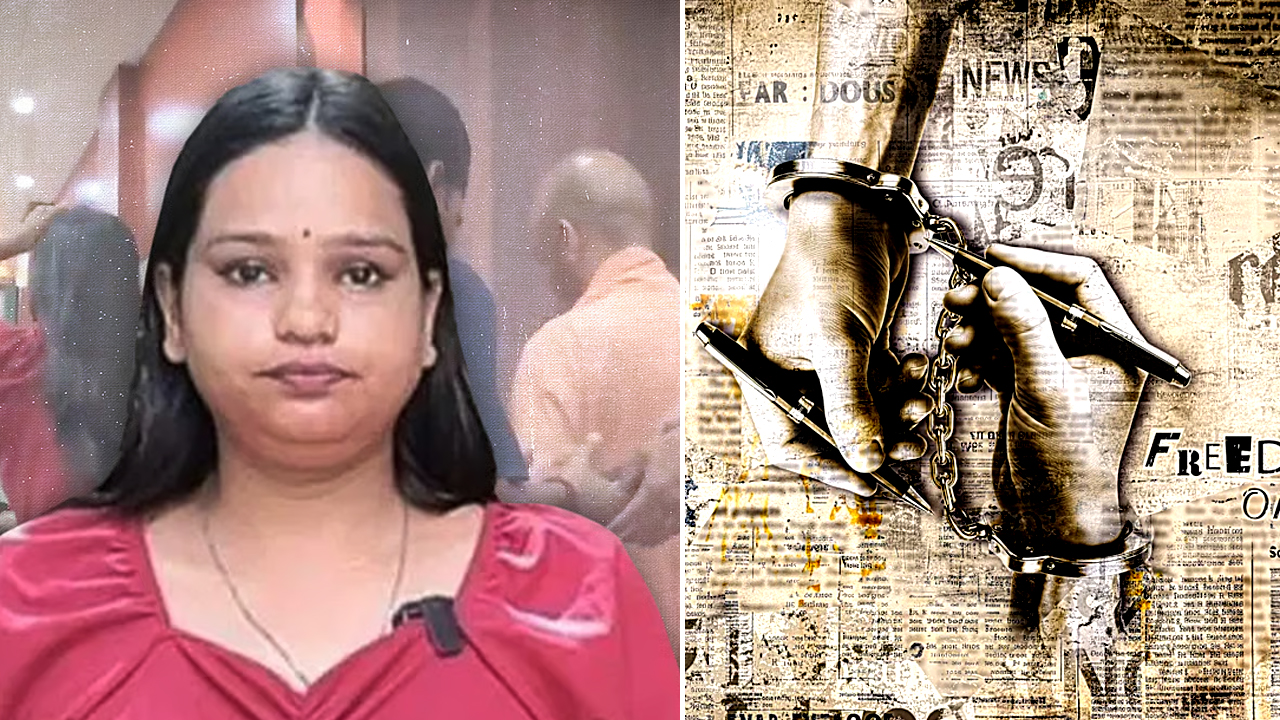
When journalists ask questions to powerful figures, be it from the Congress or AAP or BJP, there is a concerning trend of social or legal backlashes against them for doing their job.
Debasree Sarkar
On September 12, 2026, during a press meet held in Lucknow, just as the Chief Minister of Uttar Pradesh, Yogi Adityanath, finished his address and walked away from the podium, journalist Divya Srivastava from 4PM News stood up and called out, “Mr. Chief Minister, this is a press conference, and you are not even responding to a question. Why did you call for a press conference? Only, so that we get to hear what you are saying?” But this simple act of ‘questioning’ changed everything. Speaking to The Pioneer, journalist Srivastava said she asked questions during the press interaction, after which the Yogi smiled and left. Srivastava can be seen as holding a mobile phone trying to record this face-off herself as CM Adityanath and other BJP leaders begin leaving the stage after addressing a ‘press conference’ on the Sewa Sankalp Abhiyan—a month-long itinerary comprising various events chalked out by BJP in states such as Uttar Pradesh, West Bengal, Haryana, and Assam between September 17 and October 17, marking 25 years of Honourable Prime Minister Narendra Modi’s public life ever since he took oath as the Chief Minister of Gujarat. A Lucknow-based reporter told The Wire, “Usually such press conferences (emphasis mine) at the party’s office are meant for passing on the government memo with reporters hardly asking questions.” Naturally, Srivastava’s actions marked a separation from the general trend of contemporary climate.
Srivastava said that while she was leaving, people identifying themselves as Bharatiya Janata Party (BJP) supporters began shouting at her and allegedly behaved rudely, including questioning which channel she represented. Srivastava also pointed out that a narrative was being pushed on social media, alleging that she had been sent by the Samajwadi Party or the Congress. Denying these claims, calling herself an independent journalist, Srivastava said the allegations were an attempt to create a false political narrative around her questions. Srivastava alleged that she has since received threats on social media and is now afraid to leave her home. She said her family is also worried, with relatives questioning whether she became a journalist to face such treatment.
In an interview with journalist Abhishek Upadhyay, Srivastava said, “When I tried asking a question, the chief minister made a bye-bye gesture and left. Thereafter I was surrounded by BJP workers… alleging that I’m misbehaving. There is a difference between asking questions and misbehaving with someone. I didn’t use any foul language, I just requested the chief minister to respond to my query.” “One BJP member who also happens to be a spokesperson for the party insisted on knowing my name and the channel I worked for. He kept on asking about this 10-12 times during which he forced me to switch off my mobile camera and upon my refusal misbehaved with me,” Srivastava told Upadhyay in the interview. Srivastava also expressed that the experience has made her question whether the spirit of journalism—the freedom to question those in power—is still alive in India, as the controversy has left her wondering whether her years of education in journalism were “a waste of time”!
This also reminds us of the press meet of May 2026 in which our Honourable PM Narendra Modi refused to take questions from another brave young journalist, Helle Lyng of Norway, who asked uninhibitedly, “Prime Minister Modi, why don’t you take some questions from the freest press in the world?” Lyng wrote on her X account later that “Norway has the number one spot on the World Press Freedom Index, India is at 157th, competing with Palestine, Emirates & Cuba.” Even during Honourable PM Modi’s visit to New Zealand in July 2026, a Kiwi journalist asked the Ministry of External Affairs (MEA) officials why PM Modi did not conduct a press conference or take unscripted questions from the local press during his political visits.
Interestingly, even though in the latest report India’s position is undoubtedly deplorable, India has a fascinating history when it comes to press conferences. Jawaharlal Nehru, Atal Bihari Vajpayee, and Dr. Manmohan Singh are among the prominent prime ministers of India who proved the power of both domestic and international open interactions. It will be noteworthy to mention here that India’s position has seen a downward trajectory from 140th in 2014 (ascendency of BJP’s power) down to the mid-150s in recent years. But the debates around press freedom cannot be only relevant when it is being used against one political organization. We need to remember that India’s highest placement in the index history—rank 80 (out of 139 countries)—happened in 2002, when the central government of India was led by Prime Minister Atal Bihari Vajpayee, heading a coalition led by the BJP. A closer look at the opposition parties is now relevant.
In March 2025, in Congress-ruled Telangana, two women journalists were arrested over a video criticizing the Chief Minister, Revanth Reddy.
On 31st August, 2026, in Kerala, a television news programme was discussing controversial anti-women remarks made by prominent Muslim cleric Kanthapuram A.P. Aboobacker Musliar, who suggested that women should remain at home. The anchor Aparna Kurup challenged the regressive comment and questioned why such restrictions should be imposed on women. Her remarks triggered a major controversy, and Aparna and the channel, Big TV, subsequently apologized. The channel removed the program, but a complaint was filed by a man alleging that her remarks hurt religious sentiments and promoted enmity between communities. The Kerala Police subsequently booked her under provisions dealing with provocation and outraging religious feelings. This happened in a state where its current chief minister, V D Satheesan, had himself earlier opposed Musliar’s remark.
Meanwhile, in Karnataka, another Congress-ruled state, journalist G. Mahantesh’s investigative platform ‘The File’ published reports about Karnataka High Court (HC) proceedings concerning the Siddharth Vihar Trust, which is linked to Congress president Mallikarjun Kharge, Priyank Kharge, and their family. The issue involved allegations of irregularities in the allotment of land in the Trust. A lower court had ordered an inquiry, but the Karnataka HC later set aside the order. Mahantesh was reporting on these court proceedings, and after his reports were published, he stated that he received abusive calls and death threats where a caller allegedly demanded the removal of the reports.
In August 2026, an investigation by ‘the reporters’ collective’ found that the Aam Aadmi Party (AAP) had used copyright claims against at least 48 posts and videos by journalists critical of the government, with several Facebook pages subsequently taken down.
In Tamil Nadu, the Tamilaga Vettri Kazhagam (TVK) government has also faced questions over police action involving journalists, including the questioning and phone seizure of journalist Vijayan during an investigation involving TVK MLAs.
Therefore, the crucial point is the fact that when journalists ask questions to powerful figures, be it from the Congress or AAP or BJP, there is a concerning trend of social or legal backlashes against them for doing their job. In a democratic structure, this remains a severe problem of perspective that cannot be ignored in the name of certain leaders’ political strategy to prioritize direct dialogue with the people instead of showing accountability, or making it an issue of religious insensitivity or hurtfulness, or bypassing it as an infringement of intellectual property rights. The larger point here is that press freedom cannot be a principle we defend only when our political opponents are accused of curbing it. As for the Indian democracy, the test should apply equally to everyone irrespective of their affiliations. In this regards, Vajpayee’s speech at the inauguration of the International Press Institute Congress in New Delhi, underlining the press’ responsibilities, on 27 January 2001, stays immensely poignant:
“A free and responsible press is an important pillar of the Republican architecture—as essential for a healthy democracy as the legislature or the judiciary. I wish to lay special emphasis on the two defining qualities of the press—freedom and responsibility. The press is either free, or it cannot be called the press at all.”
The author is a Doctoral Candidate, Diamond Harbour Women’s University, Sarisha, West Bengal.

The govt should ensure accountability & transparency. Thanks for your marvelous statement 👍