
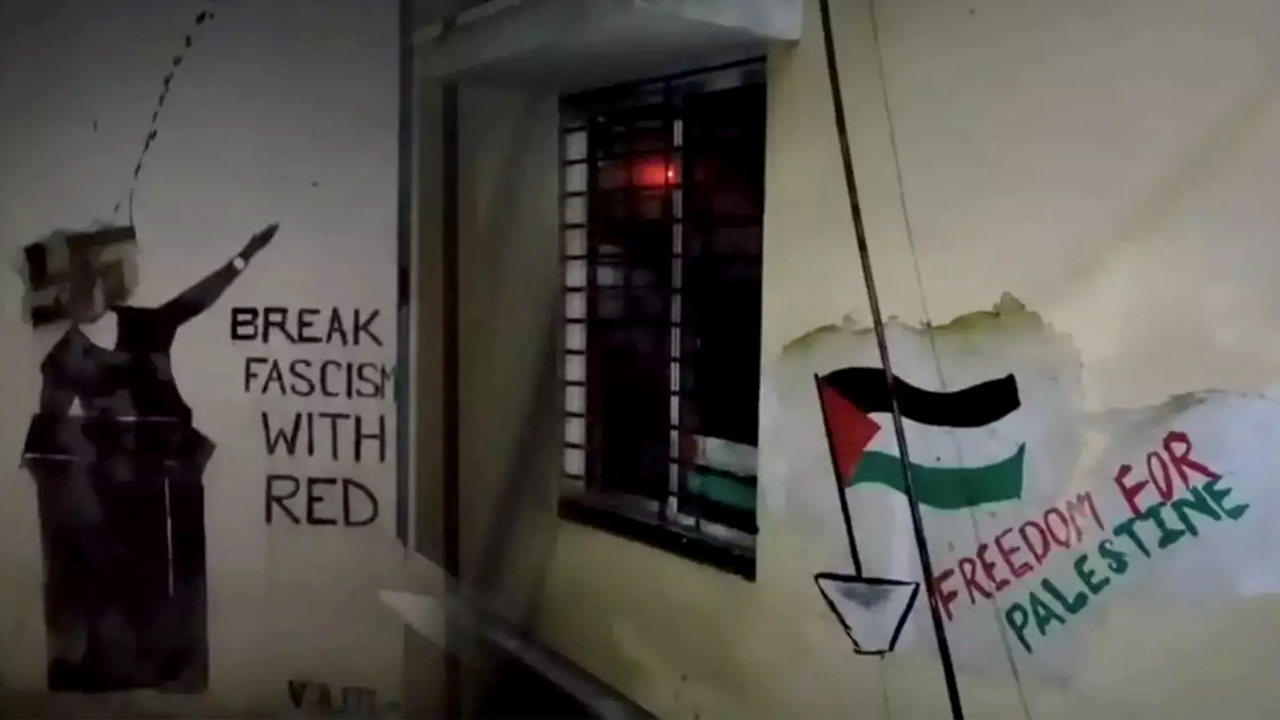
Today, as we battle to save our public universities, we must remember that what is at stake is more than just democratic practices, administrative autonomy or academic freedom.
Jhelum Roy
“I swear fidelity to the King, to his Royal successors and to the Fascist regime, and I swear to respect the [National Fascist Party’s] Statute and the other laws of the State, and to fulfil my teacher’s and all academics’ duties with the aim of preparing industrious and righteous citizens, patriotic and devoted to the Fascist regime. I swear not to be or ever become a member of organisations or parties whose activities are incompatible with my official duties.”
1931, Mussolini’s Italy. The state required all university professors to take a public loyalty oath in the name of the King and the fascist regime. Twelve refused, declaring the oath incompatible with their academic and political integrity. This defiance cost them their jobs, their social standing, for some even economic security. Nearly a century later, though, it is the refusal of the twelve that history memorialises in glorious details. Yet, today when we revisit this moment to make sense of our present, two questions jut out uncomfortably refusing to go away. The first asks, why did nearly 1250 academics, many of whom were not known fascists, comply? The second is perhaps even more obstinate: why did Mussolini need them to make a public display of allegiance at all? By 1931, the regime had already been taking hold of the university through quieter means: removing inconvenient academics, curtailing administrative autonomy, controlling appointments, rewarding political reliability and disciplining dissent. The hollowing out of the university had begun long before professors were asked to publicly swear.
So what did the oath add?
The oath offers part of the answer in its own language. It did not merely demand obedience. Professors were not merely being asked to refrain from opposing the regime. They were being asked to produce “industrious and righteous citizens, patriotic and devoted to the Fascist regime”. The oath publicly laid claim to the university’s purpose. It was not just a test of private conviction but rather a plebiscite imposed on the university. Despite wielding enormous power over institutions, the fascist project still needed public legitimacy and the public spectacle of assent could do what a million disciplinary notices could not. It allowed Fascism to claim not merely that it controlled the university, but that the university had chosen its place within Fascism. More importantly, the oath made clear that the battle was never only over who would teach inside the university, what could be taught and how. It was over what kind of people the university would make, what forms of association it would permit, and ultimately what future it would help reproduce.
So what is it in the nature and character of a public university that makes its purpose worth claiming so publicly? At its very basis, the very idea of a public university is premised on the principle that education is not a commodity but a social good that every person is entitled to. It is this very principle that makes the space of the public university answerable to certain democratic values, to practices of collective life making, and to a commitment to the society that sustains it. And, it is precisely because the university can hold open these possibilities that it has historically been such a contested site. The fact that a public university is built through collective resources, that its classrooms, libraries, laboratories, hostels, canteens, scholarships, salaries and infrastructure are sustained through the labour of the toiling masses, makes that labouring society a stakeholder in the university even if many may never step inside it. It is what makes the university ultimately answerable to this society. It is also this responsibility that bestows on the university an obligation to build democratic practices, to organise life differently and above all, to imagine that another world is possible.
The contestation that we see historically unfold is therefore a contestation over these possibilities of organising life, of ways of imagining society, and of reproducing democratic practices in a society that is otherwise deeply ordered through class, caste, gender, ethnic, linguistic, regional hierarchies. It is what makes libraries, classrooms, corridors, hostels, playgrounds, canteens that do not submit to the immediate compulsions of the market so dangerous. These no longer remain spaces organised around private returns, but rather spaces where people linger, loiter, where social life is built through the hours spent outside classrooms, through friendships, comradeships forged through arguments, reading groups, student organisations, rehearsals, strikes, or simply adda in hostel corridors, tea stalls, canteens and libraries.
It is important to note that these spaces do not magically dissolve the hierarchies that structure the society outside. Caste follows students into classrooms, canteens, and corridors. Class dictates who can afford to linger, who must work alongside studying, who can claim space with ease and who must work to catch up. Gender determines who can return late to a hostel, who can disrupt a GB to call out harassment, whose friendships are policed. Universities have historically reproduced these inequalities as efficiently as they have challenged them. What the public university cannot, however, do so easily is allow these experiences of marginalisation and inequality to remain abstract, contained within neatly insulated, airtight boxes. A caste humiliation recounted by a friend does not remain merely an entry in a sociology textbook. A comrade being stopped at the hostel gate because she returned too late makes the gendered regulation of mobility harder to treat as somebody else’s problem. The precarity of a friend who has to disappear from campus to take up a work shift to afford a fee hike, the discrimination another faces because of their food, language, religion or surname, the vulnerability of a contractual worker one sees every day who is not recognised as a stakeholder with labour rights despite working for the university for decades, all begin to acquire names, faces and histories. While friendship does not automatically politicise people, it makes indifference difficult. It begins to carry political weight. It opens up space for questioning, for dissent, for unlearning and learning, for building solidarities across differences, for political organising, for democratic practice.
In a society where democracy is lived so unevenly, these everyday humane encounters built through proximity, through friendships, however briefly and imperfectly, begin to organise lifemaking differently. Students learn to question those placed institutionally above them. People separated by caste or religion eat, organise and argue together. Workers and students find themselves on the same side of a struggle. The lives of the tea sellers outside the university gate, the sanitation workers keeping the university functional, the rickshaw puller, the bus driver become part of this collective lifemaking. This does not make the university a liberated zone. It also does not make all public universities spaces for dissent. But it does make it contradictory. The same university that reproduces caste also bears the possibility to become a site for anti-caste politics. The same campus that disciplines women can become the site where women come together to defy curfews. The same institution that prepares students for the labour market may give them relationships, habits and political capacities that refuse to understand life entirely through competition and private advancement. And perhaps this is where the danger lies.
A society ordered through hierarchy depends, in part, on those hierarchies appearing inevitable. The public university can interrupt that inevitability not only through critical theory, but also through everyday democratic practices that can, however briefly, reorganise social relations. It offers a space where authority is questioned, where solidarity is built rather than inherited, and where the ‘public’ need not arrive already defined by the state or the market, but can instead be politically constituted through disagreement, association and collective participation. In that sense, the university does not merely teach people to imagine the possibility of another world. At its most democratic, it allows fragments of another world to be practised in the present. It is this very possibility that makes the public university potentially seditious to any political project that seeks to determine in advance what kind of public may exist. It is also why regimes fight to control this space, why fascists have historically attempted to regulate what kind of public the university would produce, what forms of association would remain legitimate, and what political horizon education would serve. We have seen this in the Nazification of Universities in Hitler’s Germany, we have seen it in Mussolini’s Italy, we have seen the university become a battleground in Francoist Spain, and we can see related struggles now closer home over the saffronisation of education, the privatization of education, the erosion of institutional autonomy, the disciplining of student protest, the shrinking of spaces where democratic association can take form. What is at stake is not only what can be taught or who can speak. It is what kind of public the university will help produce, and whether it will remain a space where people can still learn to live, think and act together beyond the terms set by the state and the market.
It is why battles over public universities so often take apparently mundane forms. Whose messages can remain on the walls of a campus? Why should taxpayers’ money sustain departments that cultivate forms of critical thought capable of unsettling those in power? Why should unions remain part of university life? Why university gates should remain open to people who do not carry an identity card? Why should students, teachers and workers concern themselves with questions of caste violence, labour rights, gender justice, citizenship or democracy that appear to lie beyond the immediate business of earning and awarding degrees? Each of these questions is, in fact, a question about what a public university is for. If the university is merely an institution for producing employable individuals, then much of this collective life appears unnecessary, even disruptive. But if the public university carries an obligation to the society that sustains it, these same spaces acquire another meaning. The walls become ‘publishers of the poor’. The union becomes one of the institutional forms through which university life can be collectively organised. The open gate keeps traffic of knowledge and political life flowing from the university to society, each shaping the other. The protest becomes a responsibility to the labouring society to which the university owes its existence. This is also why attacks on public universities rarely remain matters internal to the campus. When students are beaten, unions banned, departments defunded, teachers silenced or university gates closed to the public, and the state demands unquestioning allegiance, it is an attempt to redefine this public, to reorganise social relations and democratic practices. It raises a much larger political question on the importance of sustaining these spaces where people can encounter one another outside the relations prescribed for them by the market and the state, and where the meaning of the public itself can remain open to contest.
And yet, if these possibilities make the university so politically consequential, the other question becomes harder to ignore: why did nearly 1250 professors comply? The easiest answer is cowardice. But, political courage, too, has a material infrastructure. It forces us to confront the uncomfortable truth that by the time the oath arrived in 1931, the professors who stood before it were not standing inside the same university that Fascism had inherited almost a decade earlier. The years preceding the oath had already done their work. Academics considered ‘troublesome’ had already been removed, marginalised or coaxed into retirement. Administrative autonomy had been silently eroded. Appointments and promotions increasingly passed through tests of political reliability. Student organising was criminalised and brought under fascist control. Dissent did not disappear in one spectacular purge; it was worn down through a series of smaller accommodations, disciplinary measures and silences. When one colleague was pushed out and the others continued teaching; when an appointment was politically manipulated and academic life carried on; when administrative autonomy was surrendered piece by piece without a collective confrontation, it cost the university its collective life. By the time professors were finally asked to swear, much of the associational and institutional ground from which they might have refused together had already been eroded. So, by the time the demand became impossible to mistake, professors were confronting it largely as individuals. It is important to remember that a professorship was a salary, social standing, years of labour, access to books and laboratories, professional relationships, often the economic security of an entire household. The professoriate occupied a privileged social position that fascism could negotiate with. For many, accommodation made it possible to preserve that position. Chairs remained chairs, careers continued, authority survived; for some, new opportunities opened. The regime could secure the cooperation of academic elite without dispossessing it wholesale. Class interest therefore entered the oath not necessarily as conscious fascist conviction, but through the much quieter question of what accommodation allowed one to keep.
Yet there also lingers a larger question of an ethical choice being made. The oath was unusually explicit about what professors were being asked to accept: that their teaching would help produce citizens devoted to the regime. One could tell oneself that staying inside protected students, preserved scholarship, kept a laboratory open, or left a small space for independent thought. One could distinguish a public signature from a private conviction. But the oath made that distinction increasingly difficult to sustain. It asked academics whether the continuation of their own professional lives could be separated from responsibility for what the institution itself was becoming. And it asked them to abandon the responsibility of keeping alive a different vision of the public university. Fascism did not need 1250 committed Fascists. Years of quieter institutional capture had already weakened the possibility that those 1250 would confront the question together. The regime needed them to encounter the oath as individuals, each weighing conscience against livelihood, ethics against interest, resistance against what had already come to feel normal. The cost of dissent had been individualised long before the spectacle of consent was collectivised.
It is therefore perhaps not incidental that the neoliberal reorganisation of the public university has accompanied the attacks we see around us today, and made the university more vulnerable to them. In Nazi Germany, the White Rose movement stood on the collective life built through friendships and socio-cultural practices that made courage possible. In Francoist Spain, student networks, cultural associations and solidarities that increasingly reached beyond the campus turned scattered dissatisfaction into organised opposition. During the anti-NRC, CAA in India, we have seen universities spilling onto the streets as libraries of resistance, community kitchens, neighbourhood solidarities and shared political life. It is this spilling of spaces, politicisation of friendship and reorganising of sociality and collective life that offers a glimpse of what a public university can be and what it means for a university to be truly public. It is this possibility, this potential that makes this space, these associations seditious. The public university becomes a political battleground because it can make forms of collective life that neither the market nor authoritarian power can fully prescribe. In a society organised through profound inequality, such spaces possess the power to unsettle the carefully contained order. Today, as we battle to save our public universities, we must remember that what is at stake is more than just democratic practices, administrative autonomy or academic freedom. What is at stake is this imagination, this possibility, this idea of the public university itself. The struggle over the public university is therefore also a struggle over whether we will continue to possess spaces in which other ways of living together can be made real enough to become imaginable elsewhere.
Jhelum is a feminist activist and a research scholar.