
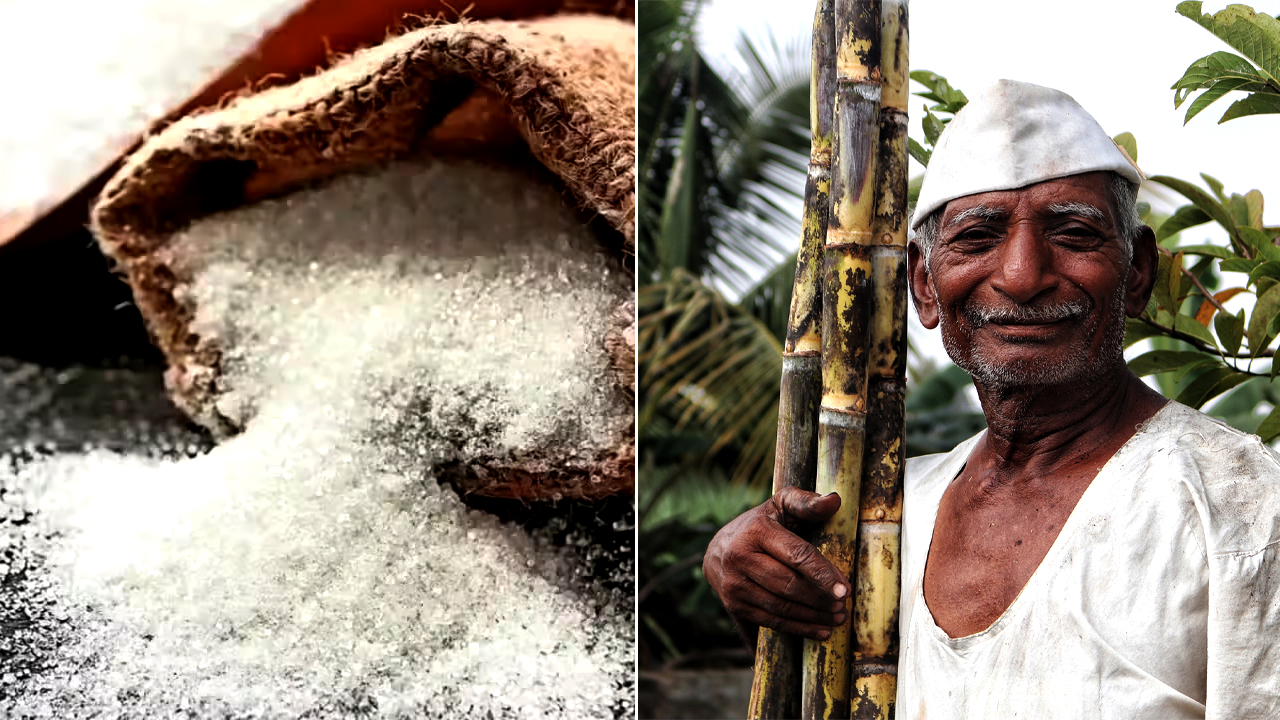
As sugar prices surge from Rs 48.18 to Rs 62 per kg in less than two months, SKM – the joint platform of farmers’ unions – accuses Modi government of facilitating market profiteering; demands Rs 5,500 per tonne for raw cane and mandatory sharing of sugar-industry surplus with cane farmers.
Groundxero Desk
Sep 17, 2026
The Samyukta Kisan Morcha (SKM) has accused the BJP-led Narendra Modi government of facilitating “market loot of people” through what it describes as an “unbridled” and unjustifiable surge in retail sugar prices, while allowing sugar mills, traders and the politically poweful sugar lobby to amass huge profits by looting farmers as well as consumers.
In a press note issued in New Delhi on September 17, the joint platform of farmers’ unions, pointed to the sharp rise in retail sugar prices over the past two months. According to SKM, sugar was selling at an average retail price of Rs 48.18 per kg on July 20, 2026. The price rose to Rs 55.70 on August 20, Rs 58.23 on August 21 and Rs 62 on September 15. In several markets, it has reportedly crossed Rs 70 per kg.
SKM has demanded that the government to end its surrender to the powerful sugar mill lobby and urgently intervene to curb speculative trading and regulate sugar prices. Its principal demands include fixing the sugarcane price at Rs 5,500 per tonne, and enacting a law mandating the sharing of sugar mills’ surplus with cane farmers.
Sugar mills, ethanol and the politics of surplus appropriation
SKM has linked the current sugar price rise to the increasing diversion of sugarcane towards ethanol production. Average sugar production between 2020-21 and 2025-26 has remained around 32–34 million tonnes, while the quantity of sugarcane diverted for ethanol has increased substantially in recent years.
According to SKM, the quantity of sugar diverted for ethanol production rose from five lakh metric tonnes, or 2 per cent, in 2018-19 to 22 lakh metric tonnes, or 6 per cent, in 2020-21, and 43 lakh metric tonnes, or 13 per cent, in 2022-23. With cane production declining, the figure fell to 34 lakh metric tonnes, or 10.5 per cent, in 2024-25.
The organisation argues that the policy has created conditions in which sugar mills and wholesale traders benefit from high ethanol and sugar prices, while cane farmers see little corresponding gain.
SKM has presented an example of the estimated loot by sugar mills based on a standard medium-to-large private sugar mill in Uttar Pradesh with a crushing capacity of approximately 5,000–8,000 tonnes of cane per day. Assuming a 130–150-day crushing season, it estimates annual white-sugar production at around 80,000 tonnes, with a commercial recovery rate of 10 per cent after molasses separation.
At the current premium State Advised Price (SAP) of Rs 395 per quintal, SKM estimates the annual cost of raw sugarcane for such a mill at around Rs 316 crore. Adding an estimated Rs 48 crore in operational costs—including labour, chemicals, packaging, maintenance and field logistics—the total annual expenditure is put at approximately Rs 364 crore or Rs 600 per tonne.
Against this, using the ex-factory sugar prices recorded in August 2026, SKM estimates the mill’s annual turnover from white commercial sugar at Rs 432 crore and total gross revenue, including molasses, bagasse and pressmud, at Rs 551.76 crore. It puts the estimated net profit at Rs 187.76 crore.
At an ex-factory sugar price of Rs 48 per kg, SKM estimates the annual net profit of such a standard Uttar Pradesh sugar mill at Rs 139.76 crore annually.
SKM argues that if 50 per cent of this profit were shared with cane producing farmers, the cane price could rise by approximately Rs 873.50 per tonne, taking it to around Rs 4,820 per tonne.
The figures are presented by SKM as an illustration of the distribution of surplus in the sugar industry, rather than as an audited industry-wide calculation.
Cane farmers squeezed at both ends
Farmers grow the cane. Consumers buy the sugar. Yet, the mills and traders, SKM alleges, pocket the expanding surplus. As retail sugar surges the Modi government is protecting the interests of the sugar mill owners while leaving farmers squeezed between rising input costs and stagnant cane prices. SKM is demanding Rs 5,500 per tonne for sugarcane and a law mandating that sugar mills share their surplus with the farmers who produce their raw material.
Cane farmers, SKM says, are increasingly confronting the combined power of sugar-mill lobbies and traders. Farmers in different parts of the country have been mobilising over the opening of closed cooperative sugar mills and demanding higher Fair and Remunerative Prices (FRP) and State Advised Prices (SAP).
For SKM, the issue extends beyond the price of sugarcane. Higher and remunerative farm prices, it argues, would increase the purchasing power of farmers and agricultural and factory workers, helping counter rural unemployment, distress migration and the broader agrarian crisis.
The organisation has also attacked the government’s methodology for determining agricultural prices, arguing that the Commission for Agricultural Costs and Prices (CACP) continues to calculate MSP on the basis of A2+FL, rather than the farmer unions’ longstanding demand for C2+50 per cent.
SKM further alleged that large cane-payment arrears remain unpaid by the mill owners despite provisions under the Sugarcane (Control) Order.
A demand to redistribute the sugar surplus
SKM has accused the Modi government of surrendering to the interests of the politically powerful sugar mill lobby by failing to curb speculative trading and allowing mills and traders to accumulate what it describes as excessive profits.
Its central demand is therefore not merely for an increase in the administered cane price for farmers but for a structural change in how the sugar industry’s surplus is distributed. SKM is demanding that the SAP be raised to Rs 5,500 per tonne at a 9.5 per cent recovery rate, alongside legislation making the sharing of sugar-industry surplus with cane farmers mandatory.
According to SKM’s estimate, raising the raw cane price to Rs 5,500 per tonne would transfer an additional Rs 92,500 crore to farmers based on current sugarcane production.
The organisation’s argument is straightforward: if the sugar mills can profit from higher market prices, the farmers whose crop provides the mill’s raw material should not be left to absorb the costs of both production and consumption.
The SKM’s demand places the question of sugar prices within a larger struggle over who controls agricultural markets and who ultimately captures the surplus generated by farmers’ produce.