
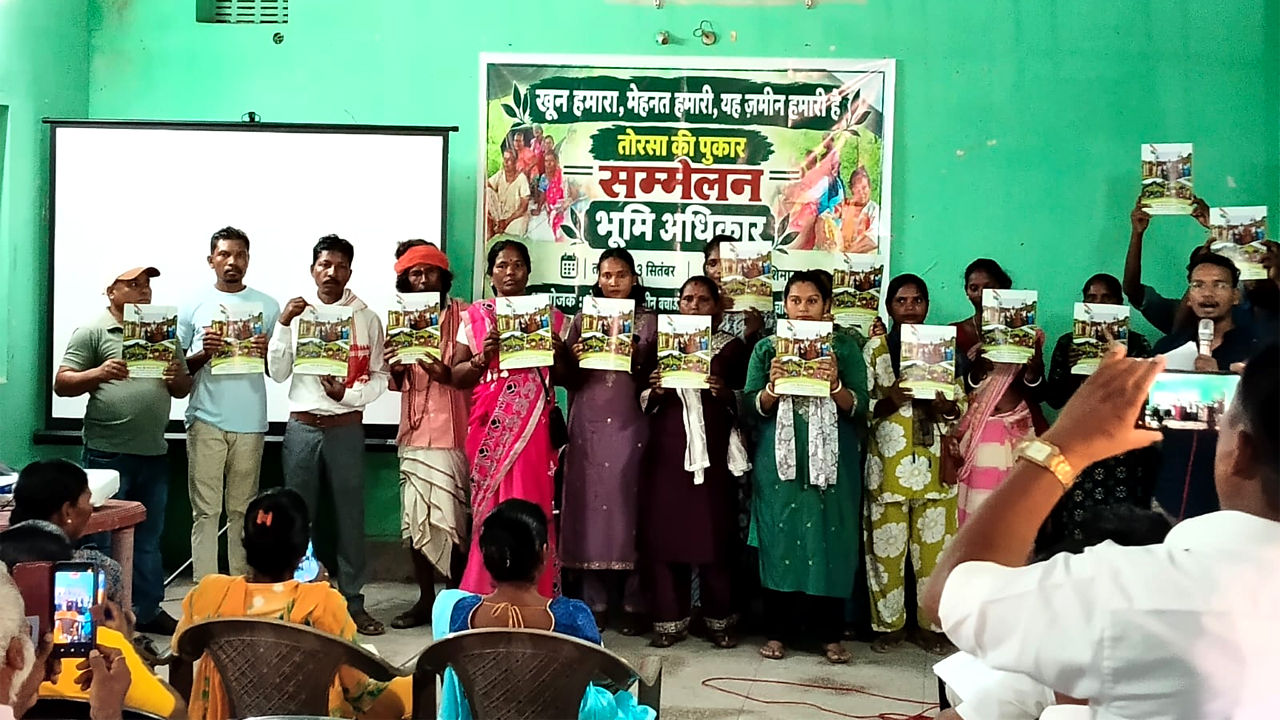
A convention held in North Bengal has called for a united movement against the continuing denial of land rights to tea workers, Adivasis, forest villagers, bustee residents and other working-class communities across the region.
Groundxero Desk
SEP 13, 2026
More than 100 people representing 10 organisations came together at the Convention on Land Rights of the People of North Bengal’s Tea-Growing Region, demanding an end to a land regime that, they said, has consistently protected the interests of tea garden owners and other powerful interests while leaving generations of workers without secure rights over the land on which they live and work.
Speakers at the convention included Rajkumar Kashyap of United Forum for Adivasi Rights (Terai), Ashish Kujur of Ulgulan Bharat Adivasi Ekta Manch (Nagrakata), Abhijit Nag of AICARD (Kalchini), scholar Neh Indwar, Rabi Rabha of Uttar Banga Jan Van Shramajivi Manch, Mohar Ali Mondalof Bhukha Manusher Adhikar Abhijan (North 24 Parganas), Rahul Barman of Paschim Banga Khet Majoor Samity (Cooch Behar), and Parimal Oraon of Rajipahra Prathna Sabha (Madarihat). Babul Lama and AnuradhaTalwar spoke from Paschim Banga Chai Majdoor Samity (PBCMS).
The convention underlined a fundamental contradiction in North Bengal’s tea economy: the labour of generations has sustained the tea industry, but the people who produced its wealth remain effectively landless. The state has protected the rights of tea garden owners while leaving generations of workers without rights to the homes they occupy and the land they have cultivated for decades.
‘Stop the acquisition of Torsa land’
The convention expressed solidarity with the people of Torsa, who have been resisting the acquisition of their ancestral land for the proposed Jaigaon Land Port.
The convention demanded an immediate halt to the proposed acquisition of 22 acres of land belonging to the people of Torsa. Instead, it called upon the government to resume 20 acres of unused and vacant Torsa tea-garden land located across the road.
The question raised at the convention was pointed: why should the land of people who have lived there for generations be taken when tea-garden land lying unused is available?
The meeting began with 15 members of the Torsa Bagan Zameen Bachao Samity, led by Miriam, formally releasing a fact-finding report on the threatened displacement. The report was prepared by Professor Virginius Xaxa, Siraj Dutta and Anupradha Singh. Participants also heard an account of the community’s more than two-month-long struggle, while advocate Tamalika Bera provided an update on the public interest litigation filed by Paschim Banga Chai Majdoor Samity (PBCMS) in the High Court.
A region-wide land crisis
The convention placed the Torsa struggle within a much wider history of land dispossession in North Bengal.
Tea workers were brought to the region as indentured labour and settled in labour lines. In many cases, they were also given land on which to cultivate food as part of their wages. Yet neither the colonial government nor successive governments after Independence recognised their rights over the land they occupied and cultivated.
Instead, according to the convention, the State continued to protect the leasehold interests of tea garden owners while treating workers’ claims to land as though they did not exist.
That historic injustice is now being intensified by the expansion of tourism and urbanisation. The Convention noted that with the development of tourism and Siliguri city, workers in gardens in Terai and the hills were facing accelerated dispossession.
The crisis, however, extends beyond the tea gardens. Forest villagers continue to face eviction despite the Forest Rights Act. Bustee settlements that have existed for decades remain without secure land rights. Rapid urbanisation has carried the struggle into towns such as Jaigaon, Birpara, Nagrakata, Metelli and Mal, where many residents and landholders still lack secure rights over their land.
Speakers also raised land conflicts along the India-Bangladesh border and in Madarihat, pointing to a wider problem: even possession of land documents does not necessarily protect people from the threat of dispossession without meaningful consultation.
The Convention also very strongly said that the government cannot continue taking land from the poor for the benefit of the powerful. The speakers stressed that the State must obey its own laws and the welfare-oriented principles of the Constitution.
From scattered struggles to a common movement
The Convention called for an end to the fragmentation of these struggles into isolated local disputes. It argued that the denial of land rights confronting tea workers, Adivasis, forest villagers, bustee residents and small landholders is part of a common political and economic process in which land is increasingly made available to powerful interests at the expense of the poor.
The participants agreed to form a Coordination Committee to bring together organisations and communities fighting for land rights across North Bengal. The convention concluded with two slogans that summed up its political message:
“Our Blood. Our Labour. This Land Is Ours.”
“Government, You Respect the Law — Then We Stand With You.”
The message from the convention was unequivocal: The people whose labour has sustained North Bengal’s economy are demanding the right to remain on, cultivate and control the land on which generations of their communities have lived.