
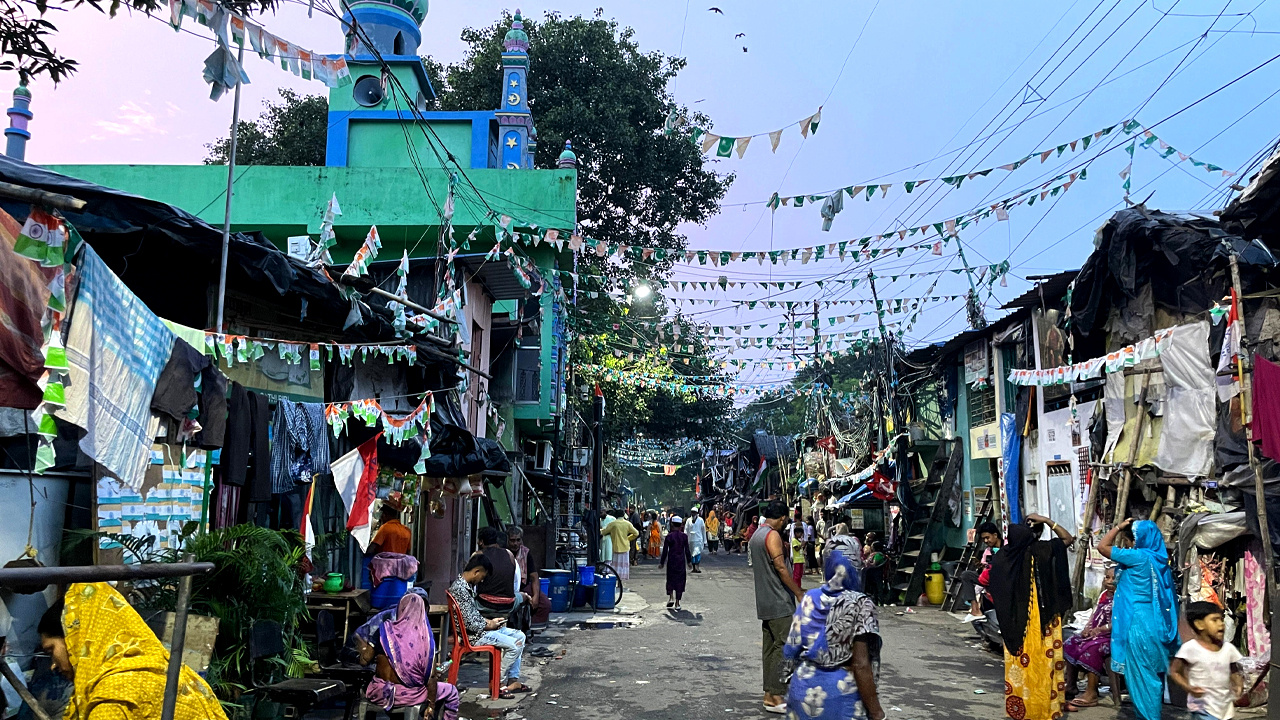
Jyotinagar offers a stark glimpse of how access to the most basic necessities can become a weapon against a politically and religiously targeted community.
Srijan Dutta
It has been 36 days since the municipal tap water supply to the Jyotinagar neighbourhood in the Cossipore area in North Kolkata, was abruptly cut off. The regime change in West Bengal on 4 May promised urban renewal for Kolkata, along with other assurances of growth and development. Kolkatans across classes bought into the prospect of infrastructural revival and societal progress. Among the 5000-odd residents of Jyotinagar Colony, who are all Muslims, many, too, had voted for the BJP. Little did they know that once elected to power, the Jiska Sath, Uska Vikas (Development for only those who support us!) slogan would be enshrined as the ‘double-engine’ government’s guiding philosophy.
The locality’s inhabitants have now realised that Suvendu Adhikari’s statement was not just mere rhetoric deployed to stir up a pre-election communal cauldron. The KMC pipelines provide treated water through roadside public taps from morning to midnight except for routine outages. This was also the norm for the six public taps at Jyotinagar colony. However, since midnight on 29 July, the taps have remained dry.
Nazmul Sheikh, a Jyotinagar youth in his early thirties, explained that this is not another typical case of deferred maintenance on the KMC’s part. He said Ritesh Tiwari, the newly elected BJP MLA from the Kashipur-Belgachia constituency, and his associates had deliberately connived in the scheme to punish the people of Jyotinagar. “We are in this situation because we are poor and Muslims. Our constituency’s new MLA, Ritesh Tiwari has publicly announced swearing on the name of Baba Bholenath that he will not do any work for Muslims in the next five years. We are being deprived of our basic right to access clean water because of his vengeful attitude towards our community”, said Sheikh. He works shifts as a driver at the Cossipore Ghat area. He expressed further anguish over his community’s ordeal stating, “My daily wage is 400 rupees. Since our water supply got suspended, I have been forced to spend around 60-70 rupees every day on drinking water during my work trips.”
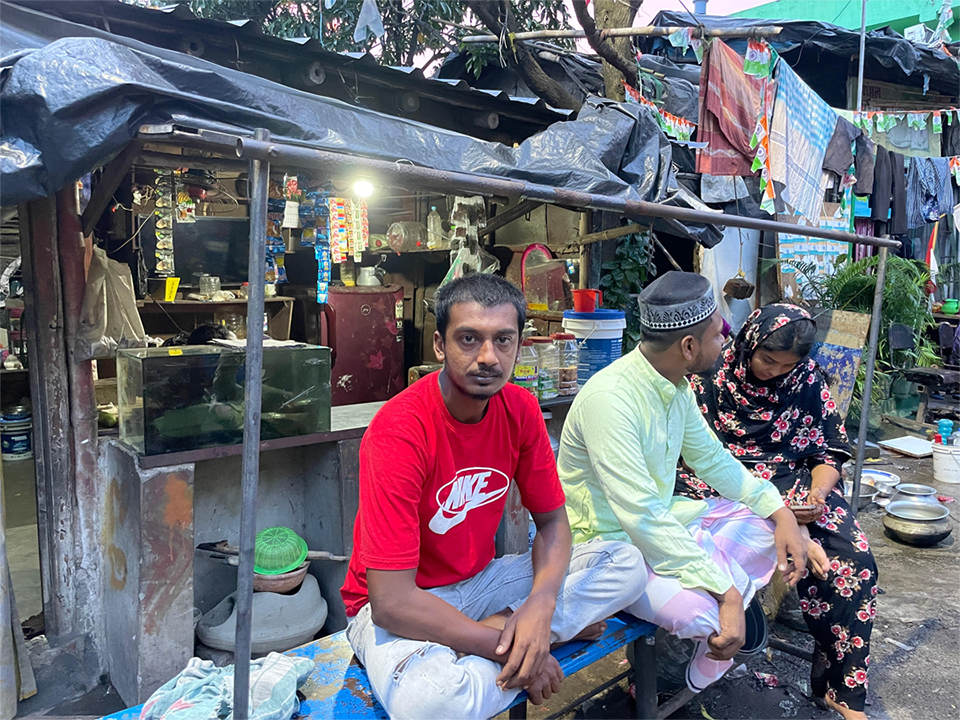
Nazmul Sheikh, a Jyotinagar youth and driver, is now forced to spend 60-70 rupees daily on drinking water.
Speaking to Sheikh Mohinuddin, who runs a tea shop and is also the president of CPI(M)-backed Paschim Bangla Basti Unnayan Samiti’s unit at Jyotinagar, made it clearer that the deprivation meted out to them, is not acute but systemic. “We are without water for more than a month. We have formally complained to the municipal authorities on multiple occasions. Each visit ends with shallow sympathetic responses and the responsibility is delegated to some obscure ‘higher authority’. Our union arranges for a municipal water tanker on every alternate day at a charge of 750 to 800 rupees. But that does not suffice everyone. Bidhayak hoyeche garib manushke dekhar jonno, amader na dekhle kisher jonno sarkar hoeyche… (An MLA must look after the poor, if they do not take care of us, what is the government for?)”, stressed Mohinuddin. Furthermore, he mentioned that the electricity connection to the street lights at Jyotinagar had also been disconnected initially. However, the connection was restored after a period of ten days. It was, once again, the logic of communalism that mandated the decision: “Since it was the month of Shraban, this road was bustling with Hindu devotees who had come to fetch water from the Ganges. One of the pilgrims tripped over in the dark. To avoid embarrassment, the authorities quickly reinstated the electricity.”
Evening was setting in when I visited Jyotinagar. My conversation with Mohinuddin was interrupted by the sight of women and children coming out from their homes with buckets, pots, bottles, and containers of various shapes and sizes in their hands. Upon enquiry, they told me that they were heading out to collect water for their evening household chores from a nearby public tap. I decided to join them in what I soon learnt has now become their daily quest as I wanted to see the nearest functional tap for myself. To my surprise, the walk was unexpectedly short. An outsider, a journalist or not, might even mistakenly think that it is the same neighbourhood. But we are no longer in Jyotinagar. It is easy to get the wrong impression if one is not attentive to the fine details. After all, the same tricolour flag that adorned the houses I walked past minutes ago flies high above the house next to the tap. But, as the eyes lower, a painted sign on the wall reads: Cossipore Kanch Sangha. In front of it, a man wearing a saffron tilak on his forehead and a red thread on his wrist can be seen patiently waiting to fill a bucket. The Muslim women and children I accompanied to the tap line up in a queue behind him.
In the meantime, Montu Kumar, a teen worker at the local glass factory after which the ‘Kanch Sangha’ neighbourhood is named, expressed how he feels about the situation at Jyotinagar. “Jyotinagar is right next to us. They are going through a difficult time. They are indeed Muslims. The taps here at Kanch Sangha are working. Hence, we share water with them like we share the work floor inside the glass factory”, said Kumar.
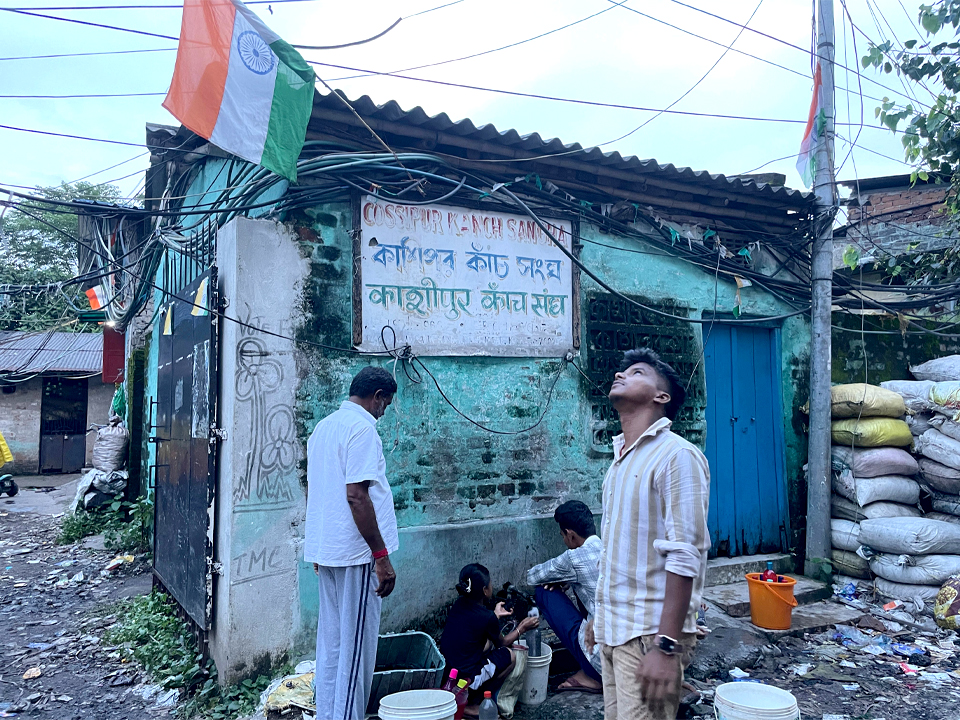
Montu Kumar, a teenaged worker at the Cossipore glass factory, looks up at the sky anticipating rain.
Evening had fully descended upon Jyotinagar by the time we returned. The Maghrib azan was being broadcast at their neighbourhood mosque by the Ganges. Most households got engaged in storing the water in front of thier houses brought from Kanch Sangha. Perhaps it was adequate to last them the night. But maybe not enough to indulge in ablution necessary for offering their evening prayers.
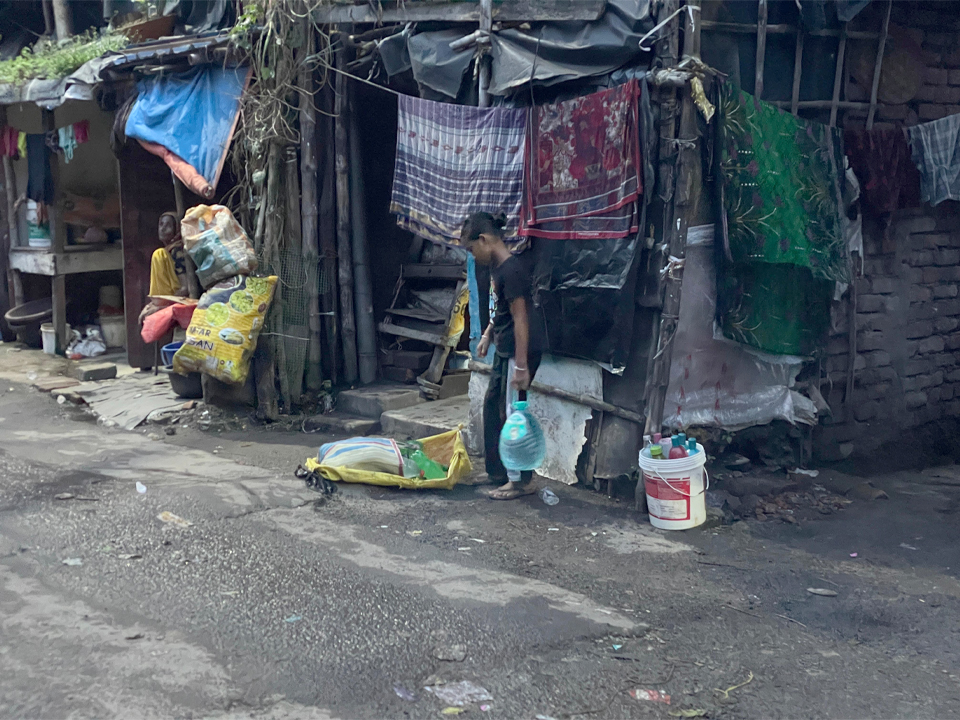
A young boy brings home water from the tap at Kanch Sangha.
I could see women and children returning home from the ghats. While most of them held buckets with washed-clothes in their hands, some were visibly soaked indicating that they managed time to bathe in the river. Dinner preparation was due. Therefore, earthen stoves were lit up outside a few homes.
I came across Ahmed, a middle-aged mason at a casual front-yard gathering. Seeing me take photographs, Ahmed approached me and asked whether I was reporting on the “water supply cut-off situation” or the “looming threat of eviction”. He disclosed to me that the BJP government has blocked the municipal water supply pipeline as part of its sinister plot against Jyotinagar residents: “Their true intention is to evict us from here. We have seen political parties of all stripes come and go. This is the first time we are seeing a party that labels its own citizens as ‘illegal settlers’ ruling the country. They say we are ‘Bangladeshi’. Our neighbourhood is more than 60 years old. This is the only rightful home we know. We have lodged a petition at the High Court. Nobody can remove us unlawfully.”
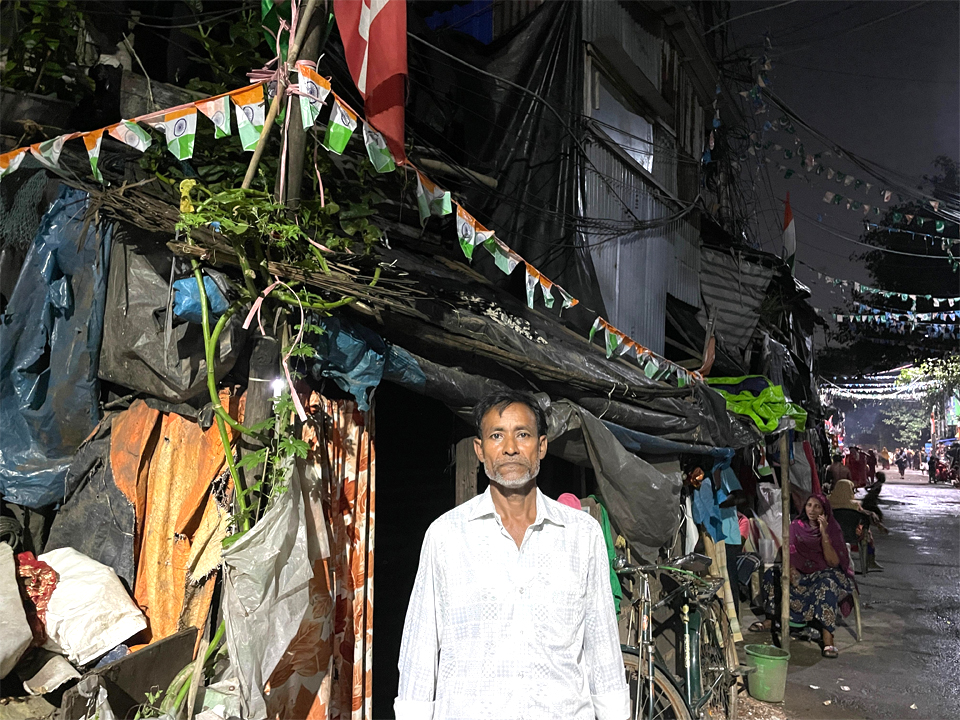
Ahmed standing outside his house in Jyotinagar
The gathering became more vibrant as women and children joined in. They elaborated on their relationship with their Hindu neighbours: “We cannot depend solely on the water tankers sent by CPI(M) and Congress workers. Had it not been for the friendly bond we share with the surrounding Hindu households, we would not have survived this long. However, that is no long-term option. They have their own water-related needs. Moreover, the glass factory also uses these taps to meet its water requirement. How can a government deny us access to water if it is a fundamental right?”
I realised how the informal setting of this conversation had enabled a multilayered exchange as one woman made an agitated confession: “There is so much talk about government accountability, yet there is no sign of the government—only journalists! We have been left dry for so long that now it feels that journalists come here to mock us. Two more journalists visited us this afternoon but we did not speak to them.”
The woman then shifted the discussion to the alarming state of the Ganges. “The river water is no longer suitable for bathing. Look what it does to your skin…”, said the woman as she struggled to hold two extremely young, playful children steady and showed me the rashes on their skin. One of the children was so small that I asked about his age. I was told that he recently turned two. The woman probably read the concern on my face and added, “It is dangerous but we have no choice but to take even six-to-eight-month-old newborns along with us to bathe in the river. At least, this one is two years old now.”
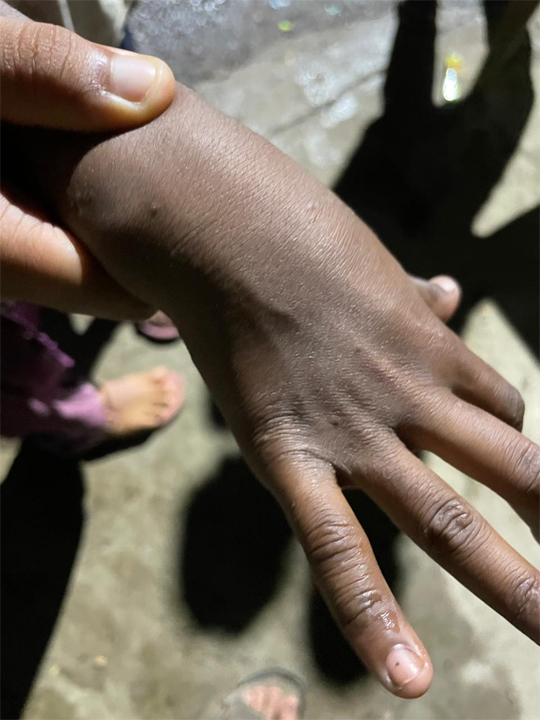
Skin irritation on a child’s arm after bathing in the Ganges.
In April 2026, Amit Shah had described Kolkata as “the city of slums”. At the time, mainstream opposition parties and sections of civil society largely perceived the remark as a political gibe at the then-incumbent Trinamool Congress (TMC) government.
But, within days of the BJP’s victory on May 4, bulldozers were pressed into service to raze roadside and railway-station vendor stalls in and around Kolkata, while the city’s informal settlements increasingly faced the threat of eviction in the name of urban renewal, with little indication of rehabilitation.
Today, it leaves no doubt that Shah’s crude electoral jibe was not merely a political rhetoric. It was suggestive of a political imagination—one in which the poor, the informal worker and the slum-dweller are treated not as citizens whose labour sustains the city, but as obstacles to its remaking. Kolkata’s working poor—who build, clean, transport, sell, cook and service the city—are among the first to be rendered disposable when the urban landscape is recast in the image of corporate capital.
Agnimitra Paul, West Bengal’s minister for Urban Development and Municipal Affairs, in a recent interview, has highlighted “universal piped drinking water” and “improved sanitation” among the five priority areas her ministry has set for Kolkata’s urban revival under the BJP government. She concludes by declaring her vision of building “cleaner” and “more liveable” cities.
But whose cleanliness, and liveability for whom?
That question acquires an altogether different urgency in Jyotinagar, where Muslim residents have been subjected to what amounts to a Gaza-esque blockade of water. The move to deny a basic necessity like water to an entire community cannot be viewed in isolation from the wider processes through which the city’s poor are being evicted and made invisible.
The question today, therefore, is not simply what will happen to Jyotinagar. It is what kind of Kolkata the new political order intends to build—and who will be permitted to belong to it.
Does the targeting of Jyotinagar’s Muslim residents part of a wider imagination of exclusionary urban development? And when the victims of such urban “renewal” are disproportionately poor and Muslim, can the process still be understood merely as an administrative project of beautification and infrastructure development?
Or are we witnessing the beginnings of something more disturbing: an ideological recasting of Kolkata in which urban renewal becomes a mask for social and communal exclusion and the cleansing of the city’s “undesirable” populations is presented in the sanitised language of development, cleanliness and liveability?
Srijan Dutta is an activist and researcher. All photographs are by the author.