
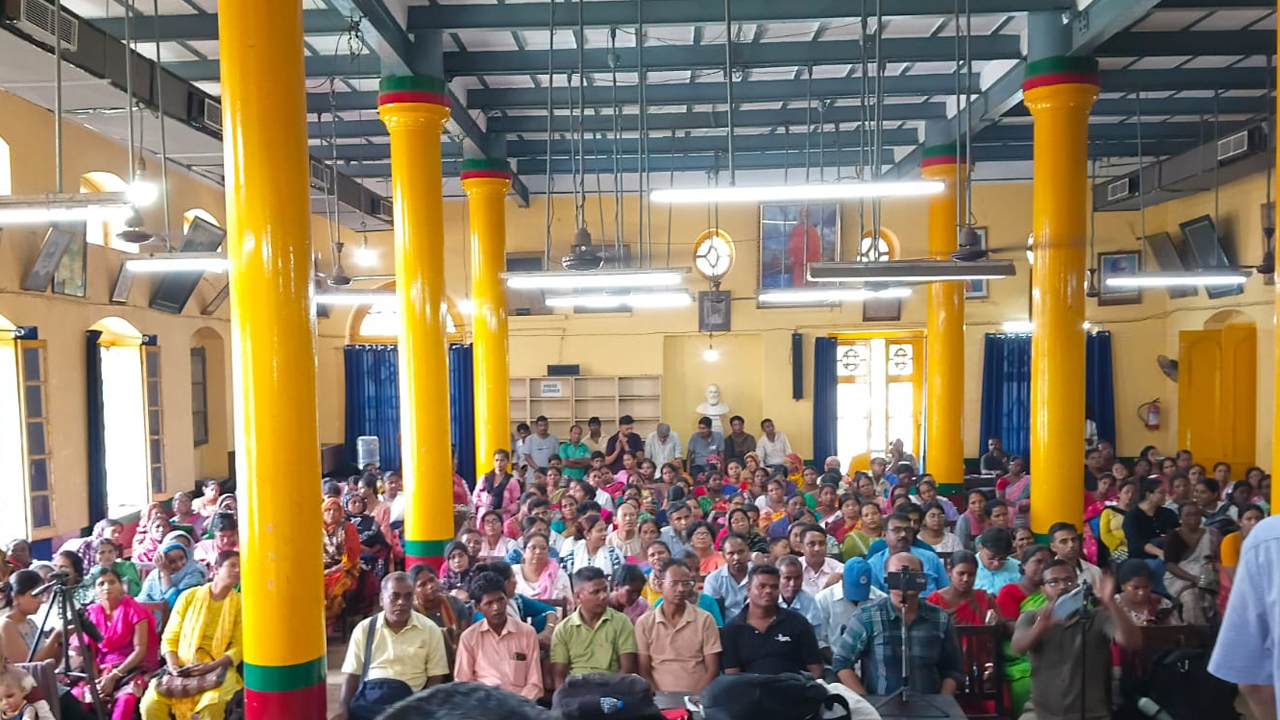
Around three hundred working people from 12 trade unions and mass organisations from the unorganised sector across West Bengal sent a clear warning to the new State Government : Workers will not accept hunger, eviction, unpaid wages, stolen PF, insecure employment or broken promises as the price of survival. If the Government fails to address their demands within 200 days by November 17th, an indefinite movement will be launched across Kolkata and beyond.
KOLKATA | 31 August 2026
Around 300 workers and working people from across West Bengal gathered at Bharat Sabha Hall in Kolkata on 29 August to warn the state government that continued neglect of workers’ rights, broken promises and anti-worker policies could trigger a mass movement.
The mass convention, organised around the “Right to Housing and Land; Right to Work and Fair Wages”, was organised by the Unorganised Sector Workers’ Struggle Forum (Asangathita Kshetra Shramik Sangrami Mancha) and the Campaign for the Rights of the Hungry (Bhukha Manusher Adhikar Abhijan). Twelve mass organisations and trade unions participated.
Farm labourers, street vendors, domestic workers, tea garden workers, hosiery workers, sex workers, midday-meal workers and residents of informal settlements spoke about their conditions and what they described as the failures of both the present and previous state governments.
Evictions, but no housing
One of the major concerns raised at the convention was the threat of eviction faced by hawkers and residents of settlements that have been labelled “encroachments”. Workers’ organisations, including the Mancha, Muktokantha Mahila Samity and Paschim Banga Griha Paricharika Samity, have been organising residents across Kolkata against evictions.
According to the organisations, legal interventions have so far helped prevent evictions in several areas. Cases cited at the convention include Dhakuria (WPA 14878/2026), Brace Bridge (WPA 11040/2026), Hastings (WPA(P) 381/2025) and Nimtala (WPA 11661/2026).
Residents also organised a 21-day dharna and a convention in solidarity with people living under the Dhakuria bridge. Their central demand is “No eviction without resettlement.” The organisations said court interventions have endorsed this principle and called on the state government to formulate a comprehensive housing policy for homeless people and residents of settlements in Kolkata.
Tea workers go months without wages
Tea garden workers at the convention described a year-long struggle over irregular wage payments, non-deposit of Provident Fund contributions, non-payment of gratuity and bonus, and denial of paid annual leave.
Particular concern was raised over Merico Agro Industries Limited, which was given control of 13 tea gardens by the previous state government. Workers alleged that they have been made to work for months without receiving wages and that PF contributions deducted from their wages were not deposited.
Despite repeated complaints, the workers alleged that the new government has taken no effective action.
The convention also highlighted the reported stoppage for six months of the ₹1,500 monthly FAWLOI subsistence allowance for workers of closed tea gardens. With already impoverished workers facing prolonged unemployment, the organisations warned that withholding the allowance is pushing families towards hunger.
Participants also opposed the proposed takeover of Adivasi land in Torsa Tea Estate, where local people have been resisting the move.
Women’s unpaid work remains invisible
The convention highlighted the widespread invisibilisation of women’s labour, particularly work that remains unpaid or falls outside conventional definitions of employment.
Women workers demanded recognition of labour routinely performed without economic remuneration. Sex workers affiliated with the Bindodinin Shramik Union demanded recognition of sex work as labour.
Domestic workers pointed to the absence of effective mechanisms within the government’s labour machinery to resolve disputes with employers, arguing that their workplaces and employment relationships remain largely outside conventional labour definitions.
Hosiery workers raised issues of low wages, unpaid overtime, gender-based wage discrimination and delays in wage revision.
Midday-meal workers opposed attempts to transfer their work to large corporate-like organisations such as ISKCON, warning that this could threaten the livelihoods of thousands of existing workers. They also reported receiving wages for only ten months of the year.
Welfare schemes: promises without delivery
The convention also criticised the arbitrary withholding or stoppage of Annapurna Yojana payments to lakhs of women, alleging a lack of transparency and proper procedure.
In rural West Bengal, the implementation of the VBGRAMG employment scheme was another major concern. Despite the promise of 125 days of employment, the scheme was described as effectively non-functional. The Paschim Banga Khet Majoor Samity reported continued harassment of workers seeking employment under the scheme.
Struggles to intensify
The participating organisations resolved to intensify their campaigns rather than wait for government assurances.
The immediate programme includes a 6 September convention at Hashimara on the land rights of tea garden workers, dharnas in six blocks of Purulia demanding the promised 125 days of employment and Annapurna Yojana, and deputations to the Labour, Education, Health, Food Supply, Urban Development, Rural Development, Land Reforms and other departments.
The organisations also announced that they would pursue legal action wherever necessary, and a report card on the state government’s performance after 200 days will be released on 17 November 2026.
The convention ended with a warning that workers would no longer accept hunger, eviction, unpaid wages, non-payment of PF, insecure employment and unfulfilled promises as the price of survival.
The organisations said that if the government fails to address their demands, they will launch an indefinite movement across Kolkata and beyond.