
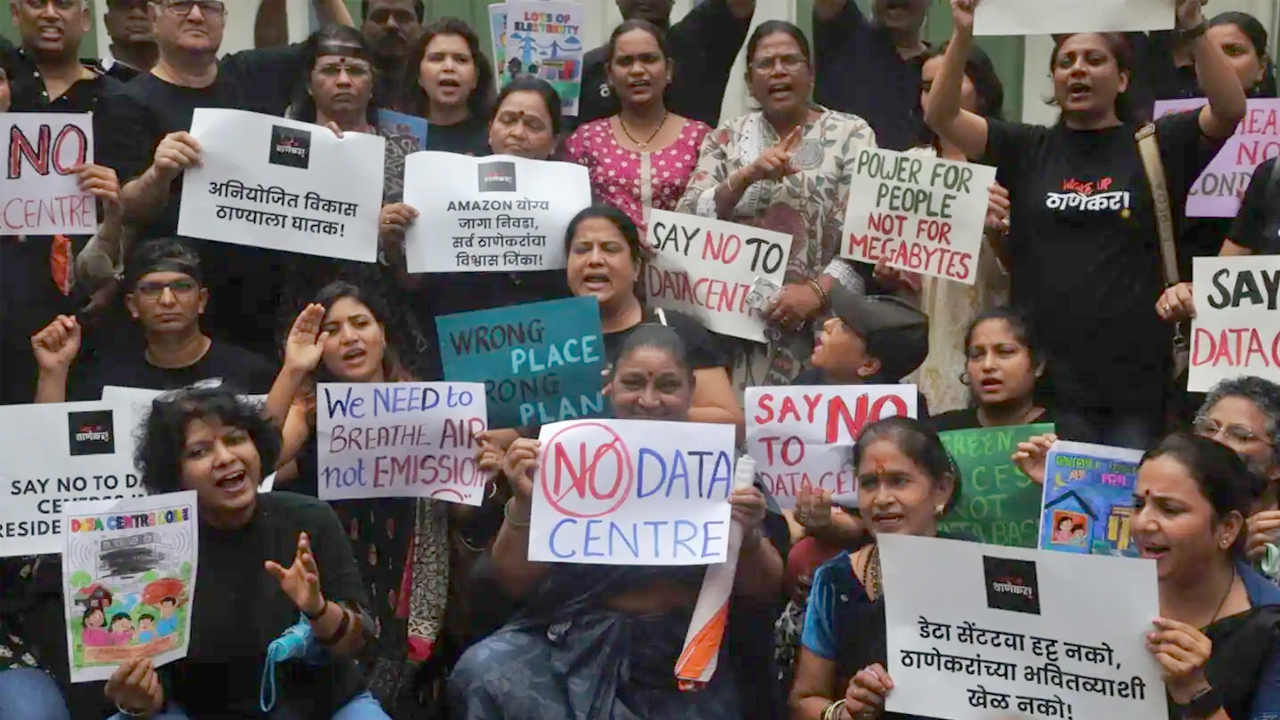
Visakhapatnam police suppress public scrutiny of the city’s rapidly expanding data-centre projects as land displacement and environmental costs come under scrutiny.
Groundxero | 11 August 2026
A peaceful campaign against the rapid expansion of hyperscale data centres in and around Visakhapatnam was disrupted by the police on Sunday (August), with the authorities first denying permission for a procession and later ordering a small gathering of protesters to disperse.
The incident has raised concerns not only over the police handling of peaceful assembly but also over growing restrictions on citizens seeking to question projects that involve large-scale land acquisition, resource consumption and potential displacement.
Andhra Pradesh is aggressively pursuing data centre investments, particularly with the Google-Adani project, aiming to establish India’s largest AI infrastructure hub near Visakhapatnam. Despite claims of economic revival and job creation, the project faces criticism for its lack of transparency, rapid environmental clearances, and significant financial incentives.
The three sites of the Google-Adani data centres are Tarluvada (Vizag Mega Data Centre Park Ltd), Rambilli (Vizag Rambilli Data Centre Park Ltd), and Adavivaram (Vizag Hyperscale Data Centre project). These are located in an ecologically sensitive terrain. Instead of treating them as a single project, they have been issued piecemeal environmental clearances, preventing any meaningful assessment of the combined impact of three hyperscale data centres in such close proximity. Environmental groups highlight discrepancies in project details, potential ecological damage, and the classification of these large-scale projects as Category B, avoiding public scrutiny.
Concerns also exist regarding the actual job creation versus the government’s projections and the long-term financial burden on the state due to extensive subsidies.
Members of environmental group Green Visakha had planned an awareness procession along Vizag’s beach road about impact of hyperscale data-centres to mark the anniversary of the Quit India Movement on Sunday. The campaign sought to draw public attention to the ecological and social implications of the government’s aggressive push for hyper-scale large data-centre facilities in the region.
The proposed procession was denied permission by the police. When around 20–25 members of Green Visakha and other citizens nevertheless gathered peacefully at the Bhagat Singh statue, police arrived and objected to the gathering.
According to the Human Rights Forum (HRF), there was no disturbance, obstruction to traffic or threat to public order. The participants were distributing pamphlets and seeking to discuss the potential consequences of the data-centre projects, including their enormous requirements for water and electricity, pressure on groundwater, environmental pollution and waste, and the diversion of land and public resources.
The protesters agreed to disperse when instructed to do so. But the police intervention did not end there.
Before leaving, the participants sought to take a group photograph in front of the Bhagat Singh statue. A police sub-inspector reportedly told them: ‘Go anywhere and take a photo, but not here in front of Bhagat Singh’s statue.’
The remark has become the most striking symbol of the episode. HRF questioned the legal basis for preventing citizens from taking a photograph at a public statue and argued that the incident demonstrated how restrictions ostensibly imposed in the name of public order can become instruments for policing dissent.
The episode comes against the backdrop of mounting controversy over the social and environmental costs of Vizag’s data-centre expansion.
One of the most contentious aspects is land. HRF said that Left political activists had recently been detained when they attempted to visit Tarluvada village to meet residents who had allegedly been dispossessed of their land for a data-centre project.
The question of who bears the cost of the data-centre boom therefore goes beyond environmental concerns. For communities whose land is acquired for these projects, the issue involves displacement, livelihood and the right to participate in decisions affecting their lives.
Preventing activists from meeting affected residents, HRF argued, effectively restricts the flow of information between displaced communities and the wider public.
Why should citizens be prevented from meeting people who have lost their land? the organisation asked, questioning what possible threat to public order could arise from activists listening to affected communities and attempting to assist them in raising their grievances.
The controversy also extends to the digital sphere. HRF alleged that social-media content critical of the data-centre projects had been removed at the government’s instance. Taken together with the restrictions on physical protests and meetings with affected residents, the organisation said these incidents suggested an effort to insulate the projects from public scrutiny.
The rapid expansion of data centres has been promoted as part of the region’s emergence as a major technology and digital infrastructure hub. But the scale of such facilities raises questions that cannot be reduced to investment and employment figures.
Hyperscale data centres require substantial quantities of electricity and water and generate heat, waste and demands on supporting infrastructure. In a city already facing pressure on land, water and civic infrastructure, environmental groups and local communities have been questioning whether the costs of such development are being adequately assessed—and who ultimately bears them.
These questions acquire an added urgency where projects involve the acquisition of land and the displacement of communities. The ability of affected residents to speak publicly, meet campaigners and organise collectively is central to any meaningful assessment of whether development is genuinely in the public interest.
For HRF, the police action therefore represents more than an isolated incident of police high-handedness.
The organisation stressed that freedom of speech and peaceful assembly are constitutional rights, and that the police cannot determine which political views citizens may express or prevent peaceful public activity simply because it challenges government policy.
“The police may enforce the law, but they have no authority to police dissent,” HRF said.
It demanded an immediate end to police interference with peaceful campaigns and called on the government to ensure that citizens are free to assemble, distribute literature, meet affected communities and raise questions about projects being undertaken in their name.
The central issue, however, extends beyond the right to protest. If the data-centre expansion is genuinely intended to serve the public interest, critics argue, the government must be prepared to answer difficult questions about land, displacement, water, electricity, environmental degradation and public resources.
Suppressing those who ask such questions does not resolve the concerns. It only deepens them.
The news report is based on a statement issued by Y Rajesh, HRF AP State General Secretary, and VS Krishna, HRF AP&TG Coordination Committee Member, on August 10 in Visakhapatnam.