
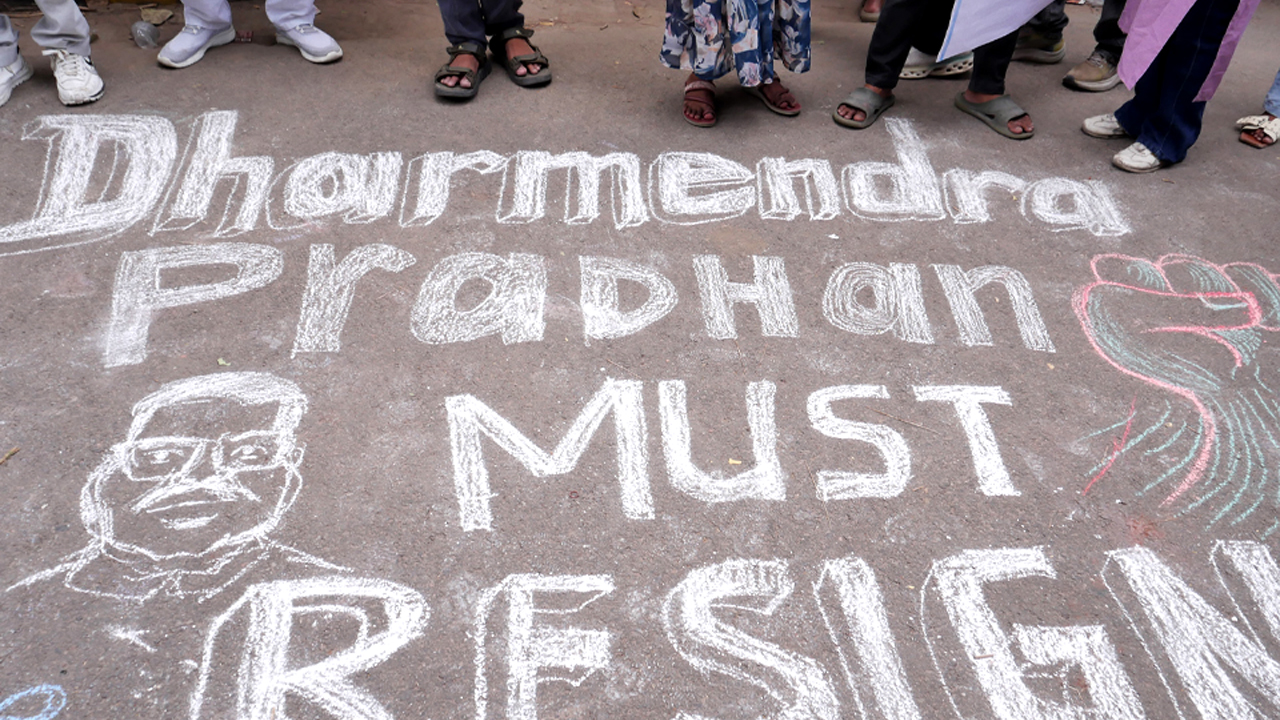
The future of the CJP will ultimately depend on whether it can transform its momentary popularity into a sustained democratic movement capable of bringing meaningful changes to India’s education system.
By Dr. Prantik Basak and Ayushiba Jadeja
The sudden and unexpected resignation of the Education Minister of India, Shri Dharmendra Pradhan, highlighted a major victory for student politics in India. The resignation was unexpected if we study the general attitude of the current regime. The victory for the Cockroach Janta Party was, however, quite significant. Not only did it highlight the role of students as an agent of democracy but also shed light on the evergreen role of student movements in the healthy functioning of a democracy. Every democracy requires certain checks and balances on the government, which, if not carried out by the political institutions in place or the media, the responsibility then falls upon the youth of the nation, especially the students. Students, therefore, can be reimagined as Gramsci’s organic intellectuals.
Two major challenges are, however, quite apparent in the present scenario. Firstly, the snowball rise of the Cockroach Janta Party (CJP) raises a lot of concerns. The CJP is unstructured internally and operates externally in an unstructured manner. It started out as a meme, which led to an Instagram page that went viral, amassing lakhs of followers within a few days (currently 26.8M followers on its main page along with several regional CJP pages with 200k+ followers each). Overwhelming popularity led to the birth of the CJP on the streets and social media support translated to support on the streets, with lakhs of youth joining the protests at Jantar Mantar in Delhi for weeks. These street demonstrations gained a massive boost with the addition of Shri Sonam Wangchuk, who led a 26-day fast until his demand for Shri Dharmendra Pradhan’s resignation was met. Matters escalated when the Delhi Police picked up Shri Sonam Wangchuk on medical grounds as per a court order by the Delhi High Court, keeping in mind his deteriorating health. The fast ultimately ended when Wangchuk received written promises from the government that the police would not file criminal cases against the demonstrators at Jantar Mantar and that the government would hold a detailed discussion on the accountability and flaws in conducting national-level examinations.
The matter did not remain restricted to the streets. The Opposition demanded a statement from the government on the police action against the protestors during the 20th July march. Therefore, the police action became another major question of accountability. The involvement of the Opposition and the raising of the matter within Parliament also showed how a movement that started as a meme was able to enter the formal political institutions of the country.
Coming back to the first challenge, the birth of the CJP on the streets saw massive participation, especially from Gen Z, but the question arises whether this is just the current trend or, in post-modern terms, a ‘fad’, like most occurrences in this current generation. A follow-up question is, was the resignation an apology from the regime or a way to neutralize the boiling blood of the youth and dissipate their revolutionary energy? If the crowd behind the CJP scatters post-resignation, the larger objectives of the movement would not be achieved. The resignation of the Education Minister, instead of becoming a pedestal for further incremental changes, would simply turn into a matter of symbolism.
The second challenge emerges from a core element of the first challenge itself, i.e. the unstructured nature of the CJP. Managed by mainly three faces who do not possess political training, it was only with the involvement of certain leftist student unions and certain political parties in the opposition that acted as a lubricant for the movement. Therefore, there always remains the concern of co-optation of such movements by political parties wherein the main leaders of the CJP might let go of the agenda and join a political party for the sake of larger selfish interests, thereby drowning the movement.
The victory of the CJP with the resignation of Shri Dharmendra Pradhan is itself contestable irrespective of whether it is symbolic or concrete. The victory, if at all a victory, is incomplete, as the demand itself was incomplete. The demand was for the resignation of one minister, but what outcome would a mere resignation achieve if no follow-up demands were in place?
The passage of the Public Examinations (Prevention of Unfair Means) Amendment Bill, 2026, can be considered one of the immediate outcomes of the movement. The Bill was introduced in the Lok Sabha on 27th July 2026. It increased the punishment for the use of unfair means from imprisonment of three to five years to imprisonment of five to ten years. The maximum monetary fine was also increased from Rs. 10 lakhs to Rs. 50 lakhs. The government, therefore, attempted to show that it was taking stricter action against those involved in examination-related offences.
The Opposition, however, opposed the Bill by questioning whether an increase in punishment would be sufficient to prevent examination leaks. Punishment alone was not enough, as there should also be measures that make sure that such leaks never happen in the first place. It does not necessarily address the administrative failure, negligence and corruption that allowed the leak to take place.
Shri Rahul Gandhi argued that India’s education system has become extremely expensive. He claimed that around Rs. 1.32 lakh crore is collectively spent by families on NEET preparation, an amount almost equal to the government’s education budget of around Rs. 1.4 lakh crore. This highlighted that the examination system has not only become uncertain but also places an enormous financial burden on students and their families. A leaked or cancelled examination, therefore, does not merely result in the loss of an examination attempt. It also results in the loss of money, time and years of preparation for lakhs of students.
The Amendment Bill, therefore, cannot by itself be considered a complete victory for the students. The increase in punishment may act as a deterrent, but it does not answer the larger questions raised by the CJP regarding the accountability of the examination authorities, compensation for affected students, the safety of examination papers and the financial burden created by the present examination and coaching system. The principle that prevention is better than cure should become the foundation of the examination reforms rather than depending solely on stricter imprisonment and monetary fines. Otherwise, the new legislation may also become symbolic in nature, much like the resignation of one minister.
Shri Dharmendra Pradhan’s exit has been portrayed by his party not as a failure of his responsibilities but as a sacrifice for the larger interests of society. His replacement, Shri Pralhad Joshi, is already in the news for his questionable past comments on sensitive and controversial matters, raising concerns about whether his appointment is morally justified. The movement, therefore, cannot afford to end with a change of minister or the passage of a stricter law. Its real victory would lie in ensuring long-term institutional accountability, preventive reforms and protection of the interests of students. The future of the CJP will ultimately depend on whether it can transform its momentary popularity into a sustained democratic movement capable of bringing meaningful changes to India’s education system.
Prantik Basak is an Assistant Professor of Political Science at School of Law, CHRIST (Deemed to be University), Pune Lavasa Campus, India.
Ayushiba Jadeja is a third year student of political science under the Faculty of Law, Marwadi University, Rajkot, India.

This is a highly plausible analysis on the state of affairs in the education system in India, based on (especially) the most recent ‘systemic glitch’ so witnessed. While it sounds consoling to punish the ‘perpetrators’ responsible for the chaos, it’s truly far better to deduce measures to deter such happenings altogether. Ultimately a man behind the bar or a resignation letter won’t do much to save the majority citizens trapped in the loop. Thank you for sharing your thoughts!