
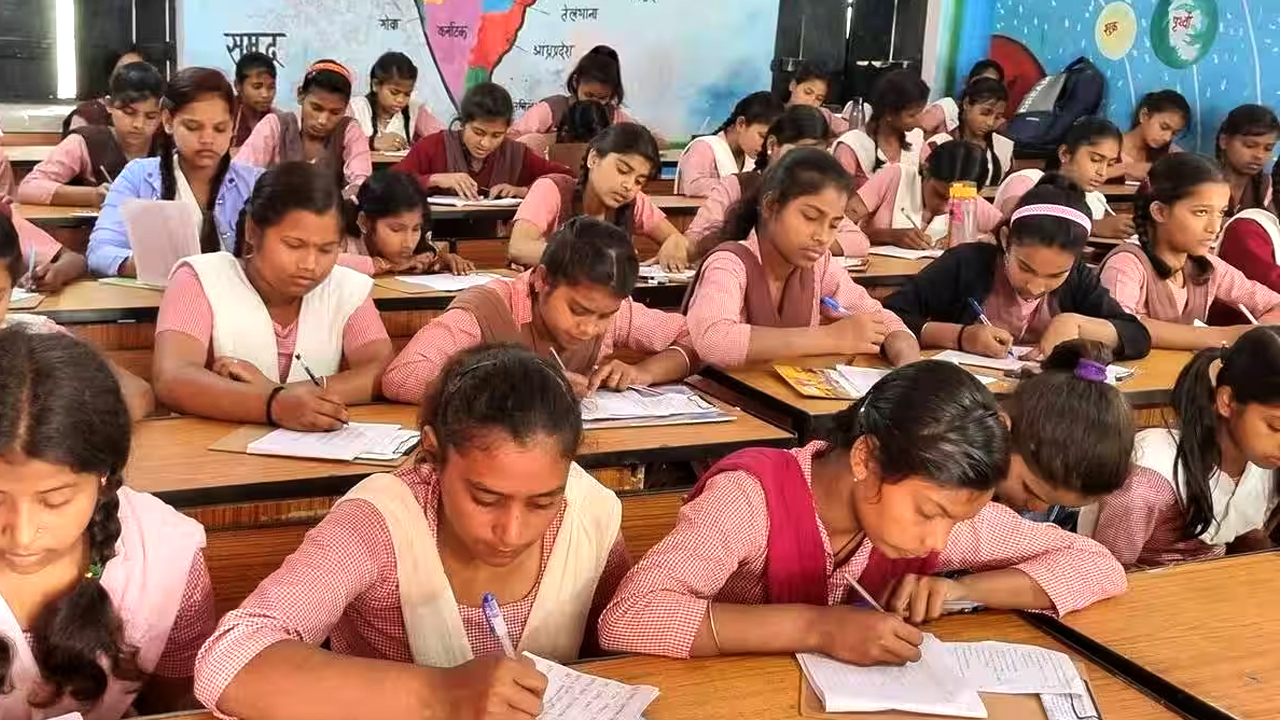
PM SHRI is the newest chapter in a much older argument about who gets to decide what do India’s children learns, an argument that, fifty years after the 42nd Amendment, still doesn’t have a settled answer.
by C. Mujeebu Rahman
For all the debate around PM SHRI in Keralam since the last Assembly election campaign, the discussion often ends up as an ideological shouting match. The concern is simple: that the Centre will use schools to push its own political and cultural agenda, and that this whole agenda started life inside the National Education Policy (NEP) 2020. The point is not baseless though. But it also hides a messier story, one where the positions of political parties have shifted depending on whether they are in power or not.
PM SHRI stands for Pradhan Mantri Schools for Rising India. It is a Government of India initiative launched in to develop selected schools into model institutions that implement the goals of the NEP 2020.
The developments so far with regards to PM SHRI in Keralam in nutshell: The Left government under Pinarayi Vijayan, after resisting PM SHRI for a long period, quietly signed the MoU with the Centre in October 2025. It happened without bringing it to the Left Democratic Front’s (LDF) own coordination committee or the state cabinet first. When the CPI, the second-largest party in the LDF, found out, it was furious, and so were opposition parties, and public intellectuals. Under that pressure, within weeks, the left government declared that it was putting the MoU in abeyance. Then came the Keralam Assembly election, and the United Democratic Front (UDF), which had promised during the election campaign, to throw PM SHRI “into the Arabian Sea”, won and formed the government. Once in office, though, the new UDF government stated it would continue with the scheme. They claimed that Keralam is legally bound because the previous left government already signed on and already received some of the money under the scheme. The LDF, now in opposition, on the other hand, says Keralam can walk out from the MoU whenever it wants. The debate, therefore, has not gone away with the change of government, it has just changed which party is defending the MoU and which one is attacking it.
Keralam is not alone. Tamil Nadu refused to sign at all and took its case to the Supreme Court after the Centre withheld its Samagra Shiksha funds. It eventually got a partial release. Punjab signed in October 2022 and then formally withdrew nine months later, in 2023, a precedent Keralam’s opposition likes to cite to show that exit is possible. Yet, after the Centre withheld Samagra Shiksha funds, Punjab said it is willing to implement PM SHRI again. In short, this is not a uniquely Keralam or a uniquely Left-versus-BJP story. It is a fight that several states, cutting across parties, have had with the Centre over fund tied to conditions.
Not a New Argument
It is tempting to read all these developments as the consequence of BJP-led central government’s policies. It is not. To see why PM SHRI provokes such a strong reaction, it helps to look at how education has been governed in India since Independence, long before NEP or PM SHRI existed.
For the generation that built independent India, schools were never just about literacy. They were meant to build a modern nation out of a deeply fragmented society, to create citizens, hold the country together, and address inequality. Education was originally a State/provincial subject. The idea was that states understood their own linguistic and social realities best. That changed with the 42nd Constitutional Amendment in 1976, during emergency, which moved education to the Concurrent List, giving both the Union and the States law-making power over it. This single amendment is the constitutional root of almost everything that follows; every later argument about NEP or, now, PM SHRI is really an argument about how far the Centre can go with the authority it got in 1976.
What is different today is the politics, not the law. In the 1970s the Congress dominated both the Centre and most states, so it could push changes through with little resistance. Now, because of the reaction from a couple of oppostion parties ruled states, the same kind of central push turns into a fight over federalism and identity, not just administration.
Much of the intellectual groundwork goes back even further, to the Kothari Commission (1964 -66). It is still probably the most influential education commission India has had. It wanted a common school system, more spending on science education, better teacher training, and more public investment in education overall. Its most famous legacy is the Three-Language Formula, meant to balance Hindi’s spread with the country’s linguistic diversity. Non-Hindi states would teach the regional language, Hindi and English; Hindi states would teach Hindi, English and a regional language. On paper it was a two-way street. In practice, it very much was not. Tamil Nadu pushed back hardest, treating the formula as a stalking horse for Hindi imposition and sticking to its own two-language policy of Tamil and English, a position it holds to this day.
The pattern repeats throughout India’s education history. The 1986 education policy, under Rajiv Gandhi, pushed further, universal elementary education, teacher training, and programmes like Operation Blackboard to set minimum classroom standards nationwide. Sarva Shiksha Abhiyan, launched in 2001, aimed to universalise elementary education, and states raised exactly the complaints we hear today: too many central conditions, too much reporting, not enough room for local differences. In other words, worries about the Centre overreaching into education did not start with the BJP or NEP 2020, they came up just as loudly under Congress-led central governments. The Right to Education Act in 2009 added another layer of national norms on top of that.
What is NEP 2020 and PM SHRI Actually Like?
NEP 2020 is usually described either as a revolutionary break or as a purely partisan project pushing a particular ideology. Neither label quite fits. A lot of its content, foundational literacy, teacher training, multilingualism, vocational education, has been the standard wish list of Indian education policy for sixty years. What is genuinely new in 2020 is structural: the 10+2 system gives way to a 5+3+3+4 structure, along with multiple entry and exit points in higher education, an Academic Bank of Credits, and a push away from rote learning towards understanding and application.
Here, PM SHRI is simply the Centre’s flagship instrument for showing off NEP 2020 in practice, a set of model schools meant to demonstrate experiential learning, digital tools, and skill development. And, it has been reasserted by even the LDF in Keralam during the controversy: PM SHRI does not force a state to drop its own board or its own textbooks. A Keralam school, selected under the scheme can, in principle, keeps using SCERT textbooks and stay under the Keralam State Board.
So why the fight, if the curriculum itself is not on the table? Is it about data sharing? Keralam is already deeply enmeshed in Central systems anyway, it reports data through UDISE+, it takes central money through Samagra Shiksha, and it operates every day inside a Centre-state framework. The objection may not be reducible simply to data-sharing or textbook content. It could be about the MoU’s language though. Also about the cumulative weight of funding conditions, performance monitoring, and branding that comes bundled with PM SHRI. The Centre might claim that national coordination and accountability need exactly this kind of central push, and that the money on offer is real and useful.
The Bigger Picture
Strip away the day-to-day politics, and the Keralam-PM SHRI episode is really about a question every federal democracy has to keep answering: how much authority should sit with the centre, and how much should stay with the states. India’s education history, from the Kothari Commission through NEP 1968 and 1986, Operation Blackboard, SSA, the RTE Act, and now NEP and PM SHRI, reads as one long attempt to strike that balance, with the pendulum, on the whole, swinging steadily towards the Centre.
Whether PM SHRI ends up strengthening Indian education or simply adding another layer of central control is still an open question. For example, does Keralam need PM SHRI’s money to strengthen its education system? The scheme’s total outlay is Rs 27,360 crore across the country over five years for roughly 14,500 schools, which work out to something under Rs 2 crore per selected school over that period, and even that comes with the state having to find 40 per cent of the cost itself under the standard funding formula. That’s not a small amount, but it isn’t transformative for a state that has already poured its own money, plus KIIFB funding, into new buildings, smart classrooms, labs and libraries across its government schools in recent years. Keralam already has one of the country’s highest literacy rates and a public education system regularly held up as a model, much like its health system. From that vantage point, the question could be about credit and ownership, not money. If some of Keralam’s best government schools are rebranded with the PM SHRI prefix, whose success story is being told? These schools got where they are through decades of state investment, community involvement and teacher effort.
What’s clear is that PM SHRI cannot be judged in isolation, as if it dropped out of nowhere in 2022. It’s the newest chapter in a much older argument about who gets to decide what do India’s children learns, an argument that, fifty years after the 42nd Amendment, still doesn’t have a settled answer. Also, amid the noise over language, ideology, and Centre-State relations, a more fundamental question has largely slipped from view: how much successive commissions and education policies have recommended spending on education, and how much governments have actually invested. For all the political battles over control, the persistent gap between educational promises and public funding may matter far more for the future of India’s schools.
C. Mujeebu Rahman is a researcher and author whose work spans questions of education, law, economy, and social change in contemporary India. His work has appeared in international peer-reviewed journals and edited volumes. He received his PhD from the department of HSS, Indian Institute of Technology Kanpur and is currently working as senior project executive officer at Kotak School of Sustainability, IIT Kanpur.