
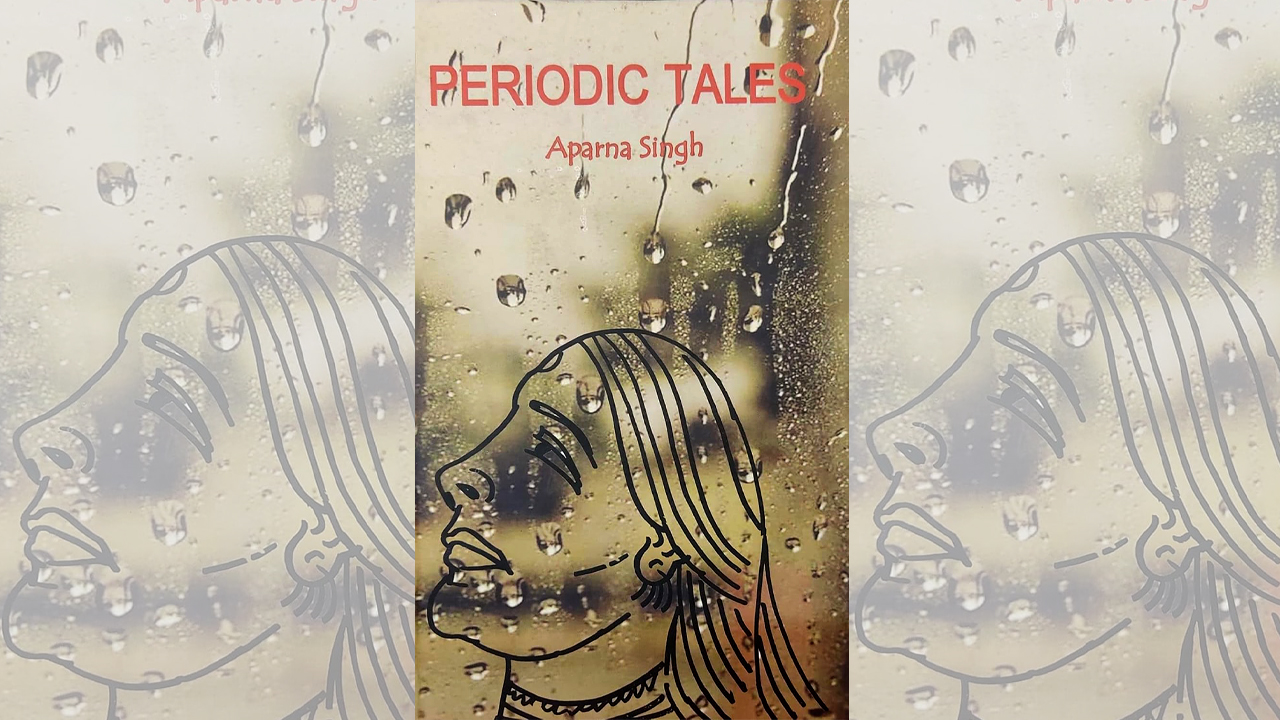
Periodic Tales is a significant contribution that confronts Indian society’s discomfort with female bodies and encourages conversations that challenge entrenched prejudices surrounding women’s sexuality, reproductive health, and mental well-being.
By Debasree Sarkar
Periodic Tales, Aparna Singh; Virasat Art Publication, 2022; pp. 161; ₹250; ISBN: 9789393063151
Aparna Singh’s anthology of twenty short stories, Periodic Tales, draws inspiration from real-life events and explores the cultural and societal practices surrounding menstruation, primarily highlighting women’s experiences during their monthly periods. The collection brings into focus a cross-section of women, including housewives, pubescent girls, working-class women, specially abled women, and athletes.
Dedicated to the “Padman” Arunachalam Muruganantham and Sobhan Mukherjee, a student who promoted menstrual hygiene by stocking public toilets with sanitary napkins, the book tellingly begins with a quotation from the Vasishtha Dharmasutra. It refers to the myth that the guilt of Brahmana murder committed by Indra appears every month as menstrual flow because women took upon themselves one-third of his guilt.1 A biological process such as menstruation has thus historically been embedded within a culture of scriptural condemnation that commands it not be seen, discussed, or, in most ways, even acknowledged. This desire to keep menstruation a secret is often accompanied by the belief that menstruating women are infectiously impure and that anyone or anything coming into physical contact with this supposed “pollutant” risks suffering unspecified horrors, including the degradation of ritual status. With this premise in mind, Singh fictionalises menstrual narratives and offers a feminist reading of the known and unknown lives of women and their supposedly “contaminated” bodies.
“Her Body” is the story of Rima’s loneliness from the very onset of menstruation after she loses her mother at a young age. Even while studying at a residential university, Rima never experiences empathy from those around her. Neither her family—her father, who preferred a son, nor her husband, who casually gropes her at night during those “indescribable” (26) days of pain—nor her employers provide her with a sensitive and supportive environment. Menstruation thus becomes, for her, analogous to the experience of untouchability among Dalits. In both cases, marginalisation stems from the body, which bears the marker of one’s perceived “impurity”—or, more accurately, one’s social marginality.
“Expectations” portrays the suffering of Mrs. Gupta, for whom the monthly onset of menstruation is a curse, as she struggles with polycystic ovary syndrome (PCOS), repeated miscarriages, and the patriarchal belief that a woman’s body is worthless unless it can reproduce. After all, women rarely find homes that embrace them without imposing preconceived notions of femininity.
“School” depicts the humiliation and insensitivity inflicted upon bright students such as Aditi, who, because of her lower-middle-class background and gender, faces unequal treatment from both her boisterous male classmates and her school. The brightest student in her class, Aditi dreams of becoming a doctor but ultimately considers abandoning school because of the hostile environment and her inability to afford sanitary pads that would otherwise ease the difficulties of menstruation.2
“Maa” tells the story of countless mothers who, even as they grow pale from anaemia, never “bother” anyone in the family with their physical distress. This silence stems from the deliberate indifference women often encounter from those closest to them.
“Shibani” speaks of perpetually half-starved girls whose lives remain inextricably intertwined with affluent urban existence. They are frequently offered unsolicited, patronising advice about using sanitary pads and maintaining a proper diet during menstruation, while their financial hardships are conveniently ignored.
“The Celebration” tells the story of a teenage girl for whom the equation of menstruation with becoming “a grown-up, a woman” (63) is far from straightforward. The story foregrounds the age-old tradition of measuring a woman’s worth through her reproductive capacity rather than her intellectual aspirations. As the protagonist observes, “Why had nobody asked me about my dreams, the plans I nursed to become a scientist? … But the mind, they said, was not as important as the body.” (66)
“Charcoal and Wood Dust” hauntingly portrays women like Usha, who fashion makeshift sanitary pads from old cloth stuffed with charcoal and wood dust because their families prioritise every need except their medical well-being. Yet the story also celebrates female solidarity. After surviving cervical cancer with the help of the narrator, a doctor, Usha joins an awareness programme promoting the use of sanitary pads, demonstrating how one woman’s empathy can transform many other women’s lives.
“Blue Blood” highlights the importance of incorporating the realities of women’s bodies into public discourse rather than erasing their discomfort and lived experiences. Mainstream media have long avoided depicting menstrual blood in its actual colour, substituting blue liquid in sanitary napkin advertisements while simultaneously overlooking women’s pain. The story underscores the importance of women-led campaigns in reshaping public perceptions of menstrual hygiene, as reflected in advertisements that have gradually shifted from blue to red representations of menstrual blood.
“Let’s Run” narrates the experiences of countless female athletes forced to withdraw from sports because of the insensitivity and backwardness of India’s sporting institutions. “Becoming” explores the lives of people whose bodily identities do not correspond with their internal sense of self—those who identify as feminine and long for menstruation, as well as those who identify as men and dread its monthly recurrence.
“The Menstrual Hut” depicts the hellish conditions in which millions of women are compelled to spend their periods—isolated in dark, desolate, and dreary spaces of exclusion.
“Frying Pan to the Fire” illustrates the compounded marginalisation experienced by menstruating women on society’s margins. Sonia, a sex worker, is sent to a reformatory where she is forced to choose between resisting custodial rape and obtaining sanitary napkins.
“Disabled” explores survival amidst the tensions between motherhood and physical disability. In “Death Wish,” narrated by the father of a differently abled girl, Singh examines how society constructs disabled female bodies as burdens, especially when menstruation occurs without the socially prescribed feelings of shame and modesty that underpin normative femininity.
“I’m Free” portrays a bold, educated urban woman who embraces feminism as a positive expression of feminine identity. Childhood memories of sanitary pad scarcity and an emotionally unavailable mother make her especially attentive to her own daughter’s needs. The story demonstrates how trauma shapes women’s psychological lives while also celebrating menopause as an act of liberation.
“Dear Sakhi” offers a feminist interpretation of the ways patriarchy has persuaded women to regard their own bodies as sites of impurity. “Pad-man” explains why role models such as Arunachalam Muruganantham are so important for young boys, encouraging them to become more sensitive to women’s physiological experiences and thereby fostering greater male participation in women’s sexual and reproductive health.
“Maa and I” explores contrasting perspectives embodied by two archetypal figures—the mother, representing the sacred, and the daughter, representing the profane.
“Letting It Go” portrays a woman grappling with the excruciating pain of endometriosis as she confronts the difficult choice between undergoing a hysterectomy and accepting a society that equates womanhood solely with the uterus and reproductive capacity.
“Why Use Pads” recounts the story of an ophthalmologist whose mother-in-law believes that sanitary napkins can cause blindness. The story dispels the common assumption that such superstitions are confined to rural settings, revealing instead that many urban women also confront such beliefs. Some, like Shalini, actively challenge them.
Overall, Periodic Tales is a significant contribution that confronts Indian society’s discomfort with female bodies and encourages conversations that challenge entrenched prejudices surrounding women’s sexuality, reproductive health, and mental well-being. Its narratives represent women from diverse socio-economic backgrounds, age groups, and life circumstances.
Singh highlights the realities of sanitation and menstrual hygiene that women in a “developing” country like India continue to endure, experiences that often leave lasting psychological scars. At the same time, she documents the resilience and ingenuity with which women navigate these hardships. The multiple perspectives represented in the collection—a schoolgirl, housewife, prisoner, migrant labourer, transgender person, young boy, father, doctor, domestic worker, and athlete—underscore the rich diversity of women’s experiences and womanhood itself.
Despite recent academic and artistic efforts to celebrate the female body and its functions—including projects such as The Lost Ones,3 The Vagina Monologues, exhibitions like Widening the Cycle, and the 2026 Sachhi Saheli Menstrual Festival, whose tagline proclaimed, “Menstruation doesn’t need whispers or shame. It needs conversations, clarity and compassion”—menstruation continues to remain “a hush-hush affair, a sad and uncouth secret, never to be uttered or discussed” (24), as reflected even in the branding of a popular sanitary napkin company.
Consequently, Periodic Tales serves as a timely intervention that underscores the urgent need for greater sensitisation within families, schools, workplaces, and other institutions so that women may enjoy genuinely equal opportunities throughout their lives.
References:
1In this text we find practices relating to the seclusion and restrictions of menstruating women explicitly linked to the mythic drama of Indra’s slaying of Vritra (the brahmana). For more details see Janet Chawla, “Mythic Origins of Menstrual Taboo in Rig Veda,” Economic and Political Weekly, October 22, 1994, p. 2817.
2In a recent judgement the Supreme Court of India held that the lack of menstrual health facilities violates principles of substantive equality and cannot be a barrier to education. The Judgement issued a continuing mandamus to ensure ‘substantial compliance’ of the Court’s directions, citing staggering drop-out rates and absenteeism among menstruating girl students. For more details, see Sudhiksha Innanje, “Supreme Court directs implementation of menstrual health facilities in schools”, Supreme Court Observer, February 18, 2026: https://www.scobserver.in/journal/supreme-court-directs-implementation-of-menstrual-health-facilities-in-schools/
3 ‘The Lost Ones’ by Nichole Speciale is a group of nine small hoops embroidered with white embroidery thread dyed with menstrual blood. The project aimed to bring attention to the gendered practice of embroidery and the shaming of the female body. To see more of Speciale’s work, visit her website: http://nicholelizspeciale.com/home.html.
Debasree Sarkar is a Doctoral Fellow, Department of History, Diamond Harbour Women’s University, India.
Email: debasree.his@icloud.com