
Unless the movement’s objectives expand beyond the resignation of an individual minister toward structural reforms, such as increased public investment in education, ending the coaching-dependent education model, and ensuring meaningful employment opportunities, changing the ruling party or replacing the Education Minister alone will bring no fundamental change to the lives of India’s students.
By Nizam
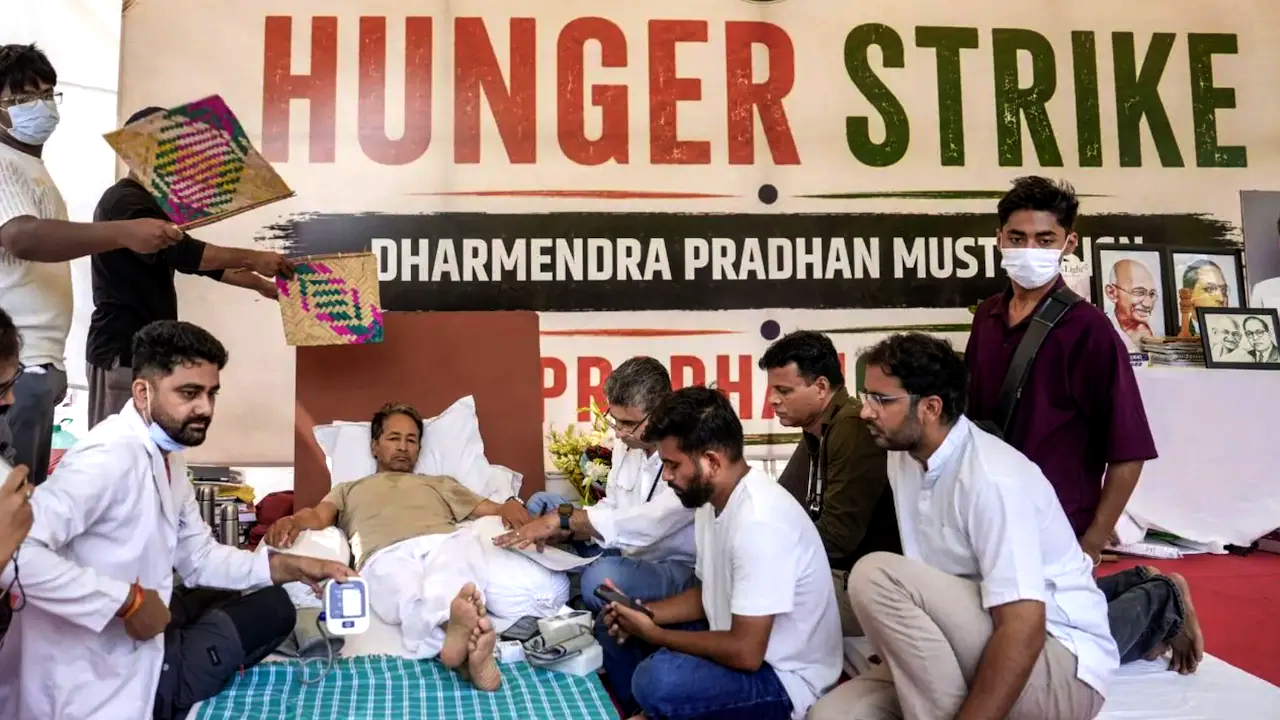
The unprecedented paper leaks and corruption surrounding the NEET-UG 2026 and other national-level competitive examinations have pushed India’s student community into a profound existential crisis. The ongoing protest at Jantar Mantar in New Delhi, demanding the resignation of the Union Education Minister, has now reached a critical juncture.
At the outset, one point must be made absolutely clear. The current movement against paper leaks and corruption in education is entirely justified and necessary. The purpose of this article is not to oppose the movement, but rather to politically evaluate both the role of the state and the movement’s present strategy. Even a just movement can fail to achieve its objectives if its strategy is flawed or limited.
In any democracy, when the future of millions of students is affected due to repeated examination scandals, the natural expectation is that those in political office accept moral and political responsibility and resign. The present BJP government, however, has chosen a different course. The resignation of the Education Minister would not merely signify the departure of one individual; it would amount to an acknowledgement of the government’s failure and the deeply entrenched corruption in the education system. Consequently, instead of accepting moral responsibility, the government’s foremost priority has become protecting its political image.
This explains why the government seeks to portray the paper leaks not as a structural crisis but merely as isolated criminal offences under investigation. Through CBI inquiries, committee formations, and prolonged legal procedures, the broader political responsibility is pushed into the background. At the same time, rather than responding to the moral force of the movement, the state increasingly relies on administrative and legal mechanisms to contain it. Shifting hunger strikers to hospitals, invoking various legal provisions, and reframing the protest as a law-and-order issue are all familiar instruments of statecraft.
At the same time, it is equally important to discuss the limitations of the movement’s current strategy. A movement that ought to be centred around millions of students has gradually come to revolve around the indefinite hunger strike of a prominent public figure who is not himself part of the student community. As a result, public discourse and media attention have shifted toward the health of the hunger striker, while the corruption of the examination system, the commercialization of education, and the future of students are increasingly pushed into the background. In a movement that should be led by students, their participation and leadership need to be far more visible and decisive.
The government, too, can derive political advantage from this situation. If millions of students were to occupy the streets across the country, suppressing such a mass movement would become far more difficult. But if the movement depends primarily on a handful of hunger strikers, it becomes comparatively easier for the administration to manage and contain it. Likewise, if the movement shifts away from its core demand and becomes narrowly framed as a campaign against the government itself, the state gains an opportunity to narrowly reframe the agitation as merely opposition politics rather than a genuine student movement, thereby obscuring the structural issues that gave rise to the protests in the first place.
Indian history demonstrates that hunger strikes alone do not necessarily compel the state to concede. During the freedom struggle, Jatin Das died after a 63-day hunger strike in prison. In independent India, Potti Sriramulu died in 1952 after fasting for 56 days in support of a separate Andhra state. In 2018, environmentalist and former IIT professor G. D. Agarwal (Swami Gyan Swaroop Sanand) died after a 111-day hunger strike demanding the restoration of the Ganga River. Perhaps the most remarkable example remains Irom Sharmila, who continued her fast against the Armed Forces (Special Powers) Act for sixteen years. The state neither accepted her demand nor allowed her protest to reach its natural conclusion; instead, it neutralised the fast by repeatedly arresting her and force-feeding her through a nasogastric tube. These episodes reveal an uncomfortable truth. States frequently possess both the administrative capacity and the political willingness to withstand extraordinary acts of personal sacrifice. Moral courage alone does not necessarily translate into political victory.
Mahatma Gandhi’s experience with fasting, however, was fundamentally different. His fasts cannot be understood as isolated acts of personal protest. They derived their moral and political power from the broader context of a nationwide anti-colonial mass movement, the organisational strength of the Indian National Congress, civil disobedience, the active participation of millions of people, and the political crisis confronting British colonial rule. The fast was one tactic within a much larger movement, not the movement itself. In other words, hunger strikes become most effective when they are backed by organised mass mobilisation. That distinction remains crucial today. A hunger strike can inspire a movement, but it cannot replace one. The real strength of any democratic struggle lies not in the endurance of a few individuals, but in the organised collective action of the many.
The rigidity of the state is not unique to the present BJP government. From the governments of Jawaharlal Nehru and Indira Gandhi to that of Manmohan Singh, Congress governments at different times also relied heavily on administrative power and ignored popular demands for prolonged periods. Governments have changed, but this institutional tendency of the state has remained remarkably consistent. Therefore, seeking solutions solely through a change of government leaves a substantial part of the problem unaddressed.
The experience of Anna Hazare’s 2011 India Against Corruption movement reinforces this reality. That movement did not become influential because of the hunger strike alone. It was supported by the BJP, then the principal opposition party, the extensive organisational network of the RSS, and broad backing from corporate media. The present student movement lacks such nationwide political and organisational support. Consequently, symbolic hunger strikes alone have failed to generate sufficient pressure on state power.
The most fundamental questions, however, lie even deeper. The resignation of the Education Minister or the arrest of a few accused individuals will not resolve the crisis in India’s education system. The paper leak is not an external disruption of this system; it is one of its predictable by-products. Where access to education becomes a market, corruption inevitably follows the logic of the market itself. The coaching industry, private education businesses, examination mafias, corrupt bureaucratic networks, and political patronage together have transformed education into a multi-billion-rupee profit-making enterprise. The larger questions concern the kind of education system India intends to build. Should access to education continue to depend on an increasingly expensive coaching industry? Why does public investment remain inadequate despite growing demand? Why do millions of young people experience such intense competition for so few educational and employment opportunities? And how can education be reclaimed as a public good rather than being treated as another sector for private profit?
These are difficult questions, but they point toward a politics capable of outlasting any single scandal. For that reason, criticism of the government, while necessary, is not sufficient. Nor can symbolic hunger strikes alone overcome a crisis rooted in the organisation of the education system. Symbolic fasting may serve as one component of a broader movement, but it cannot substitute for an organised student mass movement. Today, students face not only paper leaks but also a severe shortage of seats in higher education, declining public investment in education, unbearable psychological pressure in coaching hubs such as Kota, rising student suicides, and an acute employment crisis. Yet these structural issues have not received adequate prominence within the movement’s central demands.
A hunger strike can be a powerful weapon within a mass movement, but it cannot replace one. Unless students and young people build a nationwide organised movement alongside symbolic forms of protest, and unless the movement’s objectives expand beyond the resignation of an individual minister toward structural reforms, such as increased public investment in education, ending the coaching-dependent education model, and ensuring meaningful employment opportunities, changing the ruling party or replacing the Education Minister alone will bring no fundamental change to the lives of India’s students. Unless the structure itself changes, millions of students will continue to confront the same uncertainty, the same insecurity, and, eventually, the same crisis under a different administration. That is the challenge facing India’s student movement today, and perhaps its greatest opportunity.
Nizam is an activist based in West Bengal. The view expressed are personal.
The article has been translated from Bengali by Ijaj.