
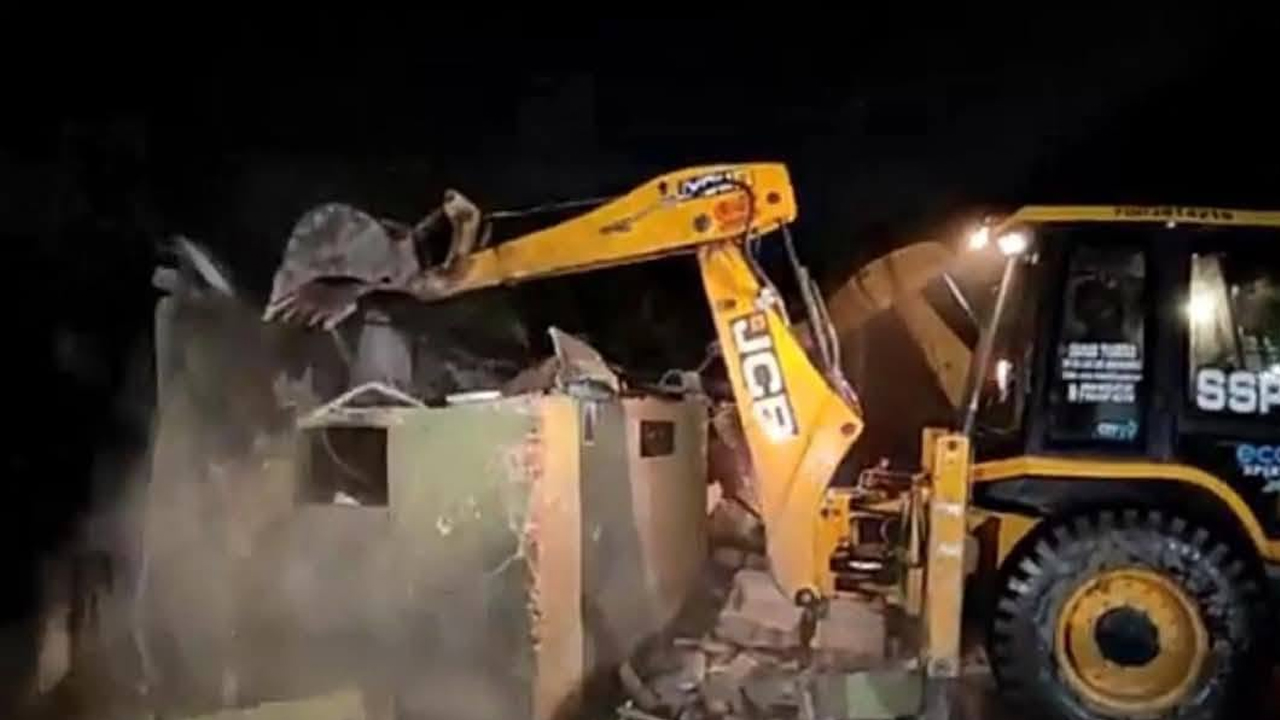
The wave of demolition and eviction drives that has swept across West Bengal in the aftermath of the BJP seizing power in 2026 Assembly elections has triggered widespread outrage and anxiety among workers, hawkers, slum residents and other vulnerable sections of society. While the BJP-led state government has defended these actions as measures against “illegal encroachments,” the images of bulldozed homes, demolished stalls and shops and evicted families have raised deeper questions about city development, urban planning and the rights of those whose labour sustains the city. Situating these events within the broader national pattern of eviction-led governance, this article examines the class character of demolition drives, the limits of rehabilitation policies, and the emerging forms of resistance that challenge the dispossession of the working poor.
By Pritha Paul
BJP’s victory in the 2026 West Bengal assembly election has been accompanied by massive demolition and eviction drives in the state — from slums and residential buildings in Tiljala, Kasba, Beleghata to shops and commercial structures in Sealdah, Howrah, Dum Dum stations among other places. Social media is abuzz with photographs and videos of broken walls and sheds, voices in the background crying out for mercy and posts denouncing the demolitions and demanding rehabilitation for the affected parties. The government, however, has staunchly maintained that the structures being demolished are illegal and unlawful and has repeatedly reiterated their no-tolerance policy towards such “illegal constructions”. For the working masses of West Bengal, these demolitions come as a shock at the hands of the newly elected government which had made lofty promises of “development” and various forms of social security and welfare.
For those who have consistently studied the BJP’s model of governance, though, this move is unsurprising. From Mumbai, Delhi, Gurgaon to Lucknow, the country has repeatedly witnessed what has been termed as “bulldozer raj” wherein demolitions have further marginalized already extremely vulnerable socio-economic groups such as daily-wage labourers and migrant workers and have been used as a tool to target minority communities and dissenters. A 2024 estimate by the Housing and Land Rights Network showed 1,53,820 houses to have been demolished in 2022 and 2023, with more than 7,38,438 individuals across the country being forcibly evicted. It was also seen that the evictions increased exponentially from 2017 to 2023, and 59% of the same took place as slum clearance, encroachment removal or city beautification drives.
In Mumbai, several slums were demolished and residents evicted – from Panchsheel Nagar to Jai Bhim Nagar to Bharat Nagar to Garib Nagar. Many of the affected parties, having nowhere else to turn to, were compelled to set up temporary shacks on the nearby pavements. Several of the residents were also earning their livelihood working as domestic workers in the very same luxury apartments whose residents sought their eviction to hike up their property prices. On the other hand, Brihanmumbai Municipal Corporation, on the insistence of Bombay Bar Association and with the assistance of court orders from the High Court of Bombay, carried out daily eviction drives to remove hawkers from the streets of Mumbai offering even more parking space for luxury cars. In Lucknow’s Akbar Nagar alone, 1800 structures were razed to the ground in the hope of construction of a riverfront plaza.
The bulldozer policy in West Bengal, therefore, does not come out of the blue. At this point, it is important to mention that demolition and eviction drives are not unique to BJP’s policy. Each party, whenever it has come to power, has carried out its fair share of brutality on the working class population by clearing out land for their bourgeois masters. Apart from the element of religious persecution cutting thought the class question, what is also unique to BJP is the scale and the speed of these evictions. A fascist government is uniquely fast in its execution of successive oppressive policies which leaves the population reeling under the rapidly changing effects of the attacks. These attacks, however, do resurrect serious questions of belonging and identity in the state which hitherto remained conveniently buried.
Bengal has been built on the backs of labourers and migrant labourers. Along with workers, Bengal’s economy and culture have also been shaped by refugees from Eastern Bengal (Now Bangladesh) who came here during the partition and the liberation war of Bangladesh, who invested every last penny they possessed to build a future here. Also the immigrants, who are defined as “illegals” within the urban borders, also have their fair share in contemporary urban structuring. From the mills to regular municipal sanitation and from the mines to tea gardens, work that was refused by the Bengali bhadrolok was taken up by or forced upon on the workers from the suburbs, migrant workers from the villages of Bengal, dalits, indigenous people and migrants from the neighbouring states such as Bihar, Jharkhand, Orissa, Uttar Pradesh, among others. The shanties being demolished today provide shelter to those who build the luxurious apartments for the Bengali bhodrolok, those who provide their services to keep these apartments clean and tidy, they cook for their employers and wash their clothes while the latter sit in air-conditioned rooms and discuss socio-political repercussions of the election results. These shanties house the hands which build the bridges and the flyovers, the railway tracks and the metro lines without which the bourgeois lives will come to a standstill. These hands clean our sewage and pick up our garbage from outside our houses so that we can breathe fresh air while the government decides to dump the waste at the entrance of their broken huts. The city, the state, the entire country owes its very existence to these very people who are begging for a shaky roof over their heads and two spoonful of rice for their hungry stomachs.
The question which arises then is who does the city – the land, the water, and the air – belong to? Those who build, brick by brick, the backbone of its future? Or those who exploit its painful past and plunder its present? The elites have always operated with a certain confident sense of ownership over the landscape of Bengal as also over those who produce it. They demand the services of the working masses but shy away from sharing public resources and seek to invisibilise and marginalise them in the name of aesthetics. How ironic is the ugliness of the whole situation! Also ironic is the fact that many among the affected individuals whose houses and shops are being bulldozed had voted the current regime to power, imagining they would be safe from any harm due to their affiliation to the majority community. What they failed to realize, and the left consistently failed to establish, is the ulterior motive of this present regime which has in reality waged a class war against the working masses of this country wrapped in the guise of religious strife. What we still fail to establish is that those who remain silent today, deeming the problem someone else’s to solve, will also bear the brunt of their silence through their own invisibilisation.
For this struggle, like any struggle but especially this one, cannot be fought without unity, without hope for unity. On the morning of 2 June 2026, hawkers at the Jadavpur station were issued verbal warnings of eviction. As night fell, hawkers gathered at the site to protest the government’s decision. Ordinary people joined in from all corners of the city. As the night grew darker, more and more people joined the hawkers in defiance of the government. They were not merely protecting the rights of the hawkers but also their own interest. These hawkers are the ones who keep the city affordable for the most vulnerable, for those who cannot afford to buy a Starbucks or a McDonald’s. A cup of tea for five bucks, a full meal for fifty – hawkers have protected us from being robbed by the big corps. In fact, they have protected us in more ways than one. They keep our streets safe and alive. Whenever I would return home late at night in Mumbai, I would cross my fingers and hope the local stores would be open. Whenever visiting a new city or in need of directions, we turn to these hawkers for our safety.
But the hawkers do not enjoy an ounce of security or protection. Even as the hawkers serve us, they pose a threat to Big Money. Only when small businesses dissolve into oblivion, can the big corps truly loot us to their heart’s content – when we are left with no option but to turn to them. Only when slums are smashed to the ground will the working classes turn to the landed classes for shelter, which will allow the real estate market to boom and gobble up the middle classes as well. This is precisely why the government’s general policy of ‘rehabilitation’ falls flat on its face – because it is a sham. It is a distraction used to enable the government to carry out its atrocities under a façade of humanity with the least amount of resistance. Most of the rehabilitation schemes are inadequate to address the grievances of the affected people and most of the times, the rehabilitation schemes are such that they cause more difficulties for the victims. They are either rehabilitated far away from their places of work and livelihood or under extremely unfavourable conditions. To add to that, the burden to prove oneself eligible for rehabilitation is placed on the affected persons who are already in a disadvantaged position. As is often the case, only a handful of the affected persons are deemed eligible under the rehabilitation schemes, leaving the rest to fend for themselves – creating a divide between the eligible and the non-eligible parties and effectively weakening the collective strength of the anti-eviction resistance.
Rehabilitation, therefore, is a tool of the government — used to legitimize and facilitate the process of eviction and demolition. In this article, I have deliberately distanced myself from discussing the legality of evictions for that question seems to me entirely irrelevant. History repeatedly reminds us what is legal is not always just. When laws are made by oppressors, those laws will seek to oppress and will be used to dispossess those who labour to produce society’s wealth. And there is nothing more heinous, more barbaric than the bulldozers destroying the homes and livelihoods of the most vulnerable sections. We are at that point in history where we need to shed all our blind faith in seeking refuge solely in courts, legislatures, or administrative authorities. Doing this is to ignore the increasingly visible class character of these institutions, including even the highest of the courts, which, more now than ever, have revealed their true class character and their apathy towards the plight of the ordinary people. The government and its institutions have repeatedly demonstrated whose interests they serve. The question before us is not whether the bulldozers are acting within the law, but whether the law itself has become an instrument of dispossession.
What unfolded at Jadavpur offers a different answer. Hundreds of ordinary people—hawkers, workers, students, residents and political activists—came together and halted the bulldozers, if only temporarily. Their united action revealed a truth that governments and corporations want us to forget: the city stands upon the labour of the working people, on the hands that break boulders and build bridges. The real strength of society lies in the collective power of those who build, clean, transport, feed and sustain our everyday lives. The bulldozers are not merely destroying homes in the slump and roadside stalls; they are attempting to erase communities, livelihoods and the very visibility of those whose labour keeps the city alive.
The struggle against evictions is therefore a struggle over who has the right to the city, who belongs in it, and whose interests development is meant to serve. If these attacks continue unchallenged, the consequences will not be confined to hawkers and slum dwellers. Every section of the working and lower-middle classes will eventually find itself confronting the same logic of dispossession. The lesson is clear: it is a Class War. Divided, the working people can be displaced one settlement, one market and one neighbourhood at a time. United, they possess the power to stop the bulldozers and challenge the ruling classes that send them. Those on the throne understand this truth. The future depends on whether the rest of us do as well.
*Note: Last night (on Sunday) the railway police, the state police and central security forces assembled at Jadavpur Station again with bulldozers. The entire area was cordoned off and the security forces brutally lathicharged the protesting activists, cleared the path for bulldozers to destroy homes and stalls. Several activists were injured and many were arrested.
Pritha Paul is an activist and lawyer. She is part of Groundxero Collective.
The views and opinions expressed in this article are personal.