
Over the past two-three months, a series of spontaneous, worker-led strikes has erupted across India’s industrial belts—from Barauni to Panipat, Manesar to Noida—cutting across sectors and states. Largely led by contract workers and unfolding without formal leadership or union direction, these struggles challenge the widely held belief that the working class has receded as a decisive social force. This article by Manas Kumar examines these developments and reflects on what they reveal about the changing contours of labour unrest and resistance.
[It has now become a common perception—particularly among sections of the left-liberal intelligentsia—that successive waves of revolutionary technological changes in industrial production over the past five decades have drastically reduced the numerical strength of the working class, rendering its capacity to intervene decisively in society almost obsolete.
This perception is based less on fact, more on a surface-level observation that the Indian working class is de facto in deep slumber in terms of sustained struggle for a long time. On the basis of this observation, some have gone so far as to theorise that the working class is no more the leading force for the revolutionary transformation of society; rather change would be achieved by the combination of struggles of the different oppressed sections of the society.
This perception/theory (whatever we may say) gained further traction particularly after more than one year long farmers’ heroic struggle against the three Farm Bills of 2020–21, which forced the Narendra Modi government to withdraw the Acts, and at the same time four new Labour Code — effectively stripping industrial workers of hard-won legal protections — were passed in Parliament with near-total silence of the workers on the ground.
This article does not intend to enter into analyzing the fault of this perception/theorization. Instead, it begins elsewhere — drawing their attention towards something unfolding over the past two months across multiple industrial belts in India. Something initiated not by parties, central trade unions, or established leaderships, but by workers themselves.
This intervention has a twofold purpose: first, to document exactly what is happening; and second, to try to understand what it signifies for those activists who are committed to revolutionary transformation of the society. The article will therefore appear in two parts.]
Part I
Let us begin with the most recent developments and than move backward.
Noida, Uttar Pradesh
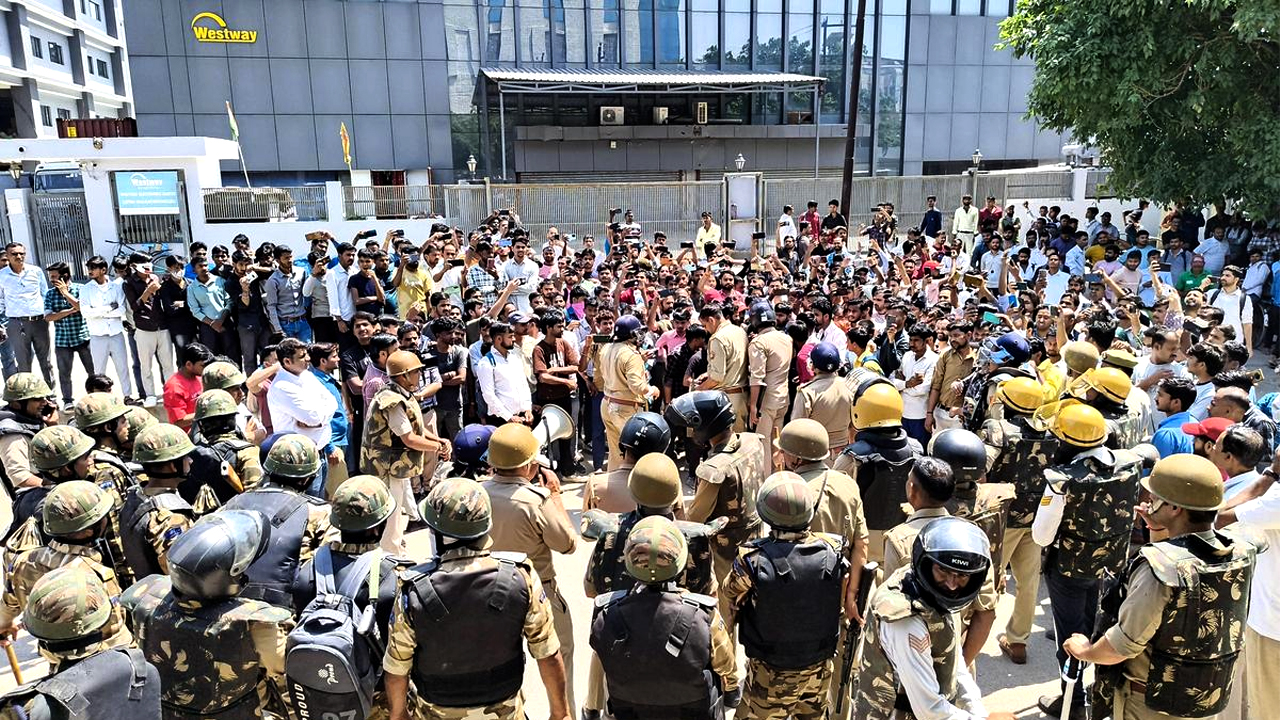
Since Monday, April 13, spontaneous strikes by the workers spread from one factory to another, from one sector to another sector of Noida’s industrial clusters, demanding minimum wage of at least Rs 20,000/- for unskilled workers.
By late Monday night, according to the Gautam Budh Nagar Police Commissioner, mobilization of the workers reached nearly 40,000-45,000. There were workers from garment, electronic, auto-parts manufacturing etc, and other export oriented companies.
Protests were going peacefully till Police and Rapid Action Force initiated indiscriminate crackdown. Workers also retaliated and the peaceful protests turned violent. Production in many factories is yet to start.
Why did this eruption of workers occur? Workers themselves provide the answer. Let’s hear some versions of the workers, directly copied below from an article published in The Print.
- Kumar works at Motherson, doing wiring work. He earns Rs 12,400 a month. “For a year, there has been no increase,” he said. “I want it to at least go to Rs 18,000-20,000 so I can manage my household. That is all we want. … I am not someone who gets into fights,” he said. “But this is suffocating. I don’t care if the police file a case. I have to fight for myself. Who else will?”
- Another worker, Ketan Kumar, who works at an export unit in Sector 57 said – “Most of the workmen here earn between Rs 10,000 and Rs 13,000 a month.” “That is not enough to run a family as inflation keeps rising.” He said wages have remained stagnant for years, building frustration.
- For Ankit Kumar, another worker, the question is not just about a raise, but about dignity. “I don’t care about anything else,” he said. “At least let us live and work with some respect.”
In this industrial area, a large number of women are also employed as workers. And, in several audio-visual interviews, many of them have openly stated that they are paid lower wage than male co-workers. Not only that, insufficient toilet facilities for them is a common phenomenon and they are also often sexually harassed and abused by the male supervisors-managers.
However, a very significant aspect of this protest has been stated by none other than the Chairman of the Greater Noida chapter of the Indian Industries Association. He was quoted in the same article of The Print, as saying, “The timing of protest is quite unique. It has no face, no leader and no organization. It just erupted and no one sensed it.”
Facing the wrath and anger of the workers, the BJP-led Uttar Pradesh government responded with the familiar carrot and stick policy to pacify the workers. As part of the carrot, initially, the District Commissioner declared that from now on, overtime would be paid at double rate, wage payment will be made by 10th of every month and a high level committee would be formed to address the demand of wage rise. Dissatisfied by those assurances, workers refused to return to work. Then, on the next day, the UP government declared minimum wage of unskilled workmen for Noida & Ghaziabad industrial area would be Rs 13,690 per month, and for other districts Rs 12,356. Workers are not happy with this meager increase; in addition, they are apprehensive that the management would not be ready even to pay this amount.
On the other hand, the stick came in, repression intensified. According to official statement, at least 300 workers are in police custody; unofficial version is that there are no traces of more than thousand workers.
Even more telling was the narrative deployed by the state and echoed by the mainstream media. The protests were framed as conspiracy. Immediately after the police crackdown, the State Labour Minister Anil Rajbhar officially stated: “The incident appears to have been carried out with the intention of disrupting the development, and law and order of the state. Recently, four suspected terrorists, with links to Pakistan-based handlers, have been arrested from Meerut and Noida. In such a situation, the possibility of a conspiracy to create instability in the state gains strength.”
Not only that, the State government has officially made the statement, as confirmed by PTI and reported in The Times of India, that the incident was not merely a case of labour unrest but part of a larger attempt to disrupt Noida’s economic ecosystem, with the involvement of certain political elements and organised groups.
Echoing the rhetoric used during the Farmers’ Struggle in 2020-21 —when farmers were branded “Khalistanis”—this time Noida workers have become “Pakistan-backed Terrorists”!
The state’s response is unmistakable: delegitimise, criminalise, and suppress.
Manesar before Noida
The Noida explosion did not emerge in isolation. It is commonly understood the struggle of Manesar workers has provided the inspiration and motivation to the Noida workers to erupt in protest and claim wage rise.
On April 3, 2026 workers at Honda Motorcycles and Scooters India in Manesar raised the demand for a wage hike to at least Rs 20,000 per month, and chose the path of strike. First Honda, then Richa Global, a major textile exporter company, soon, strikes by workers spread to one after another factory. On April 6, workers of different factories called for a general strike. Finally, the Haryana government was forced to declare a wage hike, however meager it may be. On April 9, a minimum amount of monthly wage for unskilled workers was raised to Rs 15,220 per month, even though on December 29, 2025, Haryana State Minimum Wage Committee itself had recommended Rs 23,196 as floor-wage.
Like UP, Haryana is also governed by the BJP. Hence, there is no difference in the carrot and stick policy – allowing limited concessions, followed by repression.
On the very same day when the enhancement of minimum wage was declared, the Richa Global management filed an FIR alleging that miscreants had attacked company management, employees, and police personnel with intent to kill, engaged in vandalism, assault, damaged vehicles, and indulged in stone pelting. The complaint further claimed that certain labour organisations, including Inquilabi Mazdoor Kendra and the Automobile Industrial Contract Workers Union, had instigated workers.
A similar FIR was made on the same day by another company, Modelama Exports Private Ltd. And on the basis of these two FIRs, at least 55 workers and activists were arrested, most of them at the dead of night; out of them, 11 were booked on serious charges, including attempt to murder, while 44 others, including 20 women workers, were arrested for vandalism. Those 11 have been sent to Judicial Custody for 14 days and the rest were produced at Court, yet, not all of them have been granted bail. Incidentally, except a few, most are migrant labour hailing from UP and Bihar, and their families are still in deep abyss.
Barauni-Panipat-Surat to Manesar – The March of the “Yellow Helmets”
The current wave of unrest can be traced further back.
Just three months before May Day, 2026, and after 140 years of glorious May Day Struggle in the USA, the demand for 8 hours’ work-day has started to reverberate once again in different corners of India. The demand was first raised on 22nd February by nearly 30,000 to 40,000 contract workers of Indian multinational infrastructure giant Larson & Toubro (L&T) engaged in executing the expansion project of Panipat Refinery of the Indian Oil Corporation. They additionally demanded wage hike, overtime payment at double rate, timely payment of wage, 26 work-days a month and medical insurance in case of accidents, amongst others. They went on strikes for six days and faced lathi-charges and tear-gas shells from CISF and paramilitary forces. FIRs were lodged against 2500 unidentified workers.
The expansion work of Panipat Plant is estimated to cost 32,946 crores of rupees. But what is the condition of the workers? Let’s hear from the workers’ mouth:
- Rajnish Singh, a middle-aged worker from Vaishali district in Bihar said, “Accidents go on daily. Forget help for injuries, such as giving us health benefits, such as under the Employee State Insurance Corporation. They have no concern for us and we feel they will throw our bodies into the construction site or a canal rather than compensate our families if we die working here.”
- Deepak Kumar, a welder from Uttar Pradesh, said the pay of 540 rupees a day was so little that most workers even after working for years had no savings and depended on the contractors to give them 1,000 rupees ‘kharchi’ or weekly expenses. This was deducted from their wage at the end of the month.
- “We wake up at 5 am, are at the site from 8 am till 8-9 pm, then go home to cook and clean. We barely get to sleep five-six hours before beginning again, without a break,” said Kuldeep Singh, whose work is to assist colleagues who fit steel bars to reinforce the concrete structures of the refinery. ‘Helpers’ like him are categorized as unskilled workers and earn 541 Indian rupees a day. ‘Skilled’ workers like welders, those working on boilers or erecting scaffolding based on drawings provided to them, are paid 760-780 rupees a day.
- “You are building at 200 feet height,” said Jogender Singh, “the pressure of work and time is so much, that even if a worker needs to urinate, he feels compelled to do so somewhere at that height in a corner thinking that how will he go back down and then walk 1 kilometer to a mobile toilet and then lose time climbing back to site?”
- Draupadi Sahu, a migrant from Panna in Madhya Pradesh, said women on average were paid almost one third less than the men. She had started work at 90 rupees a day, and now earned 400 rupees a day, an increase of only 300 rupees in two decades.
Significantly, the strike was completely spontaneous and on the second day of the strike a hand-written charter of demands signed by six workers was submitted to the IOCL. In mid-March, IOCL management issued a notice claiming that the demands of the workers were met, but the workers are still apprehensive whether the contractors would abide by that agreement, or not.
But the struggle of the Panipat workers also has two recent predecessors. One, state-owned Obra Power Plant at Sonbhadra, Uttar Pradesh, where workers went on strike first on January 14, 2026 and again on March 24 against delay in payment of wages; then, at Indian Oil Refinery at Barauni, Bihar – workers went on strike demanding wage hike, ESI/PF, workplace safety, basic necessities like drinking water and toilet in the workspace. And it is generally accepted that the strike at Barauni had a ripple effect on Panipat.
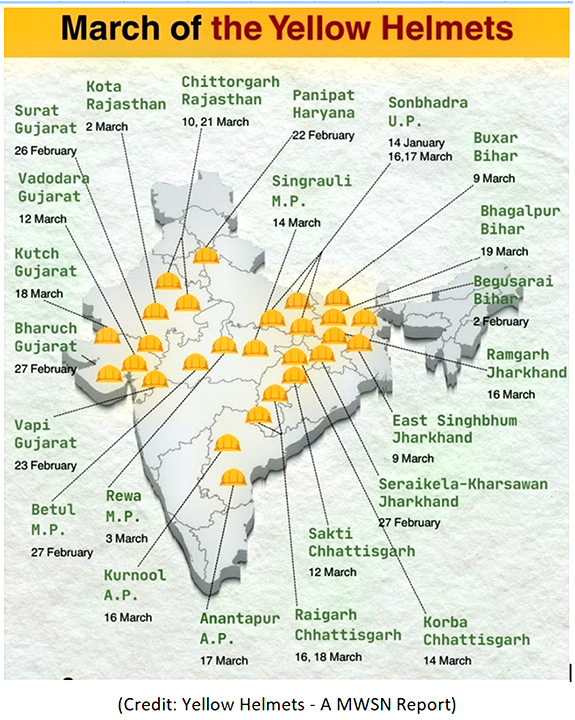
However, the struggle of Panipat has special significance. It is from here that the demand of 8 hours’ work-day has surfaced so vociferously and spread subsequently to at least 12 states. Immediately after the strike in Panipat, on February 27, more than 5000 contract workmen hired again by Larsen & Toubro doing expansion work of the steel plant of ArcellorMittal Nippon at Surat in Gujarat went on strike. Here also the demands were 8 hours’ work-day, wage hike and once again workers had to face police firing tear-gas shells and detainment of a large number of protesting workers. Barauni inspired Panipat, Panipat inspired Surat, and the rebellion of the workers spread like wild fire.
Following map of India shows how the strikes spread across different corners of India (updated up to March 18, 2026):
Let us now observe some interesting features of these struggles.
1. Everywhere protests have been spontaneous, in absence of any external leaders and/or established trade unions (in fact, they were absolutely clueless about almost all of the protests), and workers themselves have led the protests/strikes in their own way, that also without any previous experiences of struggle and organization.
2. Nature of industries where the strikes have happened: Petro-chemical, Power Plants, Steel, Cements, Textile, Coal, Engineering, Paints-Fertilizers-Chemicals, minerals etc. So, after a long time, workers have been able to make some impact on some of the very major industrial sectors of India.
3. While some of the strikes were in mega-PSUs like refineries of Indian Oil Corporation (Barauni, Panipat, Vadodara), Western Coal Field (Betul – Madhya Pradesh), NTPC (total 3 different strikes – Rehan and Singrauli, both at Sonbhadra – UP; Khalegaon, Bhagalpur – Bihar), in terms of private sectors, major big companies affected by the protests are:
- Aloke Industries, Vapi, Gujarat – owned by Reliance industries – strike of the 800 workmen continued for 26 days against 12-hour shifts, delayed salaries and inadequate facilities; contract workers of the same company at Dadra & Nagar Haveli had protested in end-2025 primarily over unpaid dues, lack of bonuses and wrongful terminations. (Source: https://thewire.in/labour/the-war-the-indian-state-and-the-worker-citizen)
- AM/NS Steel Plant, Surat, Gujarat – owned by ArcellorMittal-Nippon Steel – already mentioned earlier in the article.
Asian Paints, Dahej, Gujarat – an Indian multinational company.
- Chambal Fertiliser & Chemical, Kota, Rajasthan – owned by KK Birla Group.
- Ultratech Cement – strike at four different factories – Rewa, Madhya Pradesh; Patratu, Jharkhand; Petnikota, Andhra Pradesh; Tadipatri, Andhra Pradesh – owned by Aditya Birla Group.
- Adani Power – 3 strikes – Singrauli, MP; Korba, Chattisgarh; Raigarh, Chattisgarh – owned by Adani Group.
- ACC Cement – Sonbhadra, UP – again owned by Adani Group.
- Tata Power – Mundra, Gujarat – one of India’s biggest coal based power plants – owned by none other than the TATA Group.
- Jindal Steel – Raigarh, Chattisgarh – owned by JSW Group.
- Hindustan Zinc – Chittorgarh, Rajasthan – owned by Vedanta Group.
- Vedanta Power – Singhitarai, Chattisgarh – again owned by Vedanta Group.
- So, after a long time, workers have tried pouncing upon some of the big capitalists of India.
4. Everywhere protesters are the contract workers. While the workers related to Indian Oil & NTPC are primarily involved in some sort of industrial construction activities, in most of the private sector plants, they are engaged in core production. It is also revealed that Larsen & Toubro is a major contractor company for the refineries, under which hundreds of petty-contractors operate and workers are regularly transferred from one site to another – thus these workers have an independent networking system and information regarding working conditions and struggles from one site rapidly spread to another. Both in private as well as in PSUs, even though most of the job is highly skilled in nature, those are treated as unskilled almost in every factory.
5. Social media has played an important role in spreading struggles from one region to another.
6. Demands are common in almost all the struggles – 8 hours’ workday, wage hike, overtime at double rate, paid leave, ESI/PF, payment at a fixed day on every month, workplace safety, basic amenities like drinking water, toilets etc. So, it is evident that the nature of exploitation is also the same everywhere, whatever the nature of industries is, and whoever the owner of the company is.
7. Protests have surfaced in those states where the BJP/NDA governments are in power, the only exception being Jharkhand. It also needs to be mentioned here that on the basis of new Labour Code, new labour rules (which are under the jurisdiction of the State governments) have already been passed in BJP/NDA-led states and almost everywhere 10-12 hours’ workday has been implemented. For example, in September 2025, the Andhra Pradesh state assembly has passed the Factories (Andhra Pradesh Amendment) Bill extending the workday to 12 hours and allowing night shifts for women workers; in last December, the Rajasthan Shops and Commercial Establishments (Amendment) Ordinance, 2025 has permanently increased the daily work limit to 10 hours and the quarterly overtime cap to 144 hours. Most astonishingly, we find that NTPC itself in its Khalegaon, Bihar Plant, where maintenance workers went on strike for 8 hours’ work, has notified that workday has been extended to 12 hours.
We’ll discuss more about some of these aspects in the second part of the article.
Are we trying to de-glorify previous workers’ struggles of the 21st century?
Obviously not. During the first decade of the 21st century, we have seen some of the heroic struggles of the workers in Gurgaon-Manesar industrial belt, most significant among them at Maruti-Suzuki, Honda, Daikin etc and at some more auto-parts manufacturing companies. In particular, no one can undermine the heroic struggle and sacrifice of the Maruti workers; we can never forget and forgive the statement of RC Bhargava, the then Chairman of MSIL, who said that “Japanese investors are jittery over the situation of labour unrest in India because of what happened in Manesar” and the Punjab & Haryana High Court’s verdict of denial of bail plea of arrested workmen saying that “foreign investors are likely not to invest the money in India out of fear of labour unrest”
During the second decade, we have seen the heroic spontaneous month-long struggle of nearly 10,000 exclusively female tea plantation workers at Munnar in 2015; more than 50,000 garment workers of Bangalore in 2016, again primarily led and participated by female workers; and a series of struggles in different factories at Uttarakhand. And in 2024, we have seen Samsung workers’ struggle in Tamilnadu, majorly some among others.
However, the significant difference this time with the previous struggles is that in earlier struggles, each one was fought in isolation, either in a single plant or in a single industrial area. One struggle could not lead to another. But, significantly this time, struggles are rapidly spreading from one plant to another, one industrial sector to another, one state to another, and everywhere led by the contract workers.
Despite repression, arrests, and attempts at criminalisation, the workers’ rebellion is spreading to newer areas. From Barauni to Panipat, from Manesar to Noida, the pattern is unmistakable: one spark ignites another. For the first time in years, the “invisible” workforce of contract labour—fragmented, precarious, and systematically silenced—is beginning to appear, mobilize and act.
(To be continued)
The author is a political activists associated with workers’ movement.