
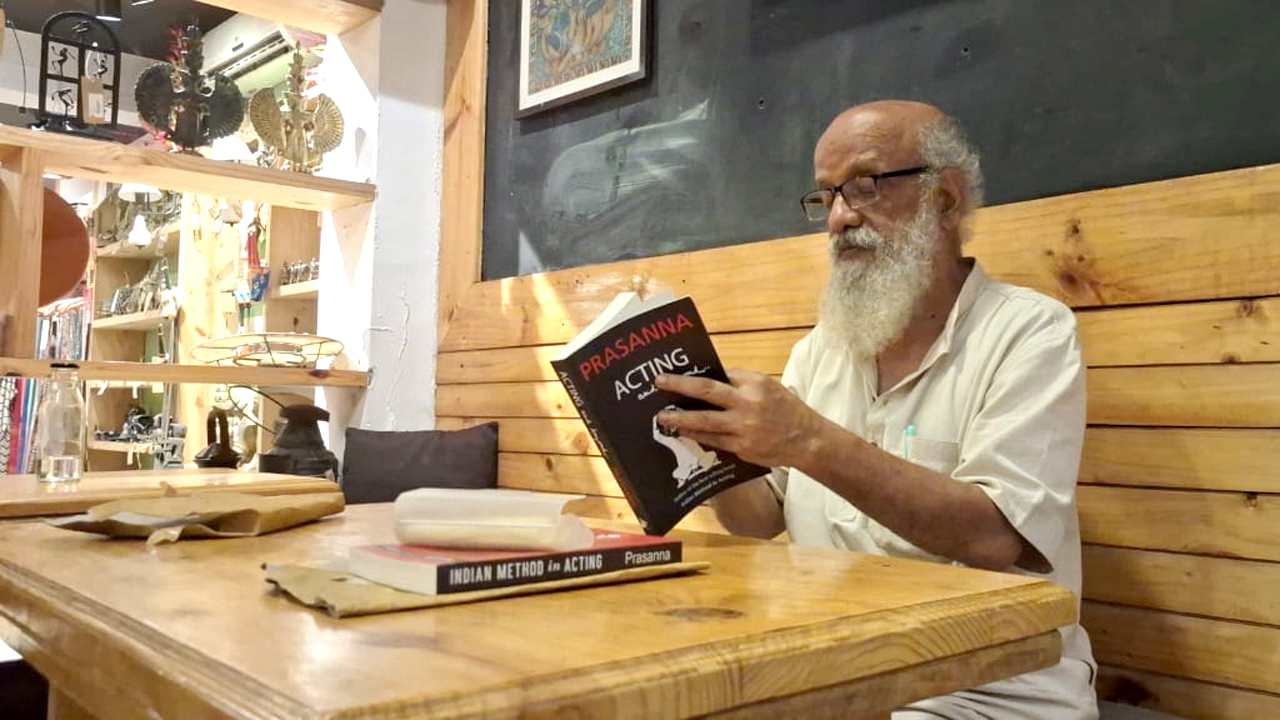
27 March is World Theatre Day. Groundxero publishes a long conversation with theatre director and playwright Prasanna. A National School of Drama alumnus and one of India’s major theatre activists, Prasanna’s method acting has shaped its own generation of actors. His theatre draws from philosophy, social understanding, political ideology, and a deeply rooted yet modern engagement with tradition.
Last year, during his long tour of West Bengal, Groundxero’s Sudarshana Chakraborty sat down with the maestro over tea and breakfast. From theatre to charkha (his handloom initiative), from Gandhi to Tagore, from politics to spirituality, and from decades of theatre practice to a long hiatus, Prasanna reflects on a life lived across multiple worlds.
GX: A long and hectic tour in and around Kolkata and other districts after many years? How is the experience? And why did you plan the tour?
Prasanna: You see, for a theatre person, Bengal is always a very exciting and happening place. When we were young, we used to come more often, watch plays, work with people, and learn from them also. Coming to Kolkata, coming to Bengal, is a natural thing for most theatre people. This time, I was not really planning this, and I don’t have that sort of contact. Luckyji was interested and had been planning this for the last six months. Eventually it happened. I’m very happy about it.
GX: After how many years are you visiting Kolkata or Bengal?
Prasanna: I come once or twice for a brief seminar or something. But really, I think after the ’80s—late ’80s—I had not really come. I had come then because of the ‘Journal of Art and Ideas’. I was trying to campaign for the journal, get subscribers and all that. After that, I had not really come as much as I wanted to.
GX: Who were the theatre persons from the theatre fraternity in Bengal you used to meet and interact with, and what changes are you seeing now?
Prasanna: I met all the big ones. I was lucky to be born in an age like that. I met Utpalda (Utpal Dutta), and I’ve seen his performances. I saw his performance for the first time when I was hardly anything—I was a first-year student at the National School of Drama. I met Badalda (Badal Sarkar); Badalda had come and worked with us. I had a very deep relationship with him.
Then I came and watched Jagannath and Marich Samvad; Bibhash (Bibhash Chakraborty) was making his productions. In fact, I did Marich Samvad in Kannada. In between, I couldn’t come because I was not really doing theatre—for about three decades, in fact four decades. I was living in this village, Heggodu, and I was deeply involved with the handloom weavers. Even now I am, except that the society or cooperative that I built is running well now. So I started feeling that, as an old man, I should not be poking my nose too much into it when it is running well. These women—rural women—with the help of managers and others are running it well.
In fact, Charkha has become the largest naturally dyed handloom in the country. So, post-COVID, I’ve been travelling.
GX: When you started doing theatre as a student of the National School of Drama, what or who were your motivations or inspirations?
Prasanna: It was an interesting time, theatrically and politically. By the time I finished at the National School of Drama, there was an Emergency declared in this country, and there was a lot of turmoil. So, when I went back to Karnataka—I wanted to go back immediately—I plunged into political theatre. Lots of protests; thousands of street plays. Then the Emergency was lifted and Indira Gandhi contested from Chikmagalur. We actually went from village to village performing hundreds and hundreds of street plays. But Samudaya—the name of the group—was also doing regular theatre, unlike, let’s say, Jana Natya Manch. We were not only doing street theatre.
GX: What were the political situations or conditions where theatre was making a difference? Was it an urban scenario or rural India where theatre had influence?
Prasanna: Samudaya always focused outside Bangalore. In fact, after five years of intense work, Samudaya had nearly 40 units across Karnataka, and some of them were in parts where almost nothing in contemporary theatre had happened—Hyderabad Karnataka, North Karnataka. We were very focused on going beyond the city. Our plays went beyond the city, our themes went beyond the city.
GX: People already had their own folk forms. When you brought a new form, what was the reaction?
Prasanna: Like any cultural action, it’s very difficult to judge immediately. If it’s powerful, it shows after a while. In Karnataka, after Samudaya, other forms of cultural expression—especially protest, Dalit movements, rebel literary movements—all began to grow.
Then things changed. Rajiv Gandhi came to power at the centre, Ramakrishna Hegde in the state. Both were accommodative, and many people were absorbed into what they themselves had called bourgeois politics. That was a difficult time for me. Socialist countries were collapsing, revolutionary ideas were becoming bureaucratic, and there was growing cynicism. It affected my personal life as well, and I went through a broken marriage.
I would say there are three phases of my life: a young phase where I felt I ruled my world; a middle phase of anger and unhappiness; and now a third phase where I try to be calmer and reconnect with younger people. That has helped me.
Charkha played a major role in this transformation. Village life teaches you that you cannot defeat people—you have to live with them. That’s where I understood accommodation and non-violence.
GX: So, is it that many young people from that time who had rebellious ideas turned to Gandhianism later in life?
Prasanna: Not all of them, but some did. I’ve seen some very striking transformations. There was a fellow called Rajen Chandy, about my age, maybe a year or two younger. He was in Bangalore, the son of a well-known police commissioner, from an upper middle-class family. Very bright. They had formed a Trotskyite group—meeting in another part of Bangalore. I didn’t like them then; I used to think, “woh to bourgeois hain.”
I lost contact with him. Much later, I met him at Rishi Valley School. His first marriage had broken, and he had remarried; his wife was teaching there. At that time, he was just living there. What a transformation it was. I was in his house when suddenly a bird came hopping and sat on his shoulder. He treated it like a small child. I thought, “Oh my God, this is amazing.” Someone as cranky and unpredictable as me could now make a bird sit on him.
He told me the story of that bird. It’s not only about becoming Gandhian in the mind—some people have actually matured and become very kind. I don’t think I’ve become that yet. I’m trying to be.
GX: How did you cope with life in Delhi, coming from Karnataka? How long were you there?
Prasanna: When I went to Delhi, I would go occasionally to direct plays because I had to earn money. My image had already gone ahead of me—that I was a “red radical.” So I had serious problems.
At that time, there was also a sudden search for Indian tradition in theatre. Girish Karnad was writing Hayavadana, Nagamandala; Vijay Tendulkar wrote Ghashiram Kotwal. Directors like Ratan Thiyam were staging works like Chakravyuha.
At a national festival, I saw some of these productions. My own play was also there—we had already staged it successfully in Kannada. But when I saw those productions, I realised I would be metaphorically “jailed” for decades, because I was not like that.
The trend then was to create something grand, non-verbal, and exportable to the West—to show, “Look, Indians also have theatre.” My work was rooted in narrative and language, something very dear to me.
So for nearly 30 years, I did what K.G. Subramanyan did—worked with young people. I directed student productions at the National School of Drama. Many avoided student work, preferring repertory or festivals. I often clashed with authorities, but rarely with students.
Over time, I unknowingly trained many actors who later became stars. While I was in Charkha, deeply immersed in handloom work and not even following the outside world, these actors began speaking about my method and influence. Only after COVID, when I stepped out again, did I realise I had become a “famous man.”
GX: Who were your closest companions during that time?
Prasanna: Not really my colleagues. Mostly people from Samudaya and Charkha—they were my friends.
GX: When you were doing street theatre, alongside people like Safdar Hashmi and Badal Sircar—what influenced you?
Prasanna: Safdar was a great friend. He wrote very generously about my serious productions. My understanding of street theatre was slightly different.
I believe an artist has to manage a “double life.” One must work seriously in art, but also engage with people’s struggles. If you don’t separate these, activism begins to intrude into art in a desperate way. I didn’t want that.
So, street theatre for me was communication—radical mass education. In serious theatre, politics and social concerns were present, but not in a forced or desperate manner.
GX: Why distinguish between street theatre and serious theatre?
Prasanna: Only for lack of a better word. I’ve done many comedies too. But compared to street theatre, proscenium theatre is like a five-day Test match—complex and layered. Street theatre is more like T20—direct, immediate.
GX: Didn’t you miss theatre during your time in the village?
Prasanna: Sometimes, yes. But the experience of working with handloom was so intense that it was worth it. I travelled across the country—Odisha, the Mahanadi belt—watching weavers create masterpieces in humble huts.
That contrast was not negative—it calmed me. It showed me that great art does not need luxury. That weaver looked like M.F. Husain to me.
I’ve seen such simplicity in many artists—Husain himself, or Mallikarjun Mansoor sitting casually on a pavement before a performance. True greatness often comes with simplicity.
GX: Did you ever feel the urge to translate those experiences into theatre?
Prasanna: The relationship between experience and art is complex. If you try to directly convert experience into art, you become a bad artist.
When I’m with people, I’m simply with them—not there to “extract” something. Of course, we all steal unconsciously.
The same applies to working with young actors. Earlier, I was more judgmental. Now I try to receive what they have—youth—and give what I have in return. That exchange removes tension and creates joy.
GX: When did you feel the current political situation was emerging?
Prasanna: For me, the turning point was 1991, during Advani’s Rath Yatra. I was angry, like many others, but I also asked—why are people supporting this?
We failed to understand that. That’s why I worked on Uttar Ramcharit.
Today, I feel those who speak of Hindu Rashtra do not understand Hinduism. They reduce it to political mobilisation.
GX: Are you a believer?
Prasanna: I remain a non-believer. But I understand something profound: whether God exists or not, humans need God.
Gandhi transformed the idea—he said not “God is Truth,” but “Truth is God.” That is remarkable.
GX: Where do you see the Left today?
Prasanna: The Left is more honest and people-driven than others, but ideologically it needs to re-examine itself—and it is hesitant to do so.
GX: Is commercialised theatre failing politically?
Prasanna: Anti-fascist movements historically had strength but also flaws. One mistake was abandoning religion instead of engaging with it. Figures like Kabir challenged structures but retained the idea of God.
Structures must be questioned repeatedly—they often end up suffocating the truth they were meant to protect.
GX: Do you connect with Tagore’s ideas?
Prasanna: Tagore is extraordinary. In some ways, he and Gandhi represent two sides of the same coin. Tagore understood complexities—nationalism, sexuality, modernity—more deeply. He will remain relevant for centuries.
GX: What about your method acting?
Prasanna: If I must name one actor who embodied it, it would be Irrfan. His subtlety, attention to detail, and minimal gestures reflected what I tried to teach.
My ideas also draw from the Natyashastra, and from practitioners like Habib Tanvir, Ebrahim Alkazi, Shanta Gandhi, Badal Sircar, and Sambhu Mitra. All of them engaged critically with tradition—seeking its essence, not its rigid form.
GX: Will we see more of your productions now?
Prasanna: Yes, I’m currently working on a Hindi production based on a Mahabharata story. It’s playful, musical, but also critical.
My recent travels across Uttar Pradesh, Uttarakhand, and Bihar disturbed me—the persistence of feudalism within democracy. It’s something I’m still trying to process.