
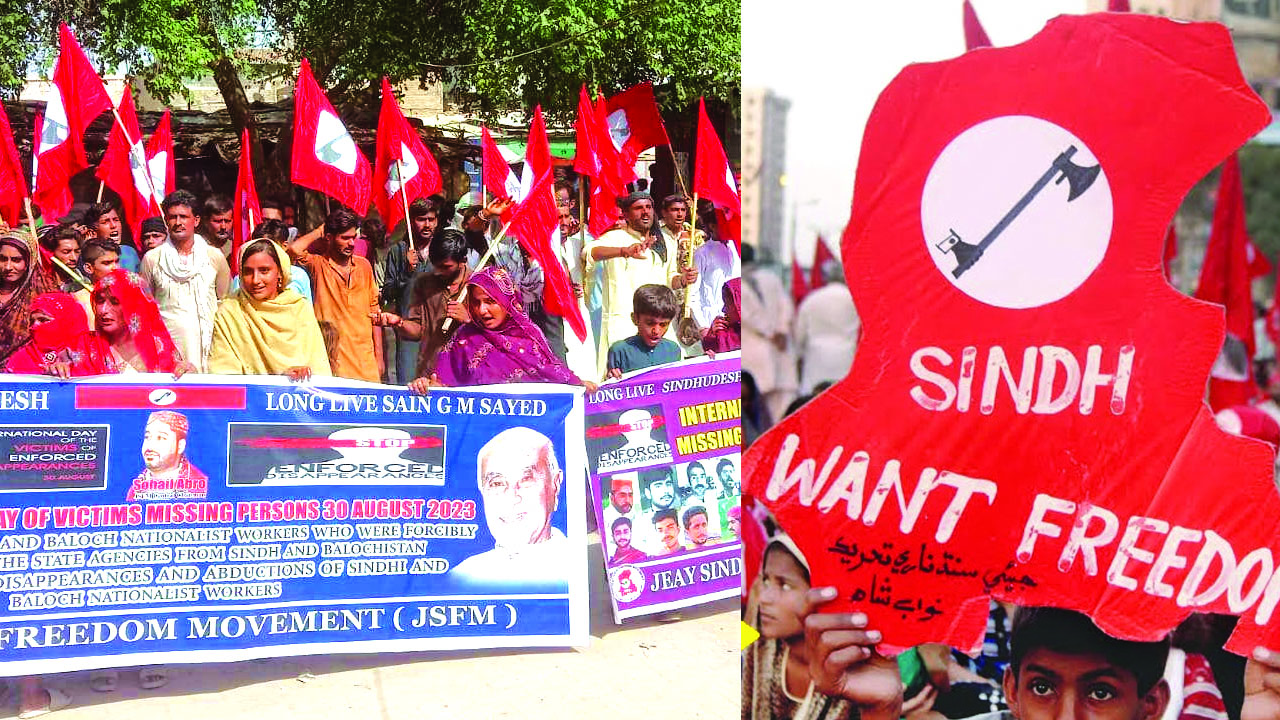
The future of Sindhi nationalism depends on its ability to reorient towards a class-conscious, inclusive framework centred on land, labour, and dignity. Without this transformation, it risks remaining symbolically powerful but politically ineffective.
By Suffyan Laghari
This article critically examines the evolutionary history of Sindhi nationalism through a class-based analytical lens. It presents Sindhi nationalism as a historically produced ideological formation shaped by colonial legacies, postcolonial state structures, and internal class and caste hierarchies. The analysis highlights how nationalist discourse has prioritised identity over structural change, and concludes by calling for a reorientation towards an inclusive, class-conscious nationalist framework.
Introduction
Sindhi nationalism occupies a paradoxical position in Pakistan’s political landscape. It has emerged as one of the most enduring expression of resistance against centralisation and cultural homogenisation, yet remains fragmented and socially limited. Existing analyses, which, often explain this paradox in terms of organisational weakness, state repression, or the electoral dominance of mainstream parties such as the Pakistan People’s Party are partial or insufficient without examining the class and caste structures shaping nationalist politics in Sindh.
This article approaches Sindhi nationalism not merely as a political movement, but as an evolving ideological formation embedded in material relations. From its colonial origins to post-One Unit radicalisation, it has been shaped largely by educated, middle-class, and upper-caste actors whose political imagination was constrained by inherited feudal and colonial hierarchies. As a result, nationalist discourse has often articulated cultural and political grievance more forcefully than economic exploitation and social inequality.
Colonial rule institutionalised land ownership, empowered religious and tribal elites, and restructured agrarian relations in ways that entrenched class divisions within Sindh. These structures persisted after 1947, even as centralisation intensified regional grievances. Sindhi nationalism thus developed within a contradiction: opposing from the centre while accommodating domination within the province.
Peasants, haris, and lower-caste groups remained symbolic subjects of nationalist rhetoric rather than active political agents. Caste-based exclusions, especially affecting Dalit and Samat communities, were rarely addressed explicitly, reinforcing their marginal position within nationalist politics. This article argues that the limitations of Sindhi nationalism cannot be understood without situating them within these structural contradictions. It seeks to demonstrate how class and caste relations have both enabled and constrained Sindhi nationalist politics.
Literature Review
Scholars on Sindhi nationalism have largely focused on political success, electoral performance, and relations with the Pakistan state, often reducing it to a reactionary or episodic phenomenon, surfacing only during moments of crisis, unrest, or ethnic conflict. Such approaches overlook the deeper historical, social, and class-based processes through which Sindhi nationalist consciousness has been constructed and reproduced over time.
Studies emphasising cultural construction highlight how Sindhi identity has been shaped through language, history, and symbolic politics, largely driven by an aspirational middle class. However, these analyses often flatten internal differences, obscuring the realities of peasants, haris, and marginalised communities.
Political histories of Sindhi nationalism trace organisational trajectories and tensions with state structures, but remain centred on elite actors. Colonial studies reveal how British rule strengthened religious and landed elites, laying the foundation for contemporary power structures. Materialist analyses of agrarian change show how peasants and labourers became structurally marginalised.
Theoretical perspectives on nationalism emphasise its constructed and exclusionary nature. Cultural symbols often obscure social inequalities, while resistance to central domination does not necessarily produce internal inclusivity. Postcolonial critiques highlight how nationalist elites reproduce colonial hierarchies.
Within Sindhi intellectual traditions, figures such as G.M. Syed, Ibrahim Joyo, and Rasool Bux Palijo occupy a complex position. Syed’s writings laid the ideological foundations of Sindhi nationalism by asserting Sindh’s historical and cultural distinctiveness. However, his vision largely romanticised a unified Sindhi identity, overlooking internal stratifications. Joyo and Palijo introduced socialist and Marxist critiques into nationalist discourse, foregrounding class struggle and anti-feudalism. Yet even these radical interventions tended to subsume caste under class, leaving Dalit and lower-caste experiences analytically marginal.
More recent internal critiques, notably by Abdul Wahid Araisar, explicitly acknowledge caste exclusion within Sindhi society and nationalist politics. However, such voices remain limited, and community-specific perspectives particularly of Samat and Dalit groups are still largely absent from mainstream scholarship.
Overall, the existing literature reveals a persistent gap between the emancipatory claims of Sindhi nationalism and its social practice, underscoring the need for a class-based analysis. A critical, class-based analysis of the evolutionary history of Sindhi nationalism must move beyond elite narratives and interrogate how nationalist discourse has been shaped, constrained, and sometimes compromised by material relations of power within Sindh itself.
Colonial Foundations of Sindhi National Consciousness
Sindhi nationalism emerged within the political economy of British colonial rule. Rather than dismantling existing structures, colonial administration reinforced them by empowering landed and religious elites as intermediaries of governance.
As Ansari (1992) demonstrates, British policies consolidated the authority of Syeds, pirs, and large landlords, embedding them within colonial administrative and legal frameworks. Land settlements and irrigation policies intensified class divisions, binding peasants to exploitative social and economic relations. The expansion of canal colonies increased agricultural output, but Feroz Ahmed (1981) notes that colonial agrarian reforms in Sindh “strengthened landlord control over land and labour while leaving peasants without effective legal or political protection.”
Cultural identity gained political significance among educated Sindhis, with language, literature, and historical memory becoming key sites for asserting Sindhi distinctiveness within colonial India. However, this cultural assertion remained largely confined to middle-class intellectuals and segments of the landed elite, leaving existing socio-economic relations largely unchallenged.
Religious institutions also reinforced this structure by combining spiritual authority with material power. The fusion of spirituality and class dominance shaped Sindhi social relations, normalising hierarchy through cultural and religious idioms. Early nationalist thought inherited this framework, often celebrating Sindh’s Sufi tradition while remaining silent on the exploitative relations embedded within it.
Subaltern political organisation remained weak, and marginalised groups entered nationalist discourse as symbolic figures. While localised peasant resistance existed, it lacked ideological articulation and institutional continuity (Ahmed, 1981). As a result, peasants, haris, and lower-caste groups entered nationalist narratives primarily as symbolic figures rather than active political subjects. Their grievances were acknowledged culturally but not translated into structural demands. Thus, Sindhi nationalism from its origins combined resistance to external domination with reproduction of internal hierarchies, a contradiction that would persist throughout its postcolonial evolution.
Early Pakistan and Centralisation (1947–1958)
After the incorporation of Sindh into Pakistan in 1947, expectations of autonomy were quickly undermined by centralised state structures. Rather than decentralisation, Pakistan inherited and intensified colonial patterns of bureaucratic centralisation, marginalising smaller provinces within a highly centralised administrative framework. Sindh, despite its historical distinctiveness, found itself increasingly subordinated within this structure.
Adeel Khan (2005) argues, the postcolonial Pakistani state was dominated by a bureaucratic military elite that privileged administrative efficiency and national unity over provincial autonomy. Sindhi nationalism during this period remained reactive, focusing on grievances like administrative domination but lacking a critique of internal class relations. Provincial elites were integrated into state power, weakening oppositional politics.
Levesque (2018) notes that during this period, Sindhi nationalism remained largely reactive rather than transformative. Language issues were, cultural marginalisation was emphasised, but economic inequalities were sidelined. Nationalist discourse prioritised symbolic recognition over redistribution.
Peasants and lower classes remained outside the political core, appearing as passive subjects. This phase exposed the narrow, elite-driven base of Sindhi nationalism and set the stage for more radical forms of nationalist expression.
One Unit and Radicalisation
The imposition of the One Unit scheme in 1955 marked a decisive rupture in the political history of Sindh and fundamentally altered the trajectory of Sindhi nationalism. By administratively merging the provinces of West Pakistan into a single unit, the state not only dissolved provincial autonomy but also erased historical and cultural distinctions that had formed the basis of regional political identity.
In Sindh, this project generated profound resentment, particularly among educated youth, writers, and political activists. This transformed Sindhi nationalism into a more assertive ideological movement centred on cultural survival. Cultural production and activism expanded nationalist discourse, but its social base remained uneven. Leadership articulated strong ideological resistance but often framed oppression culturally rather than materially.
Despite radical rhetoric, class limitations persisted. Landed elites opposed centralisation while maintaining their privileges. Mobilisation did not translate into demands for land reform or redistribution.
Although participation widened, decision-making remained elite-dominated. The abolition of One Unit in 1970 is often celebrated as a nationalist victory, yet its legacy reveals deeper contradictions. While provincial boundaries were restored, the social relations that had constrained nationalist politics remained intact. One Unit thus functioned as both a moment of radical awakening and a point of structural limitation. It intensified resistance to central domination but left internal hierarchies largely unchallenged.
MRD, PPP, and Containment of Nationalism
The Movement for the Restoration of Democracy (MRD) in the 1980s represented a critical turning point in the political history of Sindh and significantly reshaped the trajectory of Sindhi nationalism. Emerging in response to General Zia-ul-Haq’s military dictatorship, MRD mobilised broad participation, linking cultural grievance with mass politics.
The Pakistan People’s Party (PPP) played a central role in this process. The PPP absorbed nationalist sentiment, translating it into electoral politics. However, it framed resistance in terms of democracy rather than structural transformation. This incorporation neutralised radical alternatives while preserving elite dominance. Sindhi nationalism was increasingly contained within parliamentary populism, and did not result in meaningful socio-economic reforms. Cultural identity was integrated into populist rhetoric, further marginalising independent nationalist movements.
Thus, MRD represents a paradox in the evolutionary history of Sindhi nationalism. It demonstrated the depth of popular resentment and the potential for mass mobilisation, yet it also marked the effective containment of nationalist politics within mainstream democratic structures.
Class, Caste, and Representation
The question of representation remains one of the most under-theorised yet decisive issues in the evolution of Sindhi nationalism. Sindhi nationalism invokes the suffering of “the Sindhi people,” but rarely addresses internal differentiation. Agrarian hierarchies concentrate power in elite hands, while peasants and labourers remain marginal.
Intellectual traditions have engaged unevenly with these issues. Cultural nationalism often ignored class realities, while socialist critiques foregrounded class but neglected caste. Dalit and Samat communities remain structurally excluded.
Class analysis provides an essential entry point into this contradiction. Caste is a deeply silenced dimension. Even left-oriented movements struggle to address caste explicitly. Appeals to unity often mask exclusion, limiting the inclusivity of nationalist politics.
Ultimately, the question of representation in Sindhi nationalism cannot be resolved without confronting both class and caste as constitutive elements of social power. Nationalist politics that foreground culture while neglecting material and social hierarchies risks reproducing exclusion under the banner of unity.
A genuinely emancipatory nationalism require not only resistance to external domination but also a radical rethinking of internal social relations which centres the voices and experiences of peasants, labourers, Dalits, and marginalised communities as political subjects rather than symbolic figures.
Contemporary Crisis
Sindhi nationalism today faces a crisis of political imagination and social rootedness. While religious extremism and economic dispossession intensify, nationalist responses often rely on cultural nostalgia rather than material politics. Romanticised visions of the past fail to address present inequalities.
Movements around land and water initially mobilise broad participation but are often absorbed by middle-class actors, diluting their class character. The recent mass mobilisations against the proposed six canals and corporate farming projects, arguably one of the most significant popular agitations in recent years, initially carried the potential to unite peasants, fisherfolk, small farmers, and urban working classes around a shared material concern: land, water, and survival. But, as the movement evolved, it increasingly came under the influence of urban middle-class lawyers, NGOs, and segments of civil society. While this intervention contributed to legal visibility and media attention, it also gradually displaced grassroots leadership and diluted the class character of the struggle.
This exclusion reflects deeper structural contradictions. Nationalism that fails to represent the most oppressed reproduces internal domination. Without addressing class and caste, it coexists with exploitation.
Conclusion
The contemporary crisis of Sindhi nationalist politics is not simply a result of state repression or ideological confusion. It is rooted in unresolved class contradictions, strategic misalignments, and a retreat from material politics. Without re-centering marginalised communities and rebuilding organic links with everyday struggles over land, labour, and dignity, Sindhi nationalism risks becoming an elite discourse rather than a transformative movement.
The future of Sindhi nationalism depends on its ability to reorient towards a class-conscious, inclusive framework centred on land, labour, and dignity. Without this transformation, it risks remaining symbolically powerful but politically ineffective.
Suffyan Laghari is a researcher and MPhil scholar at Quaid-i-Azam University, Islamabad, and an ideological political activist associated with the Mazdoor Kissan Party, Pakistan.