
Coordinated strikes by dockworkers and port unions in over 20 ports across Europe target arms shipments, port militarisation, EU rearmament plans, and assert internationalist solidarity with Palestine.
By Groundxero Desk
7 February 2026
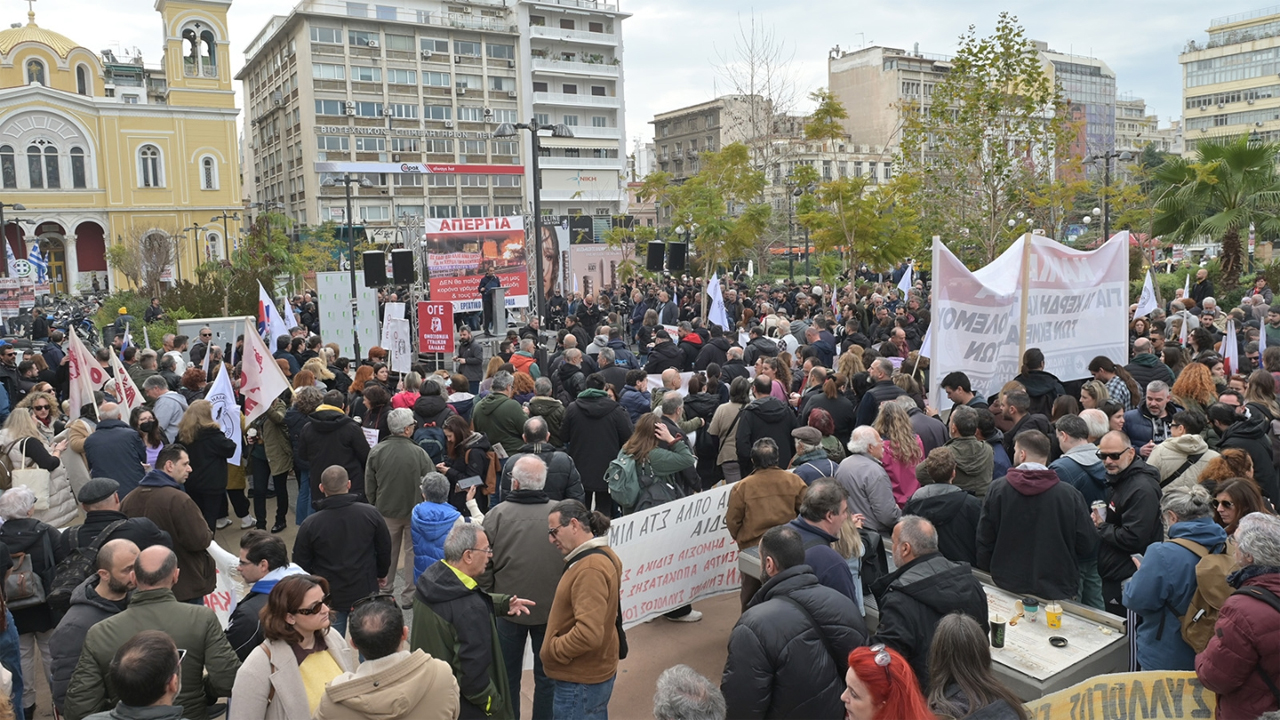
On Friday, February 6, 2026, dockworkers and port unions across more than 20 major Mediterranean and European ports carried out a coordinated International Day of Action, striking and protesting under the slogan “Dockworkers don’t work for war.” The action targeted the militarisation of ports, arms shipments to conflict zones—particularly Gaza—and the impact of the “war economy” on labour rights.
The mobilisations, involving strikes, port blockades, demonstrations, and solidarity actions, marked one of the most significant international labour interventions against war logistics in recent years. Organisers declared that the objective was to ensure that “European and Mediterranean ports remain places of peace, free from any involvement in war.”
The initiative was led by major unions including USB (Italy), Enedep (Greece), LAB (Basque Country), Liman-Is (Turkey), and ODT (Morocco). Support for the strike and solidarity actions was reported from unions in Hamburg and Bremen (Germany), as well as various port cities in the United States.
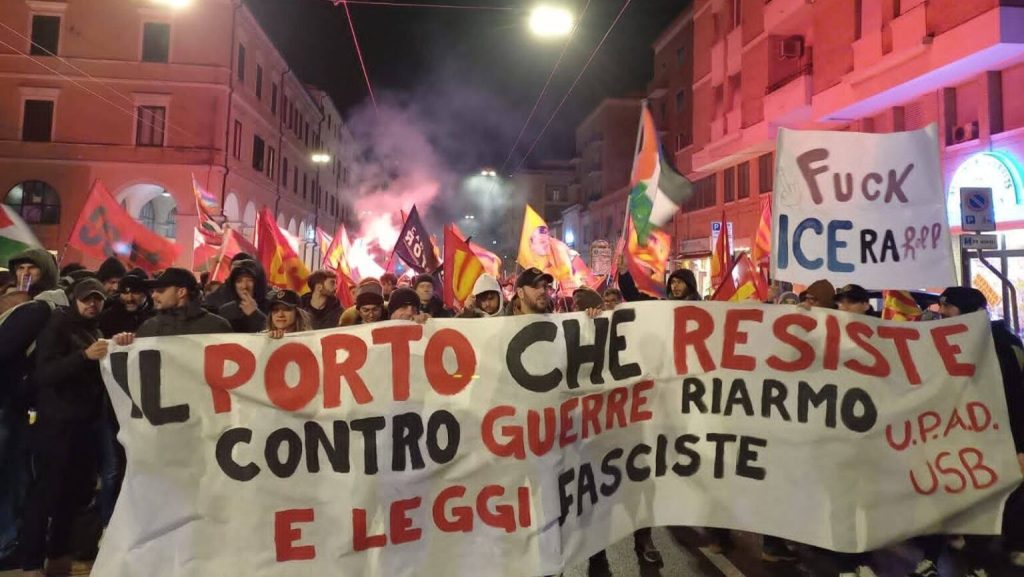
Strike banner in Ancona, reading: “The port that resists wars, rearmament, and fascist laws.” Source: Potere al Popolo Terni/Facebook
Strikes, demonstrations, and other actions were carried out by dockworkers in 20 ports across several countries, including:
- Italy: Palermo, Salerno, Civitavecchia, Genoa, Livorno, Trieste, Ravenna, Ancona, Bari, Crotone)
- Greece: Piraeus, Elefsina
- Spain: Bilbao, Pasaia
- Turkey: Antalya, Mersin
- France: Marseille
- Morocco: Tangier, Casablanca, Safi
Among the key demands is an end to the genocide being committed by Israel against the Palestinian people, openly supported the US, NATO, and the EU, as well as the rejection of the EU’s rearmament programme “ReArm Europe”. Dock workers also protested the privatization and militarization of port infrastructure.
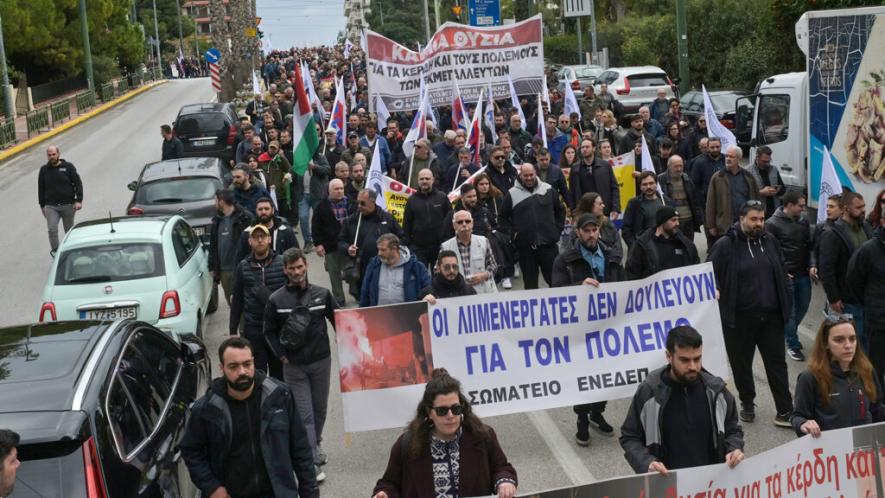
Demonstration during the strike in Piraeus Port. Source: PAME International
Some of the largest mobilizations of the day took place in several places in Italy involving not only dockworkers and port employees but also students, anti-war activists and members of the public. The trade union Unione Sindacale di Base (USB) described the moment as one of both an “internal war” as well as an external one, pointing to increasingly repressive measures adopted by European governments against workers who participate in acts of solidarity.
USB stressed that Europe’s labour movement must find an internationalist orientation in order to block the anti-worker agenda of the European Union and right-wing governments. Speaking at a launch event earlier in the week, Francesco Staccioli of USB argued that “If we don’t take this step, all our other demands will be crushed under war.”
In Genoa, the mobilization was massive. The dockworkers’ collective CALP, which had earlier pledged that “not one nail” would leave the port if Israel attacked the Global Sumud Flotilla bound for Gaza, led the protest.
“We promised to block everything – and we blocked everything. We promised a general strike – and we had a general strike. We promised an international strike – and here we are,” CALP declared.
In Greece, the Communist Party of Greece (KKE) reported militant mass rallies in Piraeus and Elefsina, as part of strike actions opposing policies prioritizing capitalist profits and imperialist wars over people’s lives and rights. Dimitris Koutsoumbas, GS of the CC of the KKE, who attended the strike rally in Piraeus said:
“Today, here in Piraeus, we are sending a message in every direction: human lives are more important than their profits. We demand immediate measures to protect health and safety in the workplace; collective labour agreements with wage increases; the removal of fuel tanks from Perama; Greece’s withdrawal from the imperialist war; and an end to the aggressive plans of the ruling class, which is sending our people to their deaths.”
Koutsoumbas also underscored the internationalist character of the action:
“Today we express our internationalist solidarity with dockworkers striking in 20 ports across the Mediterranean —in Greece, Italy, France, Spain, and Morocco— under the central slogan ‘We do not work for their war’. Stay strong, and carry on the struggle!”
The impact of the strike was felt even before it fully unfolded on February 6, as reports emerged of ships – vessels that regularly transport military cargo to Israel – disrupting their itineraries due to the strike actions. Organisers hailed this as evidence that workers positioned at key logistical chokepoints can materially disrupt war operations.
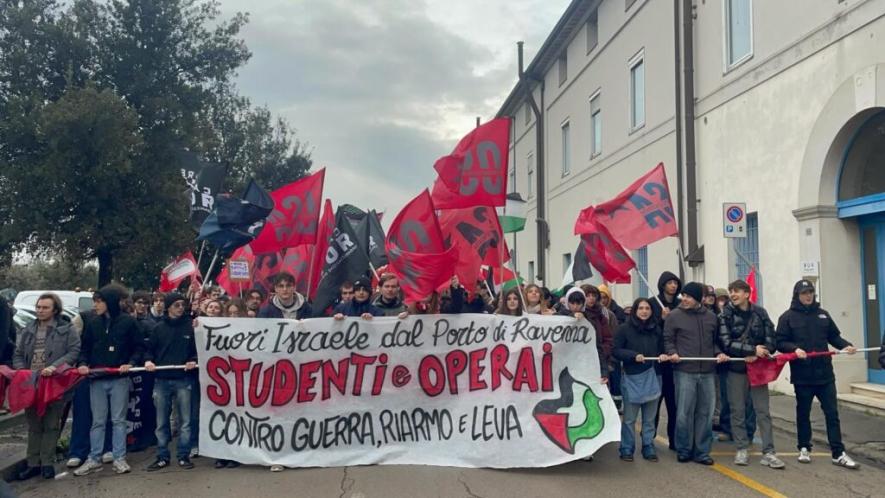
Students in solidarity with dockworkers in Ravenna (Italy)
In Ravenna, Italian dockworkers summed up the broader significance of the action:
“Today it’s the ports. Tomorrow it will be the entire logistics sector. And then it will be all workers.”
As imperialist wars intensify and governments accelerate militarisation, the February 6 action signals a growing determination among organised workers to refuse complicity in war—and to place international class solidarity above capitalist profits, national borders, and geo-political alliances of the ruling classes.