
SKM calls the interim India–US trade agreement a total sell out of Indian farmers and agriculture to US MNCs; and warns of a massive pan-India resistance if it is signed.
By Groundxero Desk
7 February 2026
The Samyukt Kisan Morcha (SKM) has launched a scathing attack on the Narendra Modi government over the Framework for an Interim India–US Trade Agreement announced today, calling it a “total surrender by the RSS-BJP led Govt. before US agricultural multinationals” and warning that its implementation would push Indian agriculture, dairy, and rural livelihoods into an irreversible crisis.
In a strongly worded press statement issued on Friday, SKM demanded the immediate resignation of the Union Commerce Minister Piyush Goyal, accusing him of misleading Indian Parliament and the public by falsely claiming that agriculture and dairy were excluded from free trade agreements. The platform of farmers’ unions also warned Prime Minister Modi, who has already welcomed this framework, to desist from signing the Trade Agreement, threatening massive, pan-India united struggles if it moves forward.
At the core of SKM’s opposition is the Trade Agreement framework’s asymmetrical tariff regime. According to the Press Information Bureau’s own release, India has agreed to eliminate or sharply reduce tariffs on all US industrial goods and a wide range of agricultural products, including maize derivatives, animal feed, soybean oil, fruits, nuts, wine and spirits. “This is not free trade — this is one-way plunder,” SKM stated.
While the US has imposed an 18 per cent tariff on Indian exports, Indian tariffs on US agricultural products — which earlier ranged from 30 to 150 per cent — are being brought down to zero. SKM pointed out that contrary to government claims tariffs on Indian goods has actually risen from zero to 3% in 2023-24, and now to 18 per cent under the new framework. “The Indian farmer is being placed under the noose of US agribusiness giants,” SKM warned.
The framework, SKM argues, exposes the falsehoods repeatedly peddled by Commerce Minister Goyal. Despite his claims that agriculture and dairy were kept out of trade negotiations, dairy products already figure in FTAs signed with the UK, New Zealand, and the EU. The India–US framework further dismantles non-tariff barriers, opening the door to imports of US milk and dairy products. One such barrier, SKM noted, was the restriction on importing milk from animals fed on meat-based feed — a point the RSS had once claimed as sacrosanct. “Now even this has been sacrificed at the altar of US pressure,” SKM remarked, accusing the BJP-RSS establishment of “eating its own claims under Trump’s command.”
The PIB press note also confirms that US maize will be exported to India in the form of Dried Distillers’ Grains (DDGs) along with Sorghum for animal feed. SKM warned that this would allow US corporations to completely monopolise India’s animal feed market.
SKM pointed out that Indian industry, agriculture and dairy sectors are now under grave threat of cheap imports that will be dumped into Indian markets. USA is already exporting crops such as maize, soya bean, and cotton to India. US wheat, being exported to India at around Rs 18.50 per kg, could devastate domestic wheat farmers if import of cheap subsidized US wheat is allowed to flood the Indian markets.
The framework also paves the entry of GM foods and GM seeds, threatening India’s biodiversity, soil fertility, and the stability of cereal, pulse, and oilseed markets. Imports of soybean oil, ethanol, fresh fruits like apples and pineapples, and dry fruits such as cashew are expected to surge — imperiling farmers in Jammu & Kashmir, Himachal Pradesh, Arunachal Pradesh, and the North-East.
SKM located the trade agreement within a broader policy trajectory reflected in the Union Budget 2026-27 presented on February 1. Agricultural growth has slowed to 3.1 per cent, employment generation remains stagnant, MSP continues to hover below even A2 costs, market prices often fall below MSP, fertiliser prices are rising, and peasant debt is mounting. Social sector spending has been cut across the board.
Simultaneously, the removal of customs duties across vast sectors in the Budget threatens to cripple MSMEs and accelerate de-industrialisation. The four labour codes and schemes like VB-GRAMG, SKM said, are part of a sustained assault on urban workers and rural labour in service of corporate houses and MNCs.
US Agriculture Secretary Rollins recently declared that opening India’s agricultural market would boost rural incomes in the United States. SKM cited this remark as proof of whose interests the deal serves. “India, home to the world’s largest poor and destitute population, is being sacrificed to secure profits for foreign masters,” SKM said, pointing out that while US agriculture is heavily subsidised, Indian agriculture suffers from negative government subsidy. With 172 million rural households and 86 per cent farmers being small and marginal, the framework represents, in SKM’s words, an “imperialist onslaught on livelihoods, being promoted by the Govt. of India.”
SKM sharply condemned the corporate federations that have rushed to hail the deal, accusing them of crony profiteering and total disregard for the workers and peasants who built modern India. Terming the interim trade framework one of the most anti-national agreements in independent India’s history, SKM appealed to all political parties, farmers’ organisations, agricultural workers’ unions, trade unions, and mass movements to resist what it called a sell-out executed without parliamentary debate or democratic consent.
The platform of farmers’ union has called for protest demonstrations across the country on 12 February 2026, urging peasants and workers to make the upcoming General Strike a decisive reply to the Modi government’s pro-corporate, anti-people agenda.
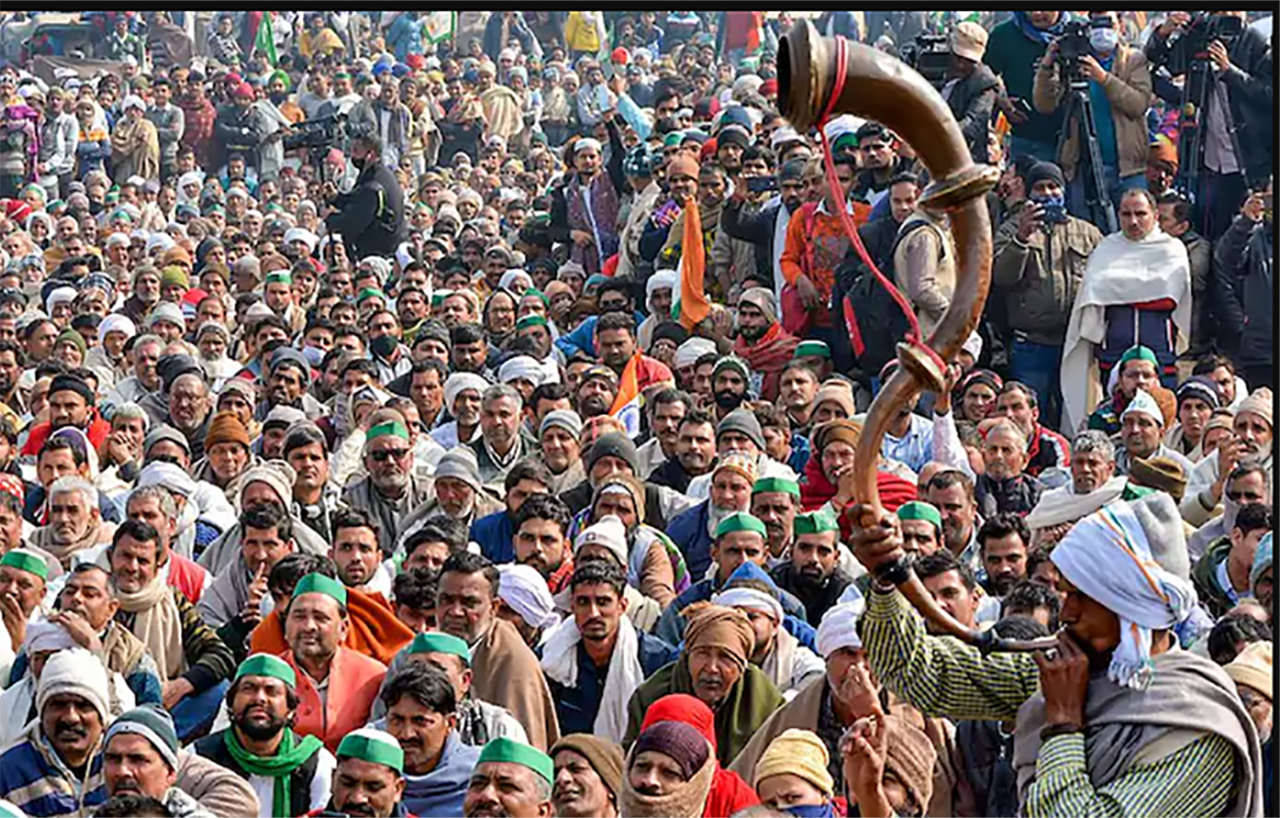
Cover Image : Farmers’ protest during the historic SKM-led farmers’ movement against the Farm Laws in 2020-21