
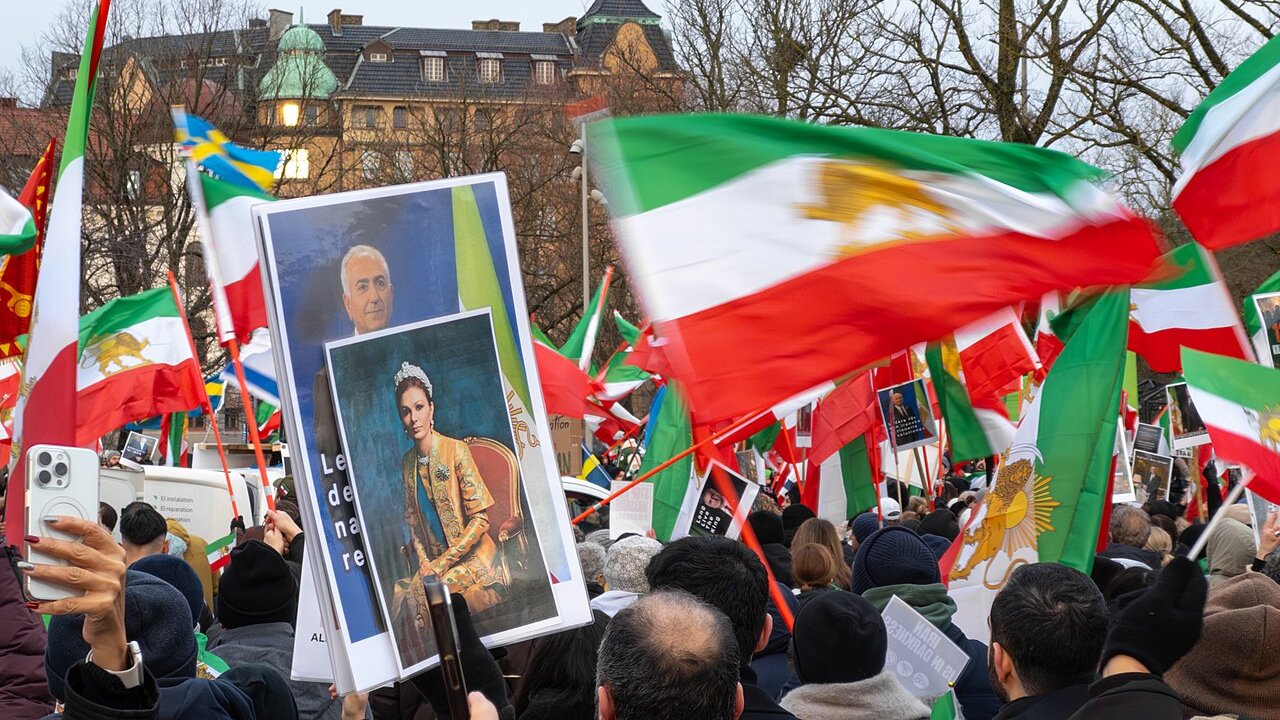
The false binary of clerical authoritarianism versus Western liberalism is precisely what sustains Iran’s crisis. Each pole feeds the other. External threats, sanctions, and war rhetoric provide the theocratic state with a permanent alibi: dissent becomes treason, protest becomes collaboration, and repression is recast as national defence.
By Arkadeep Goswami
Iran today occupies a peculiar place in global political discourse. It is portrayed simultaneously as a civilisational threat, a feminist emergency, a nuclear danger, and a moral pariah. These descriptions are not entirely false, but they are profoundly incomplete. They are fragments assembled into a narrative that serves imperialist power far more than truth. Western liberal discourse on Iran operates through a familiar grammar of imperial geo-political interest: repression is isolated from history, patriarchy is detached from political economy, and sanctions are framed as ethical pressure rather than structural violence. Women’s rights and queer rights are invoked incessantly, but only within a framework that legitimises isolation, coercion, and the permanent possibility of war. This is not solidarity; it is imperial pinkwashing, the instrumentalisation of progressive language to launder domination. While reading Iran, we must therefore refuse two temptations at once: apologetics for the Iranian theocratic state and complicity with imperial narratives that weaponise suffering of its populace. Iran’s crisis can only be understood by situating repression, resistance, gender politics, and sanctions within a single historical and material framework.
Revolution, State, and the Problem of Capture
The Iranian Revolution of 1979 was not a clerical coup disguised as a popular uprising. It was a genuine mass, anti-imperialist rupture that drew in workers, students, women, the urban poor, religious networks, and the secular left. It overthrew a monarchy deeply embedded in Western military and economic structures. For millions, it represented not only cultural authenticity but national dignity. Yet revolutions do not end with overthrow; they culminate in state formation. And it is here that Iran’s trajectory must be confronted without nostalgia. The post-revolutionary settlement did not institutionalise popular power. Instead, it gradually consolidated a bureaucratic-clerical state that neutralised autonomous class organisation. Independent unions were dismantled, left parties crushed, workers’ councils absorbed or eliminated. The language of revolution survived; its emancipatory content neutered.
Today, political power is concentrated in an alliance of clerical authority, security institutions, and semi-state capital. Large sections of the economy — construction, energy, logistics, finance, are dominated by networks linked to the state and security apparatus. At the apex of this structure stands Ayatollah Ali Khamenei, whose authority functions less as religious guidance than as class arbitration, ensuring continuity of rule, accumulation, and ideological coherence. Elections persist, but only as managed competition within a closed system. Reformist cycles repeatedly fail not because of cultural backwardness, but because the class foundations of the state remain intact. No electoral adjustment can overcome a structure designed to prevent popular sovereignty from materialising.
Sanctions and the Political Economy of Siege
Western governments insist that sanctions target the regime, not the people. This claim collapses under both empirical scrutiny and Marxist theory. Sanctions are not neutral tools; they are forms of structural violence that reorganise society along more unequal and authoritarian lines.
In Iran, sanctions have devastated wages through inflation, eroded savings through currency collapse, and fragmented labour through unemployment and informality. Access to medicine, technology, and basic goods has been systematically restricted. These are not side effects; they are the mechanism. Crucially, sanctions do not weaken the ruling class. They reconfigure it. Black markets thrive, intermediaries accumulate wealth, and security-linked networks expand their control. Under siege, repression becomes economically rational. The working class pays the price; the state and the ruling class adapt.
The collapse of the Joint Comprehensive Plan of Action marked a decisive moment in this process. Its failure confirmed what many Iranians already suspected: that reintegration into the global economy would occur only on imperial terms, subject to constant threat of reversal. The result was not democratic opening, but deeper securitisation and nationalist consolidation.
Pinkwashing and the Weaponisation of Feminism
The most insidious feature of Western discourse on Iran is not its concern with repression, but its selective moralism. Women’s rights in Iran are elevated to civilisational urgency, while women’s lives under occupation, bombardment, or austerity elsewhere are rendered invisible.
This is not feminism; it is instrumental gender politics. Iranian women are abstracted from their material conditions and recast as symbols requiring rescue by the empire. Patriarchy is presented as a cultural pathology, detached from sanctions, unemployment, housing crises, and war threats, as if gender oppression exists outside the historical and political context.
We must reject this abstraction. Gender domination is real, but it is mediated by state power, and imperial hierarchy. A woman facing compulsory veiling under conditions of inflation, precarity, and surveillance experiences oppression as a total social relation, not a single legal imposition.
Pinkwashing performs a crucial ideological function: it disconnects oppression from its material context, allowing the same powers that impose sanctions and threaten war to posture as moral saviours. It transforms solidarity into spectacle and politics into sentiment.
None of this negates the courage of Iranian women resisting control over their bodies and lives. On the contrary, it demands that their struggle be understood on their own historical terrain, not conscripted into imperial narratives that offer bombs instead of bread.
Protest, Repression, and the Limits of Spontaneity
Iran has witnessed repeated waves of mass protest, often sparked by economic grievances and rapidly expanding into broader denunciations of authority. These uprisings are genuine expressions of class anger and social exhaustion. They are not, as Western commentary often suggests, rehearsals for externally managed regime change. Yet we must reflect on an uncomfortable truth: spontaneous revolt is not yet emancipatory power. Decades of repression have destroyed independent working-class organizations. Trade unions, socialist parties, feminist collectives, and autonomous councils have been systematically dismantled. What remains is protest without durable structure and courage without infrastructure.
This asymmetry is decisive. The state is organised, armed, and disciplined. Protest erupts, is repressed, exhausts itself, and recedes. Western observers mistake repression for imminent collapse and protest for revolutionary maturity. Both misread reality.
Without organisation rooted in labour and social reproduction, revolt remains vulnerable to repression from above and appropriation from abroad. Exile elites, NGOs, and geo-political agendas rush to fill the vacuum, reframing struggle in languages hostile to material emancipation.
Anti-Imperialism without Emancipation
The Iranian state continues to speak the language of anti-imperialism, particularly in its opposition to the United States and Israel. This posture draws on a long and genuine history of imperial intervention in Iran and the region, and it resonates with popular memories of domination, coups, sanctions, and war. Yet anti-imperialism, when severed from emancipation and democratic transformation, hardens into repressive ideology. It becomes optics, a language of state survival rather than a project of popular liberation.
Resistance to imperial powers does not absolve repression at home. A state cannot claim legitimacy from defying imperial power while simultaneously repressing its own population through surveillance, censorship, and violence. Nor, conversely, does repression inside a country justify imperial coercion from outside. To argue otherwise is to accept the logic that people must choose between being ruled by their own authoritarian elites or by imperial guardians.
This false binary of clerical authoritarianism versus Western liberalism is precisely what sustains Iran’s crisis. Each pole feeds the other. External threats, sanctions, and war rhetoric provide the theocratic state with a permanent alibi: dissent becomes treason, protest becomes collaboration, and repression is recast as national defence. At the same time, domestic authoritarianism supplies imperial powers with moral ammunition, allowing coercion, isolation, and military intervention to be reframed as humanitarian concerns.
The result is a closed circuit of domination. Anti-imperialism is reduced to geopolitical positioning, stripped of its social content. Liberalism, meanwhile, is emptied of its universalist claims and redeployed selectively, only where it aligns with imperial interest. Caught between these forces, the Iranian people are denied political agency. They are spoken of as victims to be rescued or as masses to be disciplined but rarely recognised as subjects capable of shaping their own future.
The question lies in insisting on breaking this circuit. Genuine anti-imperialism cannot be measured solely by foreign policy alignment or rhetorical defiance; it must be judged by its relationship to labour, equality, and popular power. Likewise, opposition to domestic repression cannot be outsourced to imperial pressure without reproducing the very hierarchies it claims to oppose. Emancipation cannot arrive through siege, nor can sovereignty be defended through the silencing of society.
Conclusion: What Liberation Cannot Be, and What It Must Be
Iran will not be liberated by sanctions, cyber warfare, covert regime change operations, or ‘humanitarian’ bombing. These instruments have never dismantled systems of domination; they have only rearranged them, replacing one hierarchy with another while deepening social devastation. Nor will Iran be liberated by freezing history in the name of a revolution that has hardened into state property, a revolution whose symbols are endlessly invoked even as its emancipatory promise is deferred indefinitely. Liberation cannot mean the eternal preservation of a political order that demands obedience in the name of a past rupture while denying society the right to transform that rupture’s meaning.
Liberation, if it comes, will come from below. It will emerge not through sudden regime collapse or externally scripted transitions, but through the slow, uneven, and dangerous reconstruction of class organisation, independent unions, workers’ collectives, and popular forms of coordination capable of contesting both imperial capital and state power. It will require feminist politics grounded in material life, where struggles over bodily autonomy are inseparable from struggles over wages, housing, care, and social reproduction. And it will demand democratic control over social wealth, challenging the concentration of resources in security-linked and semi-state networks that thrive under siege.
Such a process will not resemble the spectacles of “liberation” broadcast by imperial media. It will not arrive fully formed, nor will it speak in a single voice. It will advance through partial victories, setbacks, and contradictions. It will be fragile, vulnerable, and persistently threatened by repression from above and co-option from abroad. But only such a process can produce emancipation that is durable rather than cosmetic.
To stand with Iran’s people today, then, is not to chant regime-change slogans from afar, nor to romanticise a repressive state in the name of resistance. It is to oppose sanctions as instruments of collective punishment, to reject pinkwashed imperialism that weaponises suffering for geopolitical ends, and to affirm the right of Iranian workers, women, and minorities to struggle on their own historical terrain, according to their own rhythms, priorities, and political imagination. Solidarity, in this sense, is not intervention; it is restraint combined with commitment, a refusal to rule in the name of rescue, and a determination to support emancipation without owning it.
In the end, certain historical facts must be stated plainly. Democracy in Iran was not destroyed in 1979; it was destroyed in 1953, when a CIA-engineered coup overthrew the democratically elected government of Mohammad Mosaddegh and reinstated the Shah against the popular will. The crime of Mosaddegh was not authoritarianism, but independence: his refusal to subordinate Iran’s resources and sovereignty to Western interests. The Shah’s restoration was rewarded precisely because he was more pliant, more reliable, and more useful to imperial power.
Sections of the global and Indian left and liberals who now speak casually of Iran’s “democratisation” through Western intervention must confront this history honestly. There is no democratic lineage in imperial regime change, only a record of broken societies and disciplined peripheries. To imagine that the same forces that destroyed Iranian democracy once can now be trusted to restore it is not radical optimism; it is historical amnesia. If this lesson is ignored, such positions will not be remembered as tragic miscalculations. They will be remembered, at best, as naïveté dressed up as moral urgency, and at worst, as the willing intellectual foot-soldiery of imperialism.
Feature Image: Iranian dissidents attend an anti-Iranian regime protest in Gothenburg, Sweden at Bältespännarparken in Gothenburg, Sweden on January 17, 2026. Some wave the Lion and Sun flag and hold placards showing Reza Pahlavi.
Image Source: https://commons.wikimedia.org/w/index.php?curid=182001699