
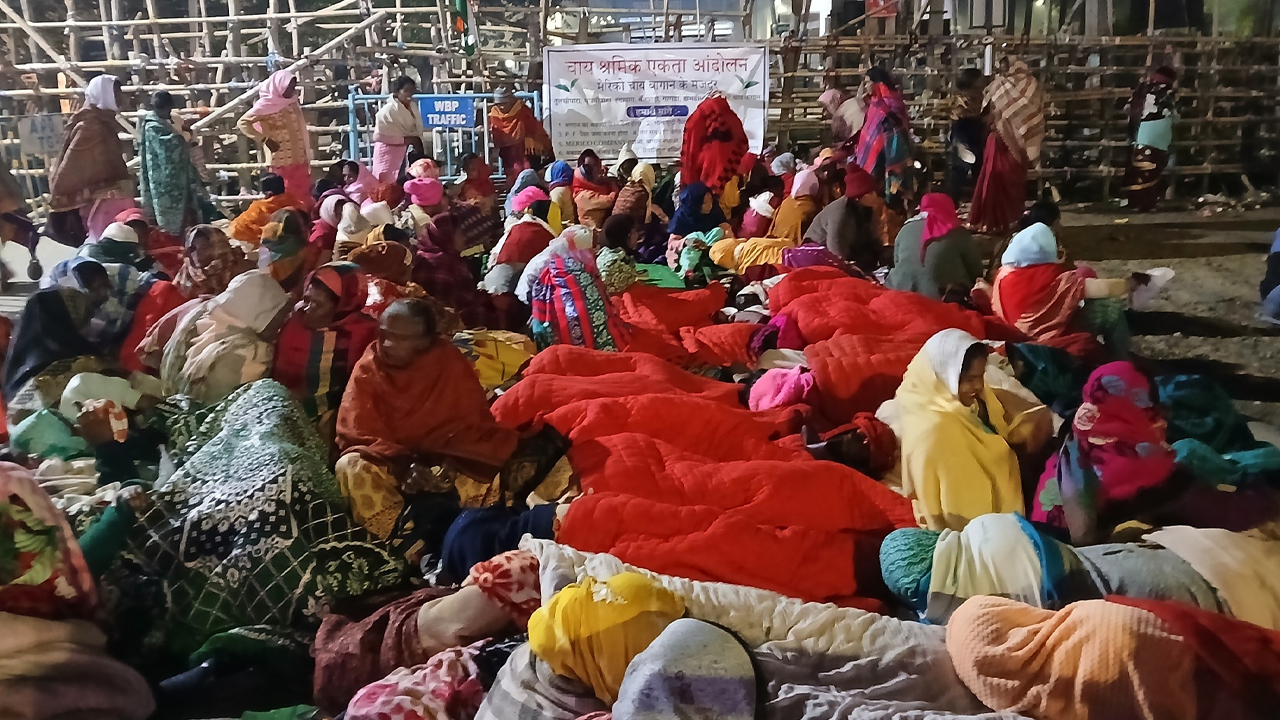
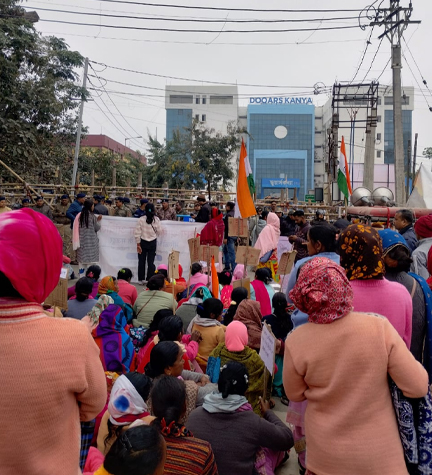
Around 150 tea garden workers from seven Merico-run estates in the Dooars are continuing a day-and-night dharna outside the district collectorate of Alipurduar, demanding months of unpaid wages and statutory dues.
Groundxero | January 5, 2026
Around 150 tea garden workers from seven Merico-run estates in the Dooars are continuing a day-and-night dharna outside Dooars Kanya, the district collectorate of Alipurduar, demanding months of unpaid wages and statutory dues. The protest intensified on Monday after a scheduled tripartite meeting failed as the owners didn’t attend the meeting, exposing once again the impunity enjoyed by corporate employers and the apathy of the district administration toward violation of workers’ legal rights.
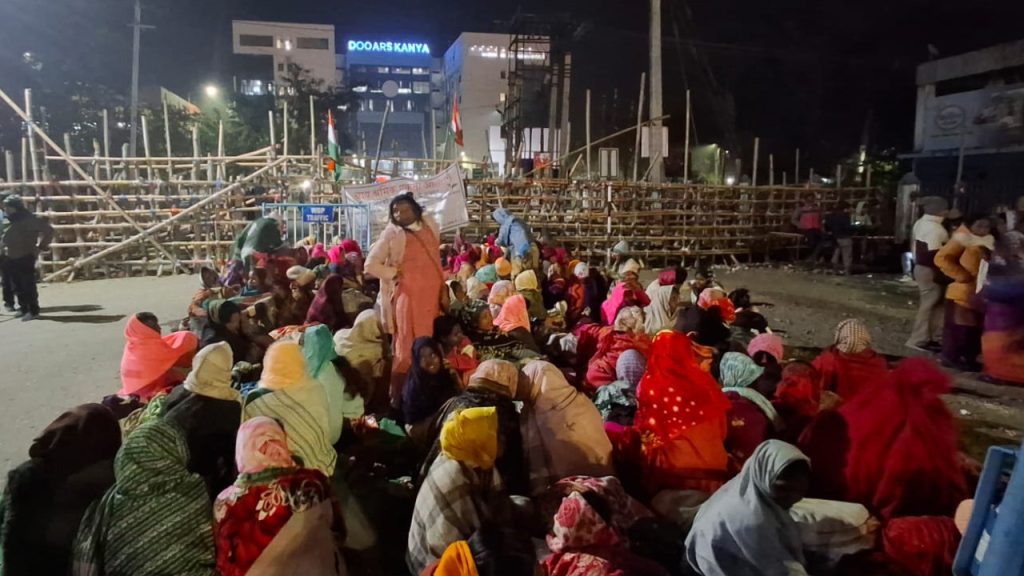
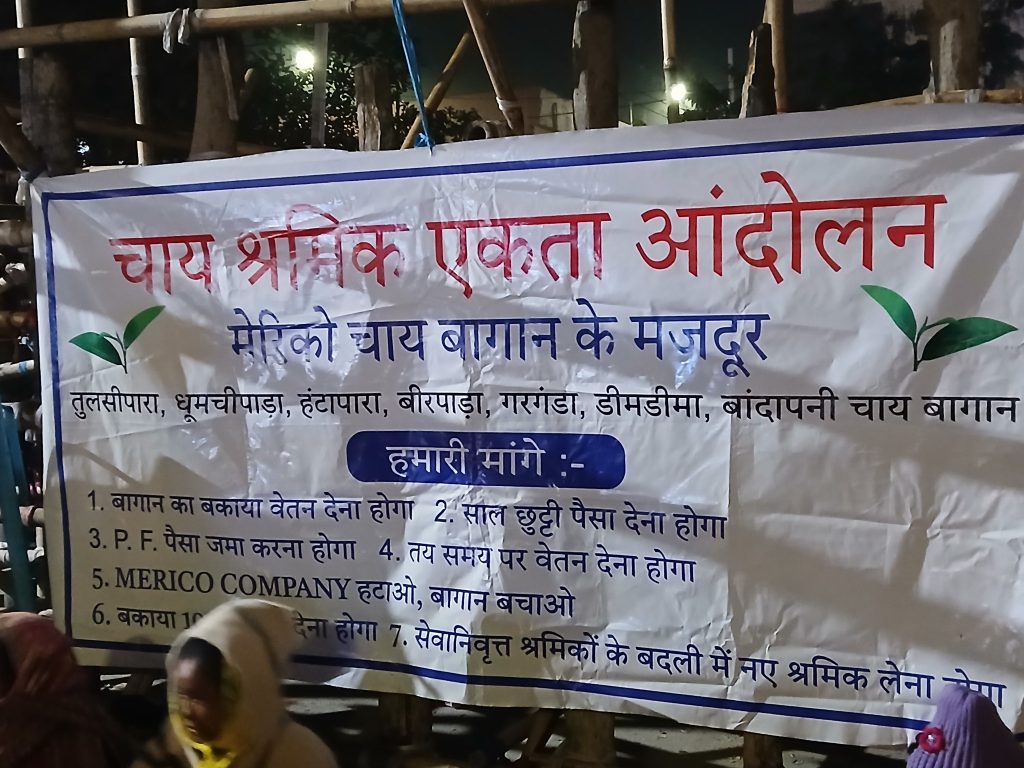
Organised under the banner of the Chai Mazdoor Ekta Andolan, the workers are demanding payment of wages pending for three to seven fortnights, along with long-denied Provident Fund, gratuity, and bonus. With no income for months, workers—many of them women—have been forced to sit through bitter winter nights in the open, simply to claim what is legally and constitutionally theirs.
The current phase of the struggle began on December 29, when around 300 workers, a majority of them women, held a peaceful “Dooars Kanya Chalo” march and sat on a dharna through the night, demanding that Merico issue a written, time-bound commitment to clear at least the outstanding wages.
Workers pointed out that denial of wages is not only illegal under labour laws but a constitutional violation, striking at their right to life and dignity. Yet, when workers delegations sought to meet the District Magistrate and the ADM (LR), Alipurduar, both officials refused, citing preoccupation with an Election Commission of India visit. The Deputy Labour Commissioner (DLC) met the workers but expressed helplessness and offered no concrete assurance. This response reflects the administration’s unwillingness to act against a powerful employer.
In a cruel irony, even as workers sitting on dharna shivered outside Dooars Kanya, the administration was busy, preparing for the Dooars Utsav, a festival meant to showcase the “culture and beauty” of the region, ignoring the injustice faced by hundreds of tea workers of the region.
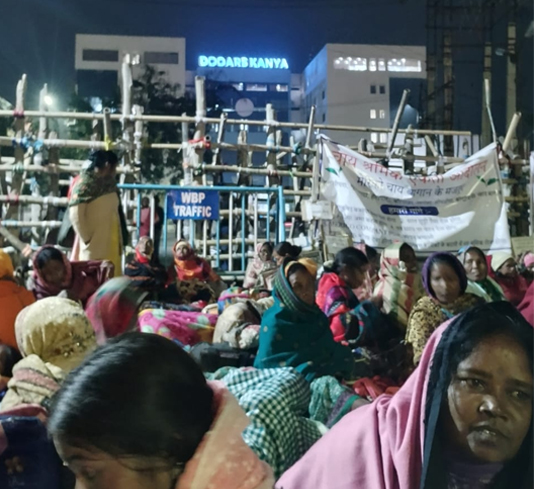
The December 29 dharna was lifted around 11 pm after intervention by Labour Minister Moloy Ghatak, who announced that a tripartite meeting between workers, management, and the labour department would be held to the resolve the issues. The minister assured that Merico would be compelled to present a schedule for clearing all wage arrears by February 2026. He also assured workers of initiating legal action under the Payment of Wages Act, including possible cancellation of garden ownership, if the company failed to comply.
Those assurances soon unravelled.
The tripartite meeting—meant to address three to four months of unpaid wages across seven gardens was postponed three times (December 31 → January 2 → January 5) as the management never showed up. The meeting on Monday became fruitless as Merico management again failed to appear. Barely an hour before the scheduled meeting at 1:30 pm, the company sent a letter stating it would not negotiate with workers’ representatives and would speak only to TMC- and BJP-affiliated unions, while asking for an additional 15 days to “arrange funds” for wages already long overdue.
Significantly, these very unions had written on January 3 claiming they were too busy to attend the meeting—exposing a clear nexus between management and these ruling part affiliated unions. Representatives of CBMU (CITU), though formally invited, were barred from the meeting.
During the aborted talks, the Deputy Labour Commissioner admitted that denial of wages constitutes a criminal offence, but refused to initiate action, claiming that only the District Magistrate had the authority—while simultaneously declining to arrange a meeting with the DM.
The human cost of this administrative apathy was immediate. As news of the failed talks spread, Mahakal Oraon, a worker from the Tulsipara Tea Estate, attempted suicide by jumping from the fifth floor of Dooars Kanya. “The worker had come for negotiations. When the talks failed, he tried to take his own life. This is unfortunate. The administration should act against the management for its negligence,” said a workers’ organiser.
The failure of the meeting agitated the workers who had gathered outside. Around 150 workers resumed their indefinite dharna outside Dooars Kanya on Monday night. At around 11:30 pm, Migni Oraon, a woman worker from Hantapara Tea Garden sitting on dharna under open sky, fell seriously ill as temperatures dropped to around 12°C and had to be rushed to hospital.
These are not isolated incidents but the direct consequences of administrative apathy. Workers who have gone unpaid for months are being pushed to hunger, illness, and despair, while responsibility is endlessly passed between officials and owners.
As the sit-in continues through day and night, defying hardships, slogans echoes from outside the Alipurduar collectorate: workers wages, dignity, and lives cannot be postponed indefinitely.
The struggle continues.