
Colonial reclamation practices, coupled with postcolonial urban development, treated wetlands as wastelands to be controlled and commodified, ignoring their vital ecological significance.
By Salini Saha
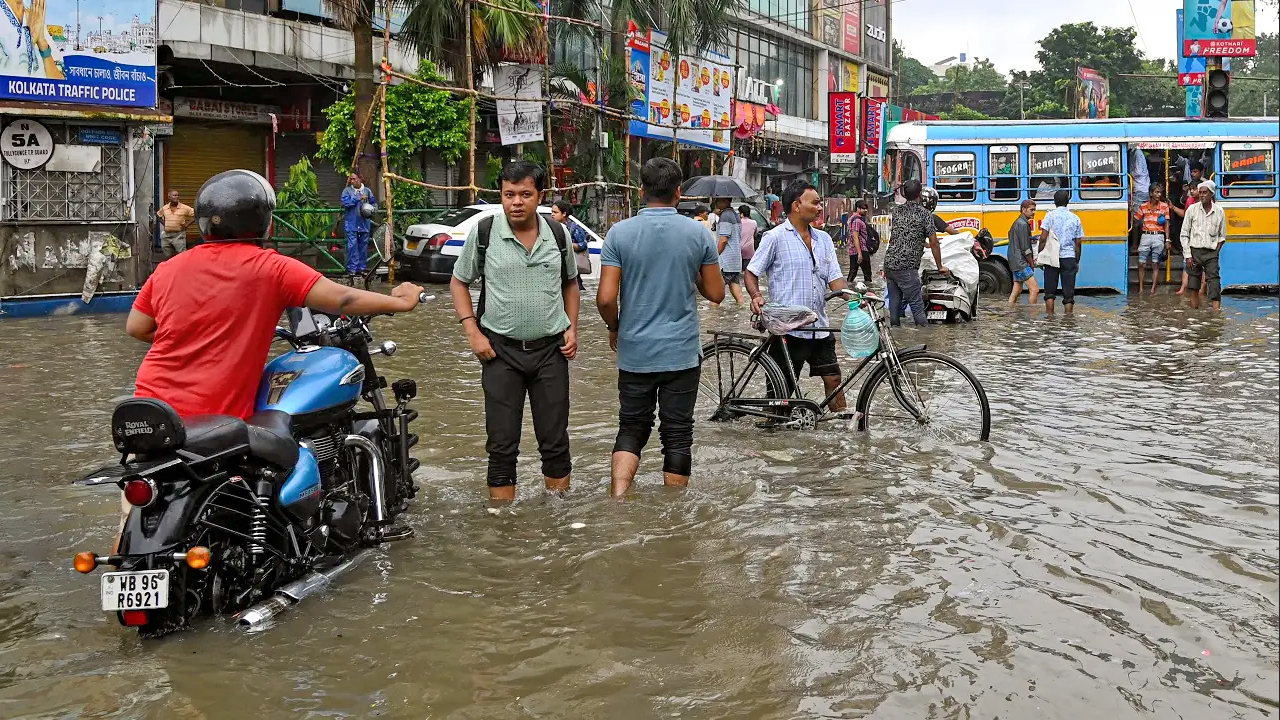
In the early hours of 23rd September 2025, a few hours of very intense rainfall submerged large parts of Kolkata. Streets turned into rivers, neighbourhoods were waterlogged for days and the entire city came to a halt. The city, long positioned as the pivot of planning, governance, and infrastructural control was brought to a standstill by the same fluid volatility that rural agrarian communities in Bengal have managed for centuries. This incident is only the most recent reminder that climate extremes, particularly monsoonal vulnerabilities, are no longer exceptional to agrarian ruralities but constitutive of Bengal’s landscapes in general, unsettling the distinctions through which rural and urban lives have been organized.
This year India has witnessed an unprecedented series of floods, underscoring the escalating impacts of climate change. States like Himachal Pradesh and Uttarakhand have recorded extreme incidences of heavy and very heavy monsoons, leading to widespread destruction, including landslides, flash floods and significant damage to human lives. These events highlight the increasing unpredictability of monsoon patterns in the country.
West Bengal too has experienced an unusually high volume of rainfall this year. But the heavy rains in Kolkata on 23rd September, was particularly severe. The city received approximately 252 mm of rain over seven hours, which is near the threshold of a cloudburst. Despite the city’s long-standing issues with waterlogging, the scale of this urban flooding is unprecedented. Experts highlighted reasons like outdated drainage systems, high tide conditions, and the accumulation of plastic waste as majorly causing the destruction. Indeed, this incident calls for a serious rethinking of urban planning mechanisms, but before that, it is essential to revisit Bengal’s climatic history and its entanglement with the region’s colonial past. In particular, Bengal’s fluid landscapes — its monsoons, rivers and wetlands, offer critical insights into the vulnerabilities and opportunities that urban planning needs to account for.
Bengal’s landscapes have long been imagined through registers of fluidity. The monsoon has always been an omnipotent background to the romantic imagination of Bengal in literature. In poetry, novels, and art, it is celebrated as a season of abundance, renewal and eroticism. For instance, Tagore’s verses drew on its registers of aestheticism and melancholy. Such a cultural representation of the natural, capturing the myriad aspects of rain, cloud, wind, water and everything that is transported from the material to the ideal spheres, through literary metaphors, have a tendency to achieve an abstraction beyond our empirical, everyday perceptions of nature. So while literature foregrounds the affective power and metaphorical powers of the rains, agrarian entanglements with monsoon through corporeal labour, crop production and sacred rituals were rarely central to Bengal’s landscape imaginations.
A critical reading of Bengal’s landscapes requires us to move beyond these celebrations of monsoonal excesses to examine how monsoon has been constitutive of postcolonial infrastructures. Postcolonial accounts of Bengal’s landscapes looked at the everyday politics of how watery terrains were cultivated, claimed, or resisted. Of pertinence here is the distinctions between charjomi (riverine wetlands) and dangajomi (elevated dry land) which reflected an ecology where soil, water and fertility were never stable entities but relational processes (Lahiri Dutt and Samanta, 2013). Charjomi like the Sunderbans, has always borne the brunt of monsoons, cyclones and flooding. In recent years, recognizing their ecological marginality, these areas have increasingly become parts of state planning and support programs aimed at improving climate resilience and human livelihoods. At the same time, the status of danga jomi as reliable and stable is fast eroding, owing to climate extremes. Today, climate change is collapsing this distinction. Erratic rainfall and intensified flooding destabilize dangajomi’s reliability as a dry land.
Urban spaces, too, embody this fluid precarity. Kolkata itself was a city built through colonial attempts to drain and stabilize the delta. Nineteenth-century British reclamation practices drained parts of Kolkata’s wetlands, creating new dried land to be bought and sold. These areas soon became valuable property and led to the growth of urban land markets (Bhattacharyya, 2018). Thus early colonial interventions in Kolkata’s landscapes reshaped its ecological and urban fabric by transforming marshes and riverbanks into commodified land through imperial legal frameworks and engineered projects. This also marked the domination of human-environment relations, as property ownership became the primary instrument through which nature was controlled and subordinated. The echoes of this measurable, ownable dry land history resonates in the present too. The colonial and postcolonial drive to stabilize the delta, create real estate, and impose technocratic solutions has left the city exposed. Flooding, infrastructural collapse, and waterborne disease reveal that urban planning has largely ignored the dynamic relational nature of land and water in this region.
These challenges are supplemented by broader ecological transformations in Bengal. Wetlands, which once acted as natural sponges, are shrinking under expansion and industrial development. Sea-level rise, currently around five centimetres per decade, threatens coastal areas and low-lying farming areas, while erratic rainfall intensifies flood, drought as well as susceptibility to cyclones. Indeed, Bengal has been highly exposed to cyclones from the Bay of Bengal, with a number of malevolent storms like Amphan and Bulbul causing extensive damage to crops, homes and infrastructure, particularly in the Sunderbans between 2000 and 2018 (Basu, 2020). Thus, monsoon patterns no longer follow predictable rhythms, and thus have become a central focus in global environmental discussions about climate change in Bengal (Bannerji and Bhanja, 2023).
Thus, while developmentalist infrastructures like embankments, drainage systems, flyovers, high rise buildings, and so on, attempt to impose this history of stability, monsoon floods remind us that land resists capture. What was historically framed as stable, built environments, are now precarious. Recognizing the impact of climate change in Bengal thus requires us to move beyond simplistic narratives of floods as isolated disasters. Instead, it demands an understanding of the region as a complex interconnected socio-ecological system where human communities, water, land, soil and wetlands are co-constitutive. Climate resilience in this context cannot rely solely on technocratic or engineered solutions, but instead need to acknowledge local, relational engagement with the environment.
This in turn also reveals the limits of a masculinist developmental imaginary, that equates land with solidity, control, and productivity. Feminist geographies of fluidity (Braidotti, 2013; Sundberg, 2014) emerges as crucial here highlighting practices of interdependence and embodied relationality as infrastructures of mastery collapse. Perhaps, the most meaningful way to rethink landscapes is to move beyond the language of extraction and control. Valuing wetlands as vital ecosystems, rather than treating them as wastelands to be drained is one such example. Wetlands have long been central to Bengal landscapes, yet they remain sites of tension, ambivalence and vulnerability. For agrarian communities, wetlands are both vital and challenging. They provide water storage but are also unpredictable, being costly to cultivate making them economically marginal and socially unclaimed. As a result, they often fall outside conventional property relations, unstable and unmanageable.
From a feminist ecological perspective (Ojeda et al., 2022) however, wetlands offer critical insights. Scholars like William Howarth (2001) argue that wetlands embody an ambivalent hybridity, and in both physical and symbolic terms, they signify fluidity, vulnerability and relationality. The historical process of drainage and infrastructure building, both in Bengal and globally, has often been framed as a masculine project of control; separating water from land and asserting human dominance over nature. Wetlands, in contrast, resist such domination, highlighting the tension between human claims of possession and ecological unpredictability.
This understanding of wetlands is directly relevant to a city like Kolkata, where wetlands have historically been drained and or encroached upon to expand the city. Colonial reclamation practices, coupled with postcolonial urban development, treated wetlands as wastelands to be controlled and commodified, ignoring their vital ecological significance. They absorb floods, regulate water flows, and support urban biodiversity. Ignoring wetlands in city planning reproduces the same masculinist, extractive logic, that feminist ecological scholarship critiques. Valuing wetland means recognizing their relational significance to ecosystems, to communities and to human survival. Wetlands, if preserved and managed thoughtfully, offer natural buffers against flooding, thereby supporting both rural agrarian practices and urban infrastructure.
Further, from a decolonial perspective, rethinking Bengal’s landscapes requires challenging inherited ideas of control and ownership, and instead recognizing land, water, and natural ecosystems as converging with human lives, knowledge and practices that have long shaped and been shaped by these environments. Extending this understanding to contemporary urban planning, I argue that interventions in urban scapes often reproduce a particular ‘way of seeing’ the landscape (Dang, 2021). They grant planners, technocrats, and environmental experts the authority to interpret urban life from a detached, seemingly objective perspective. By reducing human-environmental relations to data sets, master plans, and digital maps, these approaches privilege technical rationality over lived experience. This simplification obscures the heterogenous, more-than-human relationships that shape cities. When such global planning models are uncritically applied in post colonial contexts like India, it obstructs decolonial approaches to understanding urban sustainability.
Bengal’s climate crisis thus speaks of a rupture since it unsettles categories between rural and urban scapes demonstrating that land cannot be reduced to a developmentalist imaginary. Rather, we need to recognize it as a fluid, more-than-human terrain involving feminist understandings of relationality and decolonial reimaginings of territory.
________________
The author is a Research Scholar.