
Pushed back, Beaten and Humiliated: Stories of Migrant Workers
By Subha Protim Roy Chowdhury
According to the latest 2011 census, one in every three people in India is a migrant. Most of these people have moved within the state, while the rest have moved to other states. Based on the place of last residence (PLR), out of the 455.8 million migrants in the country, 54.3 million have migrated from their home state to another state for various reasons (Census 2011). Migrant workers from comparatively economically weaker states have met the demand for labor in economically stronger states.
Migrant workers make one of the largest contributions to West Bengal’s rural economy. It is difficult to find a village in rural Bengal, especially in the backward districts, where some family member has not migrated to another state for work. The districts of Maldah and Murshidabad are on top of this list. “In 2020, when the [Covid-19] lockdown left people stranded across the nation, a rough estimate indicated that around 1.1 million migrant workers were from West Bengal. Murshidabad district accounted for the highest migration among the state’s 23 districts,” a government official said. [Hindustan Times, 14 March, 2024]. Although there was a temporary reversal in the flow of migrants during the Covid period, the process started again after the epidemic, with migration of workers particularly to the western or southern parts of the country.
A major source of rural employment in West Bengal is ‘100 days of work’ or MGNREGA. The Union government’s decision to freeze disbursal of funds for the scheme in West Bengal for the last three years alleging irregularities and corruption in its implementation has accelerated the mass exodus from the state. It is a fact that MGNREGA was crucial toward restoring both dignity and survival for those in rural areas who depend on this program to make ends meet.
In light of this reality, in recent times, illegal detention and torture of Bengali-speaking migrant workers, especially in BJP-ruled states, have created a situation of extreme fear, panic and sense of ‘injustice’. These migrant workers are being asked to prove their Indian citizenship by the police. In some extreme cases, they have been forcibly pushed back across the border into Bangladesh. Fear and mental trauma are gripping Bengali migrant workers in those states. Many workers had left these states in panic and returned home. Some among them have though returned back to where they used to work. Many other are considering moving to non-BJP-ruled states.
The reality is, there are no jobs in this state, even if there is work at some place, it is not regular, and the wages are very low. The workers, who have returned, told us – ‘We have no way to remain in our village, we can’t remain sitting here idle and let our wife and children die without food!’
***
[Subha Protim Roy Chowdhury was part of a team that visited the migrant workers in different districts who fled those states and returned to their village homes. The team members talked to the workers to understand what really is the reality. Below is the part 1 of a series of testimonies of workers documented by the team.]
“You are Bangladeshi” you have no place in this country
Najimuddin Mondal from Tartipur village is a simple person. Tartipur village, under Hariharpara Police station in Murshidabad District, is a village of migrant workers. The village is quite big, with 5 gram panchayat members from this single village. There is a road about 1 kilometer long inside the village, although it is better to call it a pond rather than a road. A light rain in the morning, and we saw ducks swimming on the road, not literally but in reality.
It’s rare to find a family in this village with none of its members working outside of the state. Nazimuddin has been living and working in Palghar Nalasopara, Mumbai for the past one and a half years. He has previously worked in various places in Maharashtra for about the last five years. He never thought something like this would happen! Nizamuddin said that eight of them were taken to the Kalina Police Station on the midnight of June 13 after being picked up by the Mumbai Police. “I saw about 150 workers gathered there. They had been picked up from various locations in Mumbai. We showed our documents – PAN, Aadhar, Voter Card. The police took away the originals of our documents. They took our finger prints. It was the scariest day in my life. I had left my village and family behind and came to Mumbai to earn for my family. These cards and papers were our proof; what they will do, I was confused. I was unsure of what was going to happen to me in the end.”
Najimuddin continued narrating his ordeal – “Our cell phones were also taken away. The Police inquired if there was any Bangladeshi contact number in our phones. I didn’t have any such number, but many of our relatives live on the other side of the border, so the phone number of a Bangladeshi relative might be on someone else’s mobile. I got even more scared.”
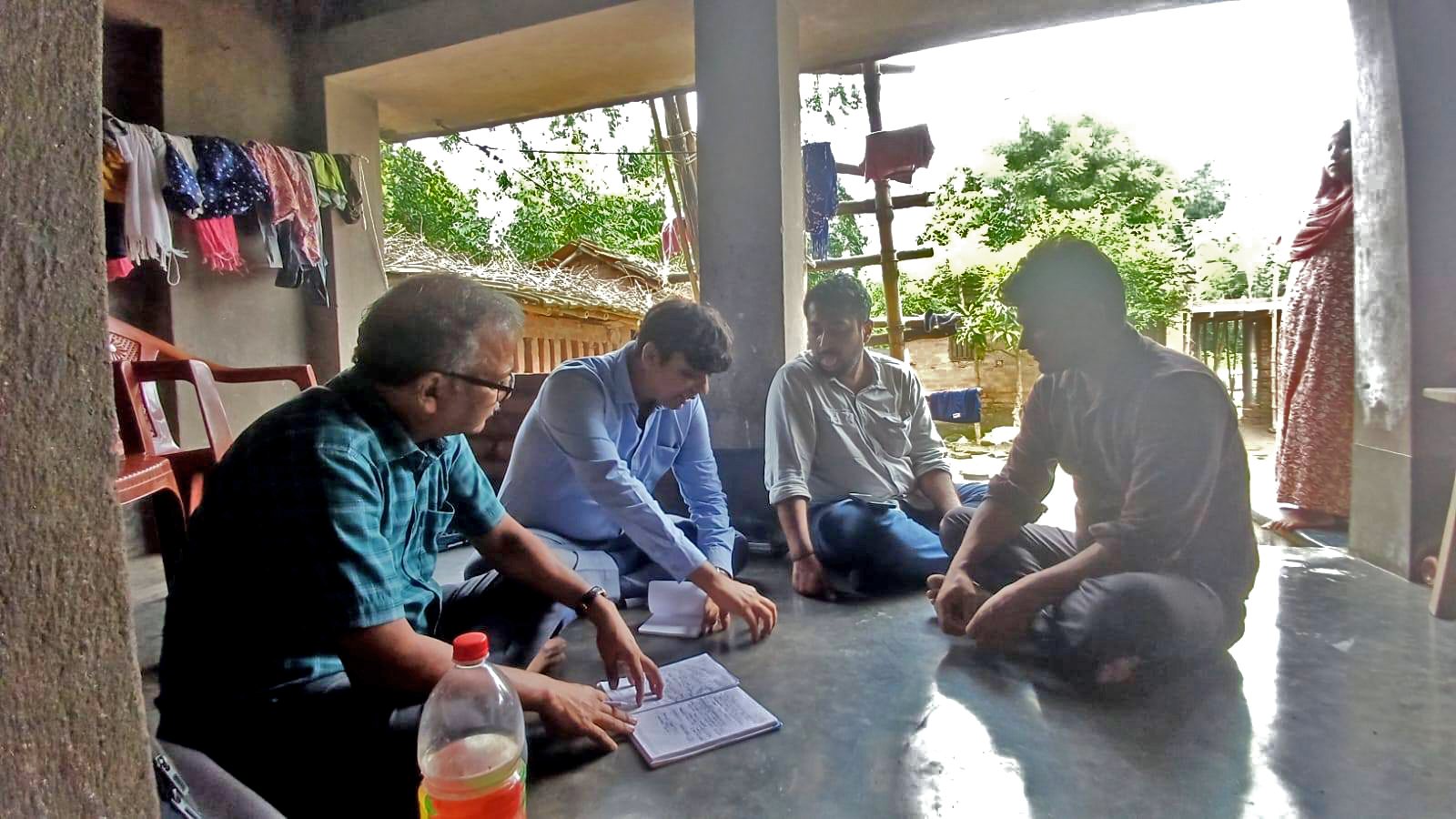
The fact-finding team members talking to Nizamuddin at his village home in Murshidabad
When asked if there really was anyone like that, Nazimuddin said, “Yes, there were Bangladeshis among those the police had called; they were talking among themselves; but why were we detained, I wondered?”
We were detained in a marriage hall. The next day we were called one by one to the police station. I became very scared. The day before, the policemen had beaten us badly, slapped and kicked us. I told them over and over again, believe me, my home is in Murshidabad, I am an Indian. But the beating didn’t stop. That day, when I heard them calling us again for interrogation at the police station, and that too separately, I was very scared, I thought what if they beat me with a stick or something more terrible! I was trembling in fear. There were two police officers, they asked me to sing the national anthem. At first I couldn’t understand, I asked, ‘What are you asking, Sahab’. He cursed me and shouted, ‘rastra gana suna (sing the national anthem)’. Believe me, I was crying and singing, ‘Jana gana mana, jaye he, bharat bhagya bidhata’. I thought this song would save me. I can’t speak for others, but it couldn’t save me from being labeled a ‘foreigner’.
At Pune airport, we were told we would be sent to Kolkata. Our hands were tied with our tag belts inside the plane. Our hands were untied at Bagdogra airport. We were given some food. We were made to stand in a line at Bagdogra airport, and then we were put in a car. I don’t remember what time of night it was. We were taken to a BSF camp, I don’t know which camp or which battalion. Like the police in Maharashtra, the BSF also beat us again at the camp. I asked, why are you beating me? They began to strike me again with a cane stick. They took off all our clothes. Did a thorough search of our body. I had money saved from my earnings – about fifteen thousand. They took it away, saying you can’t take back a single penny from our country. There were a few coins in my pocket, they took them too. They didn’t write anything down or give me a receipt of the money they took. They gave me three hundred rupees in Bangladeshi currency, a food packet and a bottle of water.
The next day, they put us in a small BSF vehicle and after a journey of about three and a half hours, they took us to the border. Seeing the big gate and the writing above on it, I realized that this was the end of India, with the border of Bangladesh on the other side. I don’t know which gate it was, I’ve never been there before in my life. I was shocked, I didn’t know anything there! It was three in the morning. There was pitch black darkness all around. I was shaking. There were eight other people in our group. I didn’t even know them all, but I heard there were some Bangladeshis. The police had found Bangladeshi phone numbers and heard conversation from their mobile phones.
Nizamuddin was asked, how did you know they were Bangladeshis? Nizamuddin said they admitted that they were Bangladeshis. They gave their Bangladeshi addresses to the Maharashtra Police, and it was noted down in a file.
The BSF took us to the gate on the border and told us, “Don’t come to India again, if you do, we’ll shoot you dead.” They spoke to us in Bengali and Hindi. We were given a bottle of water and a food packet. I didn’t see what was inside the packet. The BSF took our pictures in that condition. Of course, they took pictures countless times – Mumbai, Pune, Bagdogra everywhere.
We were pushed towards the jungle on the other side. It was so dark that I was unable to see anything. On the other side, India also had land,* tea gardens, and we sat there all night long. The next morning it would have been 6 or 6:30 in the morning, I don’t remember the date, it might have been June 14, because we reached Bagdogra on June 13. As I was walking along the road, I met the people from a nearby village over there. They asked me who I was, and I said I was Indian. There were two Bangladeshis among us. They left in the morning. Three of us were left. Later I learned that the name of that Bangladeshi village was Patgram. We didn’t enter the village out of fear because there was Border Guard Bangladesh on that side, and there was no way we could return back, the BSF was on patrol on this side. We were stranded in the middle, on the land of a Indian tea garden which extend beyond the BSF check-post. So, actually, we didn’t leave the soil of our country! [*The India-Bangladesh international border is not fully fenced with barbed wire. There is Indian land even beyond the barbed wire. The Bangladesh border is some distance away from the BSF check-post]
Some youths from Patgram village video-recorded our statement and posted them on YouTube. They took our phone numbers and put us in touch with our family at home. They gave us food. We stayed there under the open sky for two days and two nights.
The BSF came in the afternoon of the 16th to take us back. They said, “We have come to take you back.” Subsequently, they transported us to the Makhliganj police station. I didn’t have the courage to ask them why we were pushed out and why they have now returned to take us back.
I returned home on June 17.
Acknowledgement:
Paschim Banga Khet Majur Samity
National Alliance for Justice Accountability and Rights
Aamra Ek Sachetan Prayas
Centre for Conflict and Peace Study

The article begins by revisiting the localities of migrant workers and elaborating the emotions, trauma faced by them. We are eager to read upcoming issues.